What is CSRD?
The Corporate Sustainability Reporting Directive (CSRD) is an EU directive that requires large companies to report standardised information on their environmental and social impact, and on the risks and opportunities that sustainability issues create for the business. Companies report against a single EU rulebook, the European Sustainability Reporting Standards (ESRS), so that results can be compared from one company to the next. This information sits in the annual management report, alongside financial results, and independent auditors provide assurance over it.
At the centre of the directive is the principle of double materiality. Companies report both on how sustainability issues affect their financial position and on how their own operations affect people and the environment. This two-way view is what sets CSRD reporting apart from conventional financial disclosure.
The CSRD is one part of a wider set of EU rules that shape how companies account for their environmental and social performance, from emissions to governance.
Read more: Who's who in the carbon market: Key institutions and frameworks and what they do
Who needs to comply?
The CSRD applies to the largest companies operating in the EU. The criteria below set out whether a company falls within scope, and how businesses of different sizes connect to the directive.
Size thresholds for CSRD
An EU company falls within scope where it meets both of these thresholds:
- more than 1,000 employees
- more than €450 million in net turnover
Both conditions must be met, and this applies whether or not the company is listed on a stock exchange.
Non-EU companies
A company headquartered outside the EU falls within scope where it generates more than €450 million in net turnover in the EU and has either an EU subsidiary that is itself within scope or an EU branch with more than €200 million in net turnover. This brings large international groups with substantial EU business under the same reporting expectations as EU companies.
Companies already reporting
Large public-interest entities with more than 500 employees, such as major listed companies, banks, and insurers, report under the directive from the 2024 financial year. Where one of these companies sits below the size thresholds above, its Member State may grant an exemption for the 2025 and 2026 financial years, after which the standard thresholds apply. For any company weighing how early to start, the case for preparing ahead of the first report is strong.
Read more: Aligning with CSRD: the smart move for future-proofing your business
SMEs and the value chain
The CSRD does not place a direct reporting duty on small and medium-sized enterprises (SMEs). Their connection to it runs through the value chain: companies within scope need data from their suppliers to complete their own disclosures, and emissions data is central to that. A safeguard known as the value-chain cap protects smaller suppliers. A company within scope cannot require a supplier with 1,000 or fewer employees to provide information beyond the Voluntary SME Standard (VSME), and these smaller companies keep the right to decline broader requests. For an SME, adopting the VSME is the practical route: answer customer requests once against a recognised standard, then reuse the same data across every buyer.
Read more: The VSME Standard for SMEs: Simplified ESG reporting in the EU
Meeting these requests well is also a commercial opportunity. Larger corporations increasingly select suppliers that can provide clean, comparable sustainability data, so an SME that prepares early can strengthen its position with major partners rather than simply satisfying a request.
Read more: CSRD for SME Suppliers: How to turn data requests into a competitive advantage
Enforcement and penalties
Each Member State is responsible for transposing the CSRD into national law and enforcing it, and sets the penalties for non-compliance, which typically include substantial fines and, in some cases, mandatory corrective action. National authorities monitor reports, provide guidance, and apply sanctions consistently to keep the framework credible. The pace of transposition varies across the EU, so the exact rules and penalties can differ by country.
Read more: Benchmarking emissions: What's a good carbon footprint for my industry?
Beyond formal penalties, weak or late reporting can affect a company's standing with investors and partners, which raises the practical cost of getting it wrong. Accurate carbon data underpins every part of a CSRD report, and it is where preparation pays off first.
When must companies report?
Reporting is phased, so companies enter at different points, and the size thresholds apply from the 2027 financial year. First reports fall due as follows:
- Companies already reporting: from the 2024 financial year onward, subject to any Member State exemption.
- Other in-scope EU companies: first report in 2028, covering the 2027 financial year.
- Non-EU groups: first report in 2029, covering the 2028 financial year.
This staggered start makes 2026 a preparation year for many companies, giving them time to confirm scope, run the double materiality assessment, and get data systems in order before the first report is due.
Read more: Countdown to CSRD: Your 12-month plan for compliance and competitiveness
The same window helps suppliers. Even where an SME has no report of its own to file, customer data requests still arrive through the value chain, so using this time to align emissions data with net-zero targets pays off well before any deadline.
Read more: Preparing for the future: How SMEs can align with net-zero targets
What must companies disclose?
The CSRD sets the obligation to report, and the European Sustainability Reporting Standards (ESRS) set out exactly what that report contains. Developed for the European Commission and applied across the EU, the ESRS are the detailed rulebook beneath the directive: they define the topics a company must address and the specific datapoints it must disclose, so that reports follow a common structure and can be compared from one company to the next.
A company does not report on every topic regardless of relevance. It first runs a double materiality assessment to establish which sustainability matters are material — those that affect its financial position, or on which its own operations have a significant impact — and reports against those in detail. The ESRS organise these disclosures into four connected areas:
- General information: business model and strategy, sustainability-related risks and opportunities, policies, targets, and the governance of the reporting process.
- Environmental matters: the topical standards covering Climate change, Pollution, Water and marine resources, Biodiversity and ecosystems, and Resource use and circular economy.
- Social matters: the company's own workforce, workers in the value chain, affected communities, and consumers and end-users.
- Governance matters: business conduct, including governance structures, board responsibilities, and stakeholder engagement.
Reports are designed to work alongside international standards, including those of the International Sustainability Standards Board (ISSB), and the EU Taxonomy Regulation. Independent assurance providers give limited assurance over the published information. For a fuller walk-through of how the directive affects an individual business, our guide to what CSRD means for your company sets out the essentials.
Reporting all three emission scopes
Emissions run through the environmental disclosures. Companies report their greenhouse gas (GHG) emissions across all three scopes defined by the GHG Protocol: Scope 1 covers direct emissions from owned or controlled sources, Scope 2 covers indirect emissions from purchased electricity, steam, heating, and cooling, and Scope 3 covers all other indirect emissions across the value chain. Reporting all three gives stakeholders a complete picture of a company's carbon footprint and makes disclosures comparable from one company to the next.
Read more: How do carbon footprints work?
A practical compliance checklist
A short checklist helps a company work through its obligations in order:
- Determine applicability: check the company against the employee and turnover thresholds using the most recent consolidated figures.
- Set the reporting boundary: identify which subsidiaries and controlled entities fall within the report.
- Run a double materiality assessment: establish which topics are material to the business and its stakeholders.
- Gather data across all domains: collect environmental, social, and governance (ESG) data, including emissions across all three scopes.
- Apply the ESRS: structure the disclosures against the standards.
- Document and assure: record how data is collected and verified, and prepare for limited assurance.
- Train the team and review: make sure responsible staff understand the requirements, and schedule regular reviews as guidance evolves.
Read more: SME carbon footprints: a practical guide
How the CSRD developed
The CSRD did not appear all at once. It grew out of an earlier rule and was refined again before its main reporting phase began. This background adds useful context, and a company can assess its obligations from the sections above without it.
From the NFRD to the CSRD
The first EU rule on sustainability disclosure was the Non-Financial Reporting Directive (NFRD). It covered a small group of large public-interest companies and gave them wide discretion over what to report, which made results hard to compare. The CSRD replaced it in 2022, standardising the content through the ESRS, extending assurance, and bringing sustainability information into the management report alongside financial results.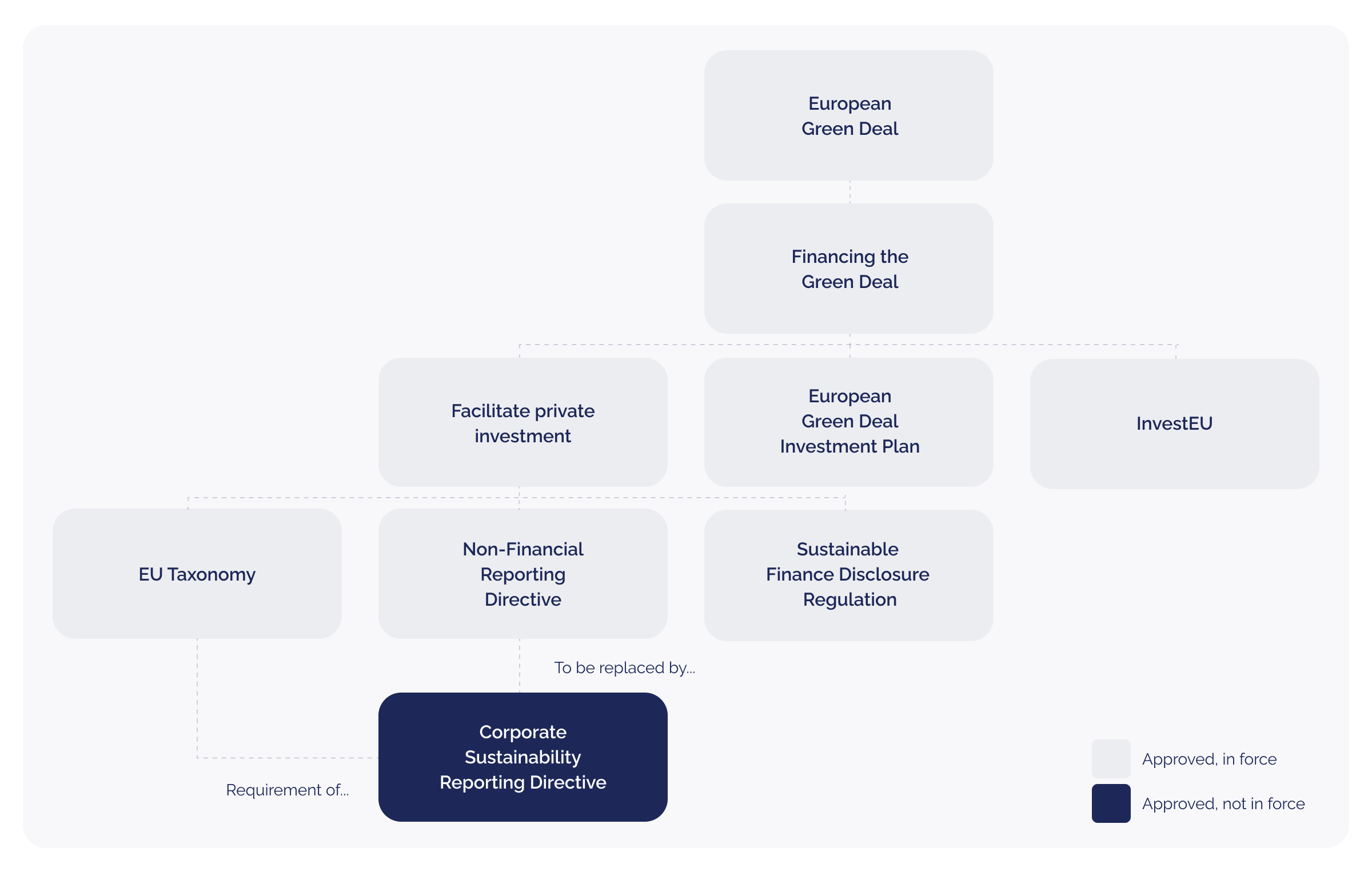
The 2026 simplification
In 2025 the European Commission proposed the Omnibus package to simplify EU sustainability rules and ease the reporting burden on business, and the resulting directive took effect in March 2026 (Accountancy Europe). It raised the size thresholds so the directive focuses on the largest companies, around 6,000 of them, rather than the roughly 50,000 the earlier thresholds would have captured, and it took listed SMEs out of the mandatory scope. It also simplified the standards: the Commission adopted the current ESRS in July 2026, applying for financial years beginning on or after 1 January 2027, with more than 60% fewer mandatory datapoints than the first version, around 320 in total (Mayer Brown). The core of the framework holds firm, including double materiality and reporting across all three emission scopes.
The EU continues to expand its sustainability rulebook, with measures such as the Carbon Border Adjustment Mechanism (CBAM) now working alongside the CSRD for companies that trade across the bloc's borders.
Read more: The next carbon standard: What CBAM and CSRD mean for European businesses
Scope 3, the value chain, and the road ahead
For most companies, Scope 3 emissions make up the largest share of the carbon footprint, since they cover everything from purchased goods and services to the use of sold products. Measuring them means understanding the whole value chain and drawing accurate data from suppliers and partners, which is where much of the practical effort of CSRD reporting sits. Sectors with long, global supply chains, such as manufacturing, retail, and consumer goods, tend to carry the heaviest Scope 3 load.
Read more: Why scope 3 emissions are your biggest blind spot—and what to do about it
Getting Scope 3 data right is a data-quality challenge as much as a reporting one. Companies improve it by working closely with suppliers, building sustainability into procurement, and designing products that are cleaner to use and easier to recycle. Reliable supplier data is the foundation, and improving its accuracy repays the effort across every disclosure that depends on it.
Read more: How to improve Scope 3 data accuracy for CSRD

Close-up of a variety of tree seedlings. Hongera Reforestation Project, Green Earth.
Value-chain engagement becomes the norm
Value-chain collaboration is now standard corporate practice rather than a compliance exercise. Companies build longer-term supplier relationships around shared environmental goals and use their purchasing power to raise standards across their networks. This runs alongside the growth of green finance, where investment, lending, and insurance are increasingly tied to sustainability performance, and companies that lead on these measures can attract stronger partnerships and a stronger market position.
Read more: How to reduce your business' travel emissions through nature
As international standards move closer to the EU's approach, companies that operate globally can expect similar expectations in more of their markets. Preparing for one rigorous framework tends to prepare a company for the others, and staying informed keeps a business ready for what comes next.
Read more: How to stay ahead of the curve on sustainability
Measuring your full value-chain footprint is the practical first step, and Green Earth can help you get there.
Becoming sustainable with Green Earth
The CSRD asks companies to measure their full environmental impact, and to reduce and take responsibility for the emissions that remain. That starts with a clear, accurate picture of the carbon footprint across all three scopes. Green Earth provides carbon footprint analysis in line with the GHG Protocol, giving companies within scope and their suppliers the data they need to meet CSRD reporting requirements and to plan real reductions.
Where emissions are hard to abate within the value chain, Green Earth's verified carbon units, each representing 1 tonne of CO₂ removed or avoided, let companies compensate for what they cannot yet cut. As a leading nature-based project developer with full oversight of our projects, we deliver high-integrity units backed by ecosystem restoration, conservation, and biodiversity enrichment, so compensation also supports local communities and nature. Our carbon units draw on projects such as the Hongera Reforestation Project in Kenya.
Read more: The hidden strength of nature-based credits in corporate decarbonisation strategies
As companies are asked to reduce and compensate for their footprints, demand for high-quality carbon units is set to rise, particularly for Scope 3. Compensating with Green Earth supports progress towards net-zero targets and strengthens a company's standing with investors, partners, and customers. Together with a clear reduction path, it forms part of a credible approach to carbon offsetting within a wider sustainability strategy.
Read more: The importance of carbon offsetting in achieving net zero
The CSRD makes sustainability a core part of how large companies are measured, and its reach extends through every value chain. Companies that treat it as an opportunity rather than a hurdle can improve their operations, deepen stakeholder trust, and become sustainable through nature. Green Earth is ready to help you take that step with confidence, from measuring your footprint across all three scopes to compensating for the emissions you cannot yet cut.



