
Carbon offsetting
Carbon emissions
UAE

The Environment Agency – Abu Dhabi (EAD) has issued Resolution No. (03) of 2026, establishing an integrated framework to measure, report, and verify (MRV) carbon emissions across the emirate. The resolution introduces a specialised mechanism to register and accredit the verifiers who check this data, set against clear requirements and standards.
The agency describes the resolution as a shift from building regulatory frameworks towards practical implementation, grounded in reliable and audited emissions data. It links the framework to stronger competitiveness for the emirate’s industrial sectors and a move towards more efficient, sustainable production.
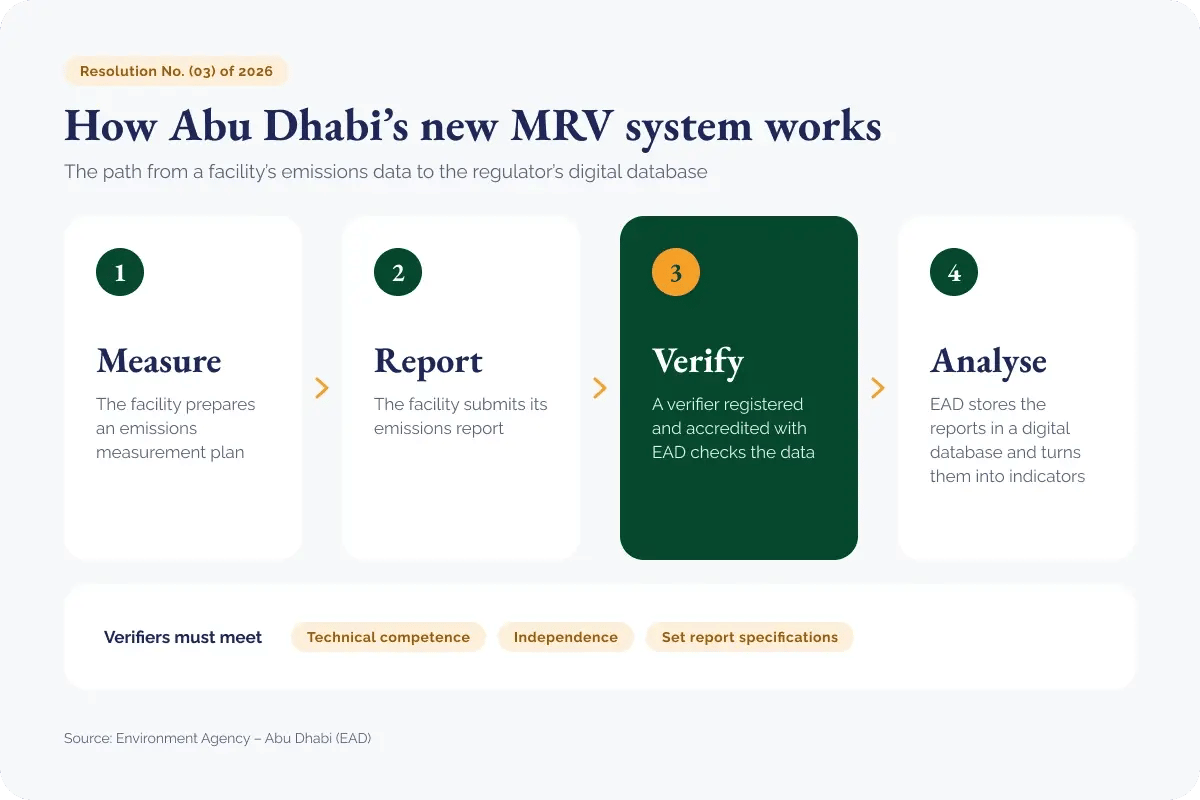 How Abu Dhabi’s new MRV system works infographic.
Facilities within the scope of the resolution now submit emissions reports for verification by verifiers registered and accredited with the agency. Those verifiers meet clear standards for technical competence and independence, and follow specific requirements for preparing verification reports.
Read more: Want a simpler way to buy carbon credits? Discover our carbon marketplace
The provisions apply to facilities in targeted sectors whose activities produce emissions at or above a threshold set in the resolution. Operators hold defined obligations: preparing emissions measurement plans and reports, and verifying their data. The resolution also sets out how facilities register and how verifiers are registered and accredited.
Facilities outside the scope can opt in, measuring and reporting their emissions in coordination with the agency and the entity that regulates their activity, in line with the resolution’s requirements.
EAD takes responsibility for a digital emissions database that receives, verifies, stores, and archives reports electronically, with controls for data quality, accuracy, and confidentiality. The agency will apply advanced analytics to this data, generating indicators and reports that help relevant entities manage emissions and ground decisions in evidence.
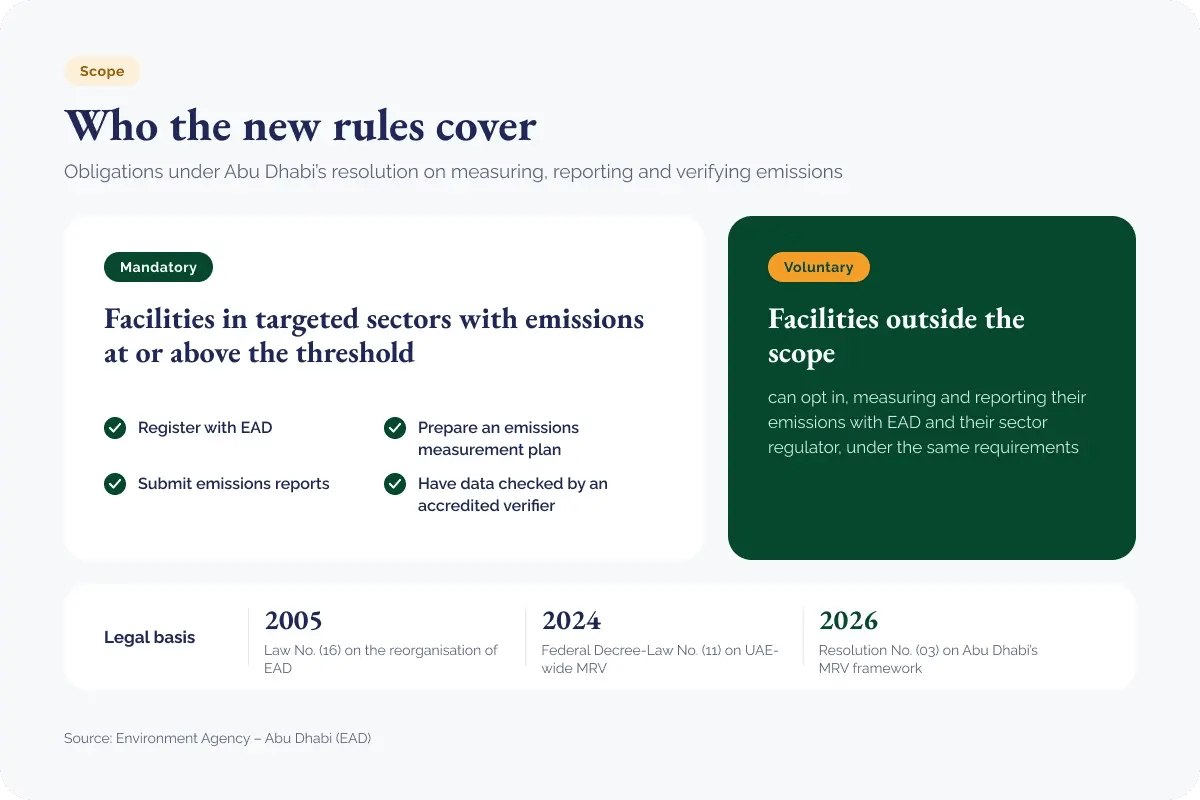 Who the new rules cover infographic.
The system rests on Federal Decree-Law No. (11) of 2024, which directs the competent authorities across the UAE to develop mechanisms for measuring and reporting emissions and verifying the accuracy of their data, in coordination with the Ministry of Climate Change and Environment. It also draws on Law No. (16) of 2005 on the reorganisation of EAD.
EAD expects the MRV framework to lift demand for specialised verification services, opening opportunities for private companies, consultancies, and qualified national professionals, and building local capability in carbon accounting and the auditing of environmental data.
Read more: Private capital invested in nature grows fivefold in a decade
As accountability for emissions data tightens, the business case for measuring and reducing emissions grows stronger, and so does demand for carbon credits that can withstand the same scrutiny. Even steady reductions leave hard-to-abate emissions, and businesses preparing for this shift need a dependable supply they can stand behind: credits that are verified, traceable, and backed by real environmental results. Green Earth provides that supply, giving businesses access to high-integrity carbon credits from nature-based carbon projects that restore ecosystems and support local communities, so you can meet rising expectations for quality with confidence.