
Carbon credits
Carbon markets
Decarbonisation
Carbon credit providers vs marketplaces is the first comparison many buyers try to make. In this comparison, a carbon credit provider is the project developer: the company that originates credits from its own projects and sells them directly. A carbon credit marketplace is a platform that lists credits from many projects at published prices.
You can buy carbon credits from a project developer, a broker, a trader, an exchange, or a marketplace, and each one offers a way to compensate for your emissions and support nature restoration. The five differ in what each can tell you about the project behind a credit and how its price is built.
For a sustainability or procurement lead holding several quotes, the difference between a carbon credit provider and a marketplace shapes how much you can check about each credit and how its price is set. This article defines the five seller types, shows what developers, marketplaces, and brokers can tell you about the project, looks at what shapes the price, and explains how to choose the right route for your purchase.
Who sells carbon credits?

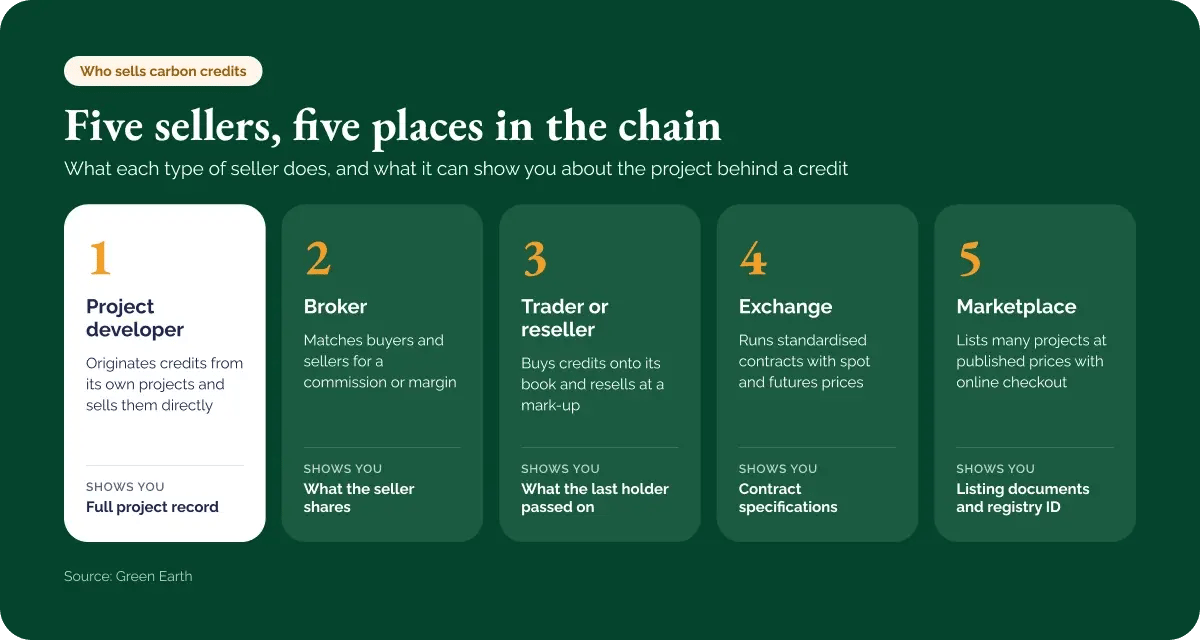
The carbon market can put several businesses between a project on the ground and the company that ultimately retires a credit, meaning credit is permanently removed from the market and cannot be claimed again or resold. So who actually sells carbon credits? There are five types of sellers, each with a different place in the chain. Two of them, project developers and carbon credit platforms, sit at the centre of this comparison:
- Project developer: Originates carbon credits from projects it designs, finances, and monitors, and sells them to buyers directly.
- Broker: Matches a buyer with a seller and earns a commission or margin on the deal, sourcing across the market rather than from its own stock.
- Trader or reseller: Buys credits onto its own book and resells them later at a mark-up, holding the price risk in between.
- Exchange: Runs standardised contracts and an order book, with spot and futures prices set by supply and demand.
- Marketplace or retail platform: Brings many projects' credits together at published prices, each listing with an online checkout and its documentation.
One company often fills two of these roles at once. A developer can run its own marketplace, and a broker can also trade on its own book, so the best fit depends on your needs rather than the label. The registries and standards bodies that sit behind every seller play a separate role, set out in our guide to who's who in the carbon market.
Read more: Best carbon credit providers and companies in 2026
What each seller can show you about the project
One test works for every seller: Ask what it can show you about the project behind a credit. The answer also settles a common question, should I buy carbon credits from a developer or a broker, because what a seller can show depends on where it sits in the chain:
- A developer holds the full project record, because it produced it: the project design document, the monitoring data, and the verification reports.
- A marketplace holds the listing documentation and the registry reference for each credit it lists.
- A broker or trader holds what the previous holder passed on, which varies with how many times the credit changed hands.
Brokers and traders add value too. They source scarce volumes, assemble bespoke portfolios, and move large tenders quickly, so buyers with those needs are right to use them. If you want the full project record, start with a developer.
Two attributes within your purchase carry most of the weight: additionality, meaning the project needed the credit finance to happen, and permanence, meaning the stored carbon stays stored. Whichever seller you choose, the documentation should let you check both, and a clear registry reference lets you confirm the credit exists and follow it through to retirement.
Read more: How to choose high-quality carbon credits
What shapes a fair price
Price matters to every buyer, so it helps to know how carbon credit brokers make money. A broker or trader earns a fee, a commission, or a margin on the credits it passes on, and knowing that helps you read a quote and compare like for like.
Read more: Carbon credit price guide: Understanding spot, forward, and market factors
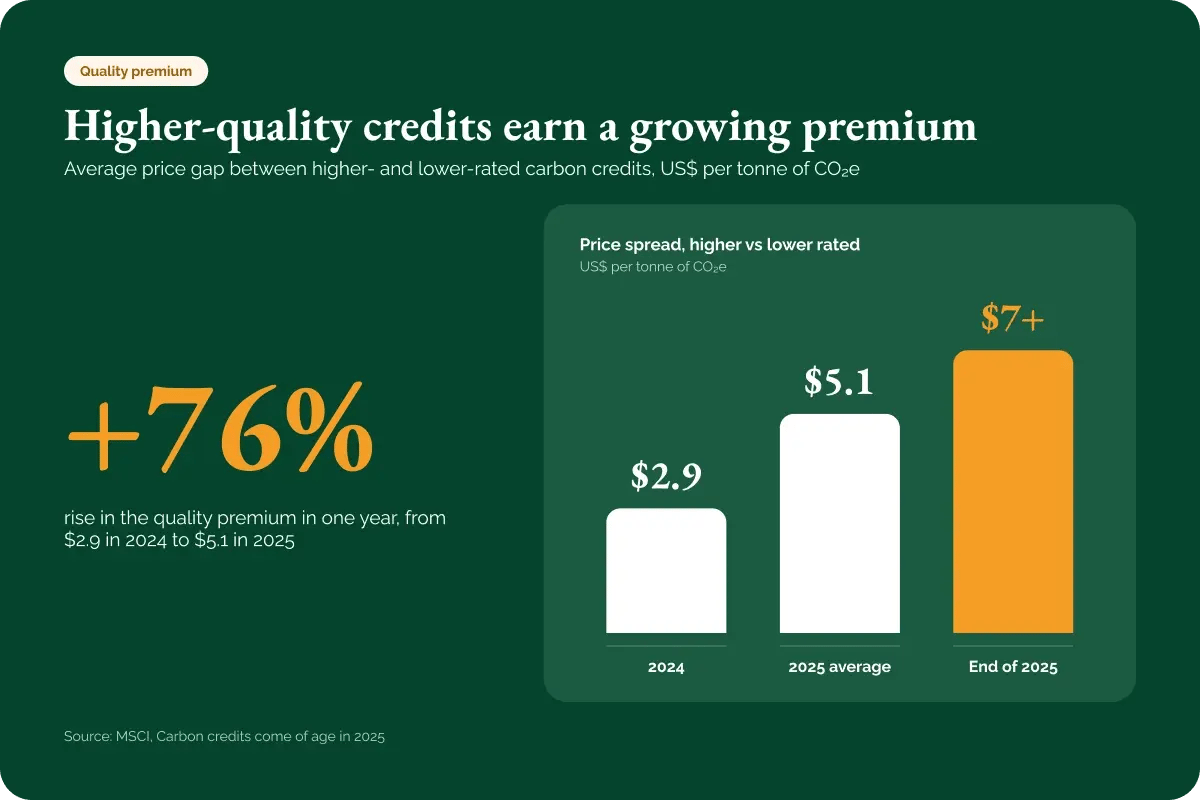
Quality increasingly shapes the price, and it rewards good projects. Higher-quality credits are earning a growing premium: MSCI reported that the average spread between higher- and lower-rated credits widened to $5.1 per tonne of carbon dioxide equivalent (CO₂e) in 2025, from $2.9 in 2024, and passed $7 by the end of the year. The same analysis found that nature-restoration credits rose in both retirement volume and price during 2025. That is why it helps to buy from a seller that can show you what sits behind the credit.

Is it cheaper to buy carbon credits directly?
It can be, but not necessarily. Buying direct from a developer cuts out a broker's margin, but a credit's price tracks the quality of the project behind it and the terms of the deal, such as bulk purchases, more than the route you take to buy it, so a well-priced marketplace listing can match a direct quote.
Beyond the headline price, a fair deal comes down to visibility and the quality behind it. Other buyer preferences can also shape the price, like the project location and co-benefits.
When you buy carbon credits directly from a developer, you deal with the team that built the project, with the full project record on hand and room to agree terms such as volume and timing. There is also more room to negotiate forward purchase agreements, which fix a price now for credits delivered later, often at lower prices than marketplace spot prices.
When you buy from a marketplace, the per-credit price, the project description, and the documentation sit in one place, so you can compare listings on the same terms, see what you are paying for, and buy online.
Read more: Want a simpler way to buy carbon credits? Discover our carbon marketplace
How to choose the right seller for your purchase
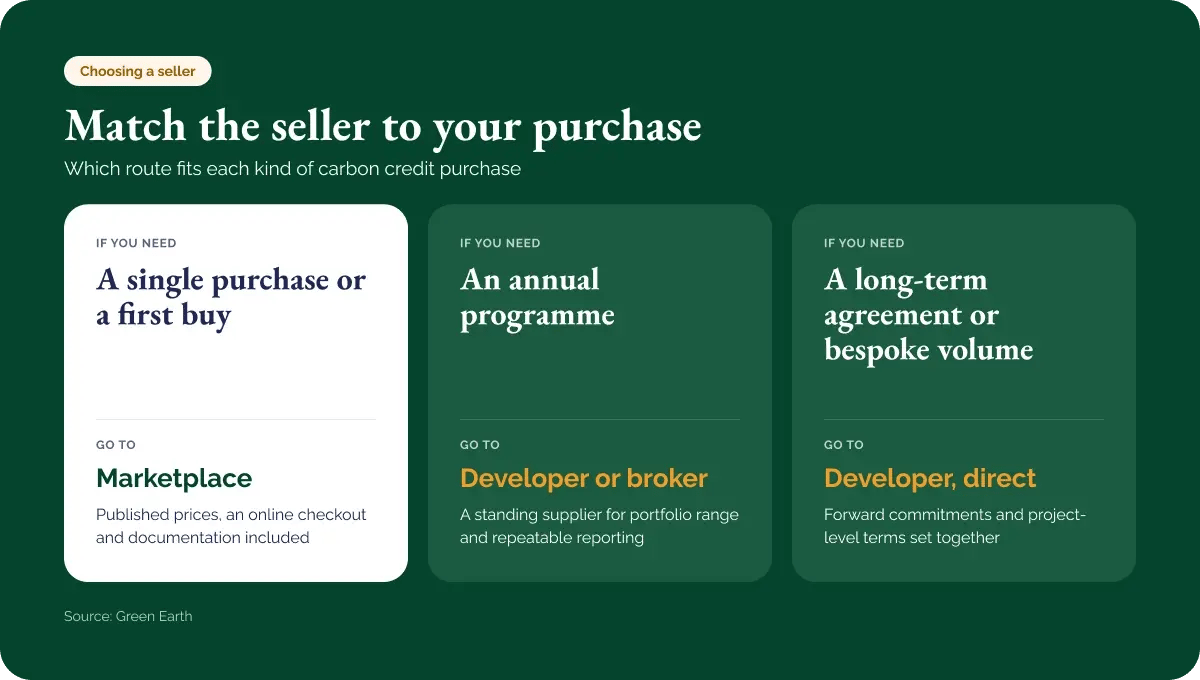
The right seller depends on what you are buying and how much. Buyers asking what is a carbon credit marketplace usually want a straightforward route for a single purchase, and a marketplace is built for exactly that. Larger or longer-term purchases suit other sellers. Find your kind of purchase below to see which seller fits it:
- A single purchase or a first buy: A marketplace fits, with published prices, an online checkout, and documentation included.
- An annual programme: A standing supplier relationship fits, such as one with a developer or broker, for portfolio range and repeatable reporting.
- A long-term purchase agreement or a bespoke volume: Direct engagement with a developer fits, where forward commitments and project-level terms are set together. A broker or trader can also assemble volume across several projects.
Whatever the route, ask any seller three questions: what the price is, what sits behind it, and what you receive when the credit is retired. A seller that answers all three in writing gives you a claim you can stand behind.
Read more: What business leaders need to know before buying carbon offsets
Green Earth: developer and carbon marketplace in one
We work as both a developer and a marketplace. We develop nature-based carbon projects from end to end, restoring ecosystems and supporting the communities around them. Our team runs each project on the ground, keeping oversight from planting and monitoring through to verification and retirement, so supporting documentation, a standard, and a registry ID sit behind every credit.
Our marketplace lists our own projects alongside independently verified third-party projects from our global portfolio at published prices, with the documentation a buyer needs in one place: an Impact Report on the funded project, a Carbon Credit Certificate recording the credits purchased and retired with their registry details, a Communication Package that helps a buyer showcase and describe the contribution, and a Contribution badge. That combination answers all three questions a buyer should ask, for our own carbon credits and for the third-party credits listed beside them.
Ready to compensate for your emissions and support nature restoration? Explore our portfolio of verified projects and buy the credits that fit your goals.