
Carbon offsetting
Carbon credits
Sustainability
Carbon footprint
CSRD

EU carbon credit claims changed on 27 September 2026, the day the Directive (EU) 2024/825 began to apply across the European Union. The change is narrow. It changes how a company can talk about the credits it buys. A product can no longer be called neutral on the strength of compensation alone; however, every specific, evidenced statement about what a company measured, reduced, and funded stays fully available.
For sustainability and marketing leads reviewing a report, a website, or a campaign about their carbon footprint, the practical question is: What can you say about carbon credits after September 2026? This article sets out what the rules prohibit, what remains available, and the evidence a buyer needs behind a statement that holds. It is written for companies that buy carbon credits, and it points to where your own legal counsel takes over.

The new EU carbon credit claims rules are specific. A company can no longer tell consumers that a product is carbon neutral on the basis of compensation, and it can no longer use a generic environmental label it cannot substantiate.
It can still state precisely what it measured, reduced, and funded, naming the project, the standard, the vintage, and the credits it retired. The rules reward specific, evidenced statements over broad neutrality claims. It favours buyers of traceable verified carbon credits from a named, registered project rather than an unspecified portfolio.
What the Empowering Consumers Directive means for EU carbon credit claims
The rules come from the Empowering Consumers Directive, which amends two laws that every seller to EU consumers already works under: the Unfair Commercial Practices Directive and the Consumer Rights Directive. Member States were mandated to write it into national law by 27 March 2026, and the measures apply from 27 September 2026.
The directive adds practices to Annex I of the Unfair Commercial Practices Directive, the list of practices treated as unfair in all circumstances. A practice on that list is prohibited outright, so an enforcement authority does not need to prove that a particular consumer was misled. Three additions matter most to a company making carbon credit claims:
- Unverified sustainability labels (point 2a): Displaying a sustainability label that is not based on a certification scheme or established by a public authority.
- Whole-product claims from one aspect (point 4b): Making an environmental claim about an entire product or business when it applies to only one aspect or activity.
- Compensation-based neutrality (point 4c): Claiming, on the basis of compensation, that a product has a neutral, reduced, or positive impact on the environment in terms of emissions.
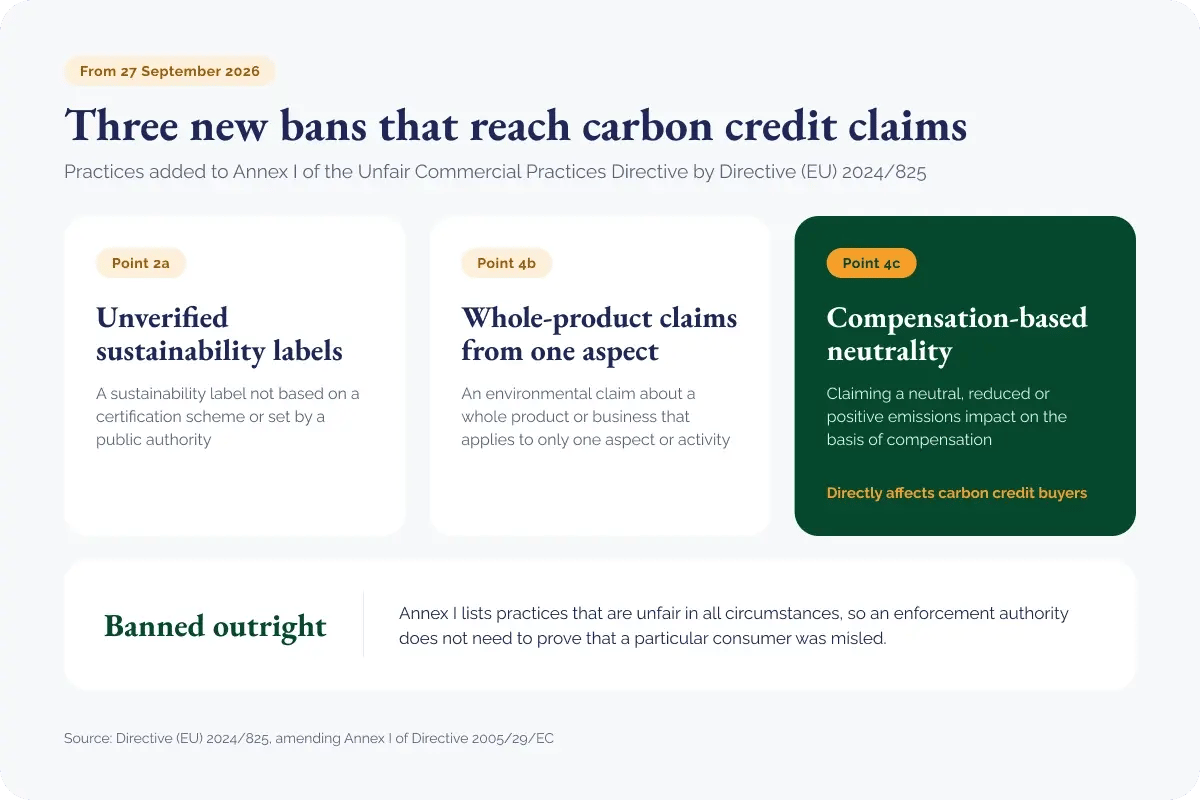 Three new bans that reach carbon credit claims infographic.
The third addition reaches carbon credit buyers directly, and it answers the question many teams are asking. Can you still say carbon neutral in the EU on a product? Or, Can we advertise a product as climate neutral in 2026? No, not when the claim rests on compensation alone. That product-level neutrality claim is now prohibited.
The same logic sets out which environmental claims are banned in the EU: the generic and the compensation-based, stated about a product without the substance to support them. The prohibition is narrow. It removes a form of words, not the footprint a company measures or the restoration it funds.
Read more: Legal challenges in carbon offsetting: What recent lawsuits teach us
The words that are now off the table
So what does the Empowering Consumers Directive mean for carbon credits in practice? Start with the directive's own examples. Recital 9 and 12 names the product claims it treats as misleading when they rest on compensation rather than the product's own performance.
For a marketing team, the first task is an audit: go through your packaging, product pages, and campaign assets, and flag anywhere these banned terms appear:
-
Neutrality terms: "carbon neutral", "climate neutral", "CO₂ neutral certified", “climate compensated”, “climate net zero”.
-
Positive-impact terms: "carbon positive", "climate positive", "environmentally correct”, “nature’s friend”.
-
Reduced-impact terms: "reduced climate impact", "limited CO₂ footprint", “gentle on the environment", "environmentally friendly", "carbon friendly”, “energy efficient”, “biodegradable”, “biobased”.
A standalone generic term such as "carbon neutral" or "carbon compensated" can also fall under the separate prohibition on generic environmental claims (point 4a), which applies whenever a trader cannot demonstrate recognised excellent environmental performance. That phrase is narrow. Recognised excellent environmental performance is tied to schemes such as the EU Ecolabel, or an equivalent officially recognised standard under ISO 14024 Type I. A carbon-neutrality certificate does not, by itself, meet it.
Read more: How to choose high-quality carbon credits
What you can still say
After the list of what a product can no longer claim, the directive is just as clear about what it protects. Recital 12 states that the prohibition "should not prevent companies from advertising their investments in environmental initiatives, including carbon credit projects, as long as they provide such information in a way that is not misleading".
Specific, substantiated statements about a clearly identified aspect of what a company did remain available, and this is where environmental claims substantiation becomes the whole game. It favours companies that bought traceable verified carbon credits from a named project over those holding an unspecified portfolio.
Such claims should only be allowed when they are based on the actual lifecycle impact of the product in question, and not based on the offsetting of greenhouse gas emissions outside the product’s value chain.
Recital 12, Directive (EU) 2024/825 of The European Parliament
So how do I substantiate a carbon credit claim? After flagging the problematic terminology which is now targeted by the Directive, the second step is to replace the headline with the evidence behind it, and build communication you can substantiate with facts. Below are a few examples:
- From neutrality to funded action: Replace "This product is carbon neutral" with "For every unit sold, we funded the restoration of 20 m² of degraded land through the Greening of the Dried Aral Sea Project, verified under the Verified Carbon Standard."
- From a whole-product badge to a named contribution: Replace "Our range is climate compensated" with "In 2025, we purchased and retired 500 verified carbon credits, each representing 1 tonne of CO₂, funding saxaul restoration on the dried banks of the Aral Sea (Verra ID 5628)."
- From a vague pledge to a defined commitment: replace "We are moving to net zero" with "We measured our 2025 Scope 1 and Scope 2 emissions at 4,200 tonnes of CO₂e and will reduce them 42% by 2030, with progress verified annually by an independent auditor."
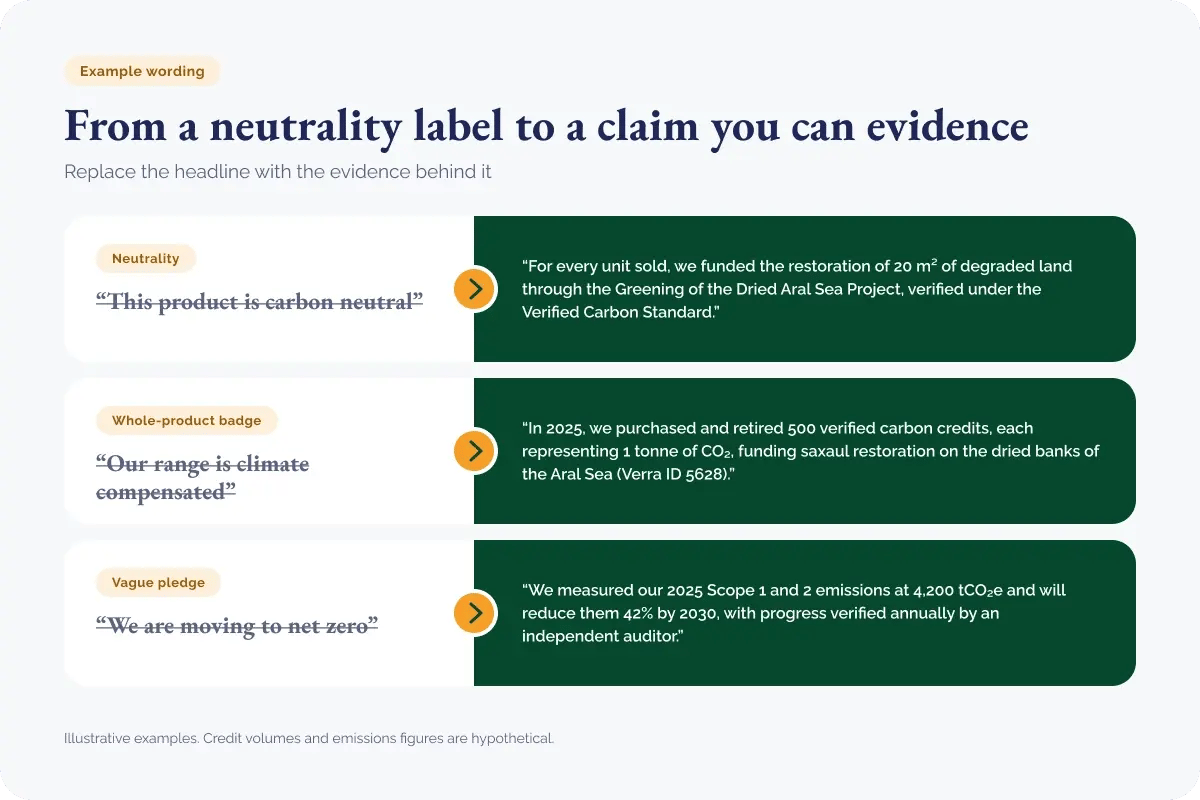 From a neutrality label to a claim you can evidence infographic.
A worked case makes it concrete. A company funding restoration through the Greening of the Dried Aral Sea Project, a Verra-registered project under the Verified Carbon Standard (methodology VM0047, project ID 5628), can state exactly that: the project, the standard, and the tonnage it retired. The registry reference makes the statement checkable, which is what substantiation now requires.

Forward-looking targets remain available on conditions. A commitment such as a future reduction goal is permitted where it rests on a clear implementation plan, measurable milestones, and independent verification. A pledge with none of these behind it does not qualify.
Read more: What business leaders need to know before buying carbon offsets
Do product carbon footprints still make sense?
Yes — and the directive changes what a company may claim, not what it may measure or fund. Measuring a carbon footprint is the first step of any credible environmental strategy. It sets the baseline a company reduces against, reports against, and funds against.
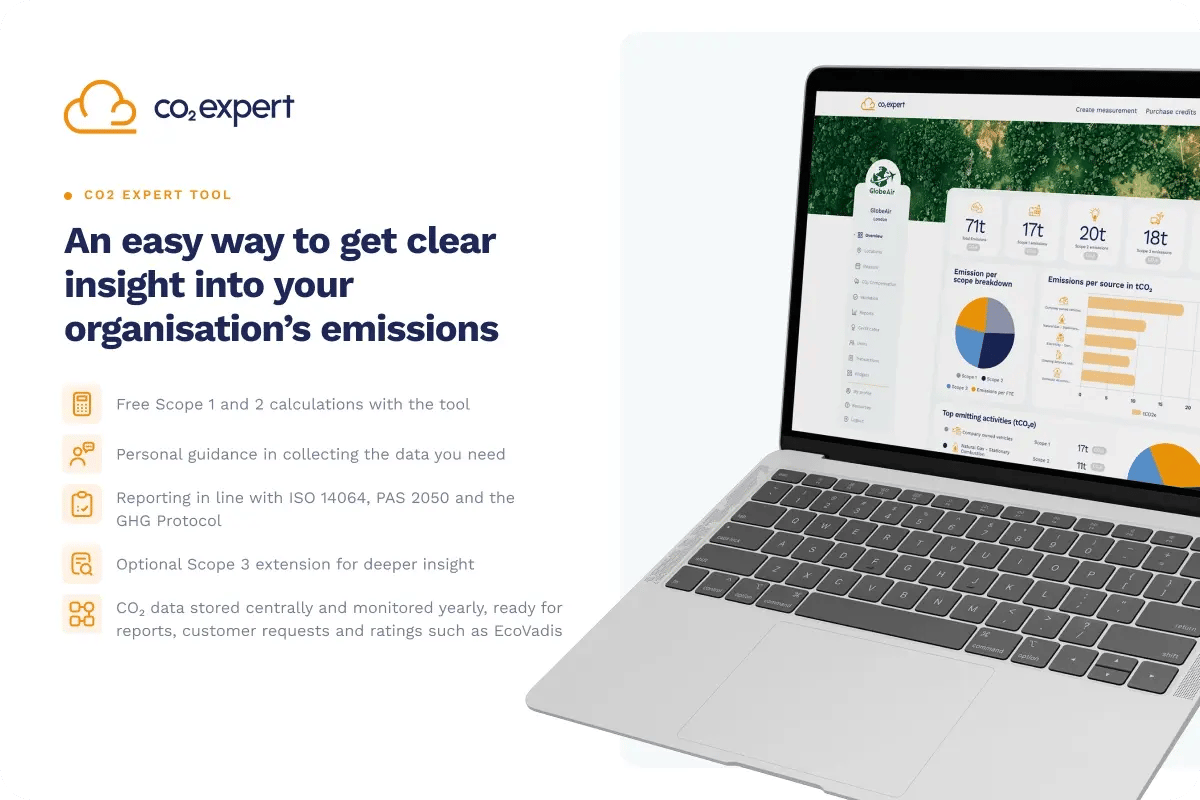 CO2 Expert tool.
A company that has not measured is guessing, and a claim built on a guess is the kind the new rules are designed to catch. This is where our own journey starts too, with the CO2 Expert business carbon footprint calculator putting a defensible number under a business before anything is claimed or funded.

A product carbon footprint takes that a step further. It measures a single product across its lifecycle rather than the business as a whole, and it puts a company ahead. It answers the question customers, tenders, and value-chain reporting increasingly ask, and it is the foundation of the specific, substantiated product statements the directive still allows.
Measuring a product's footprint and funding compensation against it both remain available. A company can measure a single product at, for example, 12 tonnes of CO₂ and fund 12 tonnes of verified restoration through a named project such as the Greening of the Dried Aral Sea Project.
The same purchase can be described two ways, and only one is now allowed:
- Permitted, a factual funding statement: "We funded 12 tonnes of verified restoration through a [named project], equivalent to this product's measured footprint".
- Prohibited, a neutrality claim: "This product is carbon neutral."
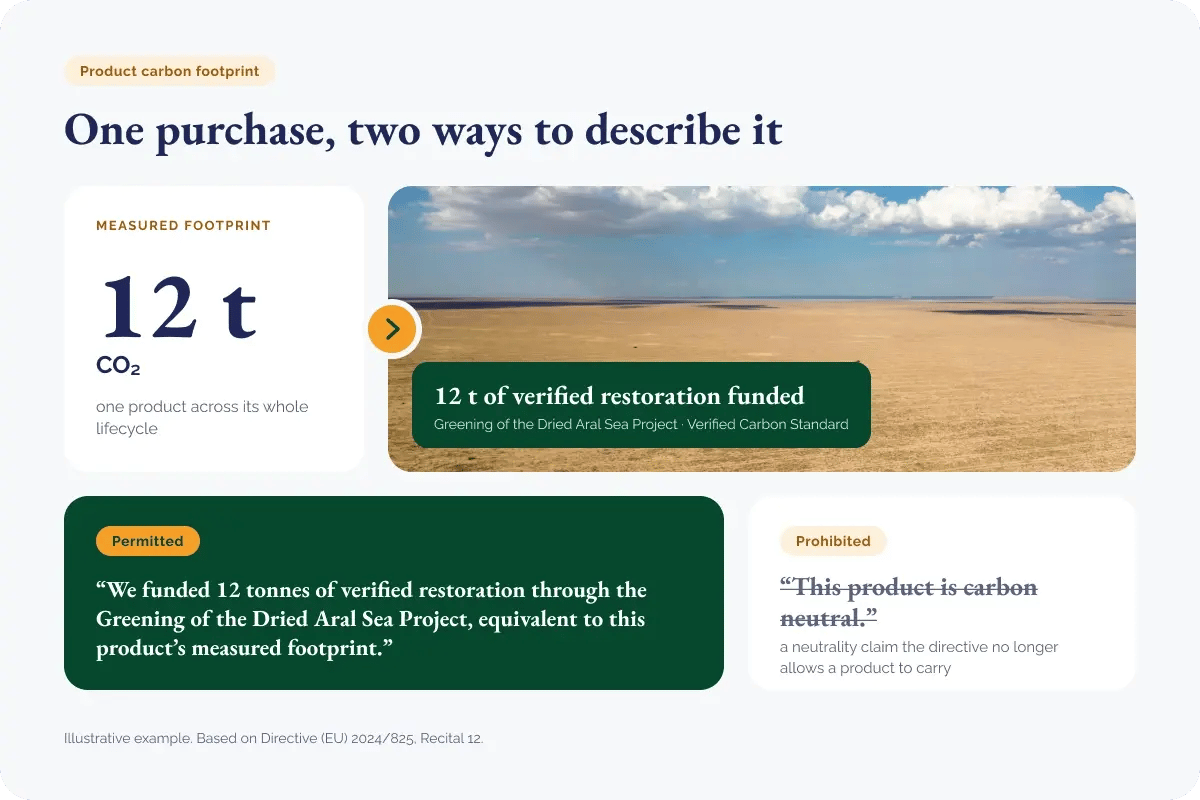 One purchase, two ways to describe it infographic.
Recital 12 expressly preserves a company's right to advertise its investment in carbon credit projects, so the funding statement stands. A measured footprint and the restoration funded against it are facts a company can state; the claim that the product therefore has no impact is the conclusion the directive no longer allows a product to carry.
Read more: What is a life cycle assessment, and why does it matter?
Product claims and corporate claims
The directive is consumer law, so what a company may say depends on who it is speaking to. A compensation-based statement in a sustainability report written for investors is not a consumer claim, and point 4c does not reach it. The Commission's guidance confirms the point does not extend to company-level statements of that kind.
The catch is what happens next. Lift that same sentence out of the investor report and put it on a product page, an ad, or packaging, and it becomes a consumer claim — and every prohibition in this article applies to it.
The audience decides the rule, not the wording. So the safe practice is to keep a claim at the level you can evidence, keep product communication and corporate reporting apart, and to write each for the audience it is actually meant for.
Where a specific application affects a consumer campaign, this is the point to bring in your own legal counsel. The directive states what is prohibited; how it applies to a particular claim is a legal judgment rather than a marketing one.
Read more: The hidden strength of nature-based credits in corporate decarbonisation strategies
Measuring, reducing, and compensating together
Compensation and reduction run together, they are complementary approaches. Reductions take years to deliver, and a company will still carry its hard-to-abate emissions every year while implementing reduction strategies across Scope 1, 2, and 3 emissions. Compensation runs alongside that work, funding nature restoration before internal reductions are complete and also addressing past irreducible emissions. Buying verified carbon credits to fund that restoration remains fully available, and saying you’re doing so remains available too, in the specific, evidenced form the previous sections set out.
The directive draws a line between two things that were often blurred: a reduction inside your value chain, and a contribution to restoration beyond it. Both are legitimate, and stating them separately and accurately is now the requirement. A company that funds restoration and says precisely what it funded stands on firmer ground than one that folded everything into a single neutrality label.

The evidence behind a claim that holds
A claim that holds rests on a chain of evidence, and every link in it is a document. For a verified carbon credit, the chain runs from the project registry entry, to the credit's serial number and vintage, to the retirement record that shows the credit was permanently taken out of circulation, to the certificate that confirms it. Quality sits underneath: additionality, meaning the project needed the finance to happen, and permanence, meaning the carbon stays stored.
Green Earth supplies the documents that map to each statement a buyer might make, for credits from our own nature-based projects and for the verified credits available through our marketplace:
- Impact Report: Information about the funded project.
- Carbon Credit Certificate: The credits purchased and retired, with the registry details.
- Communication package: Contribution badges for external use and guidance on wording statements.
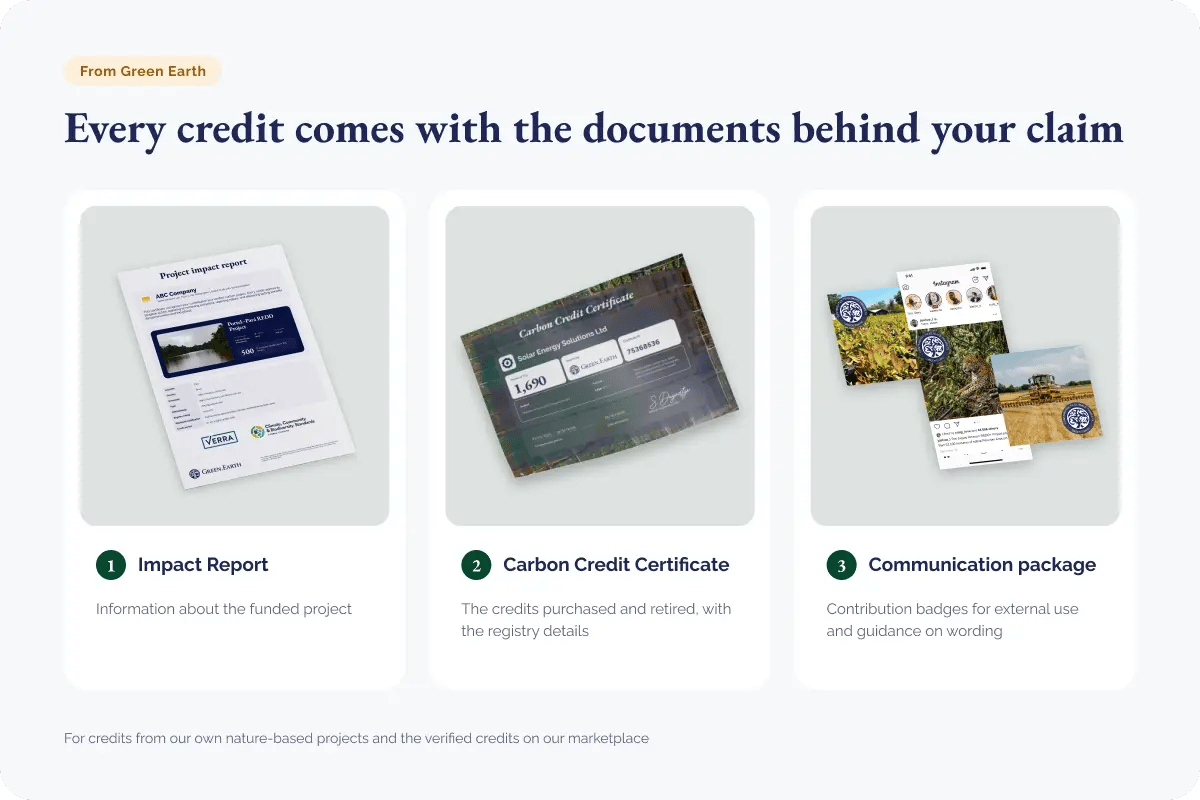 Every credit comes with the documents behind your claim infographic.
A buyer who can name the project, the standard, and the retirement can write a specific claim that meets the directive. A buyer holding an unspecified portfolio from an unnamed source cannot. The rules reward the traceable purchase that a named, registered project provides.
Restoration you can point to
Green Earth develops nature-based carbon projects from end to end, keeping oversight from planting and monitoring through to verification and retirement. That oversight puts a name, a standard, and a registry reference behind every credit, the detail a defensible statement now depends on.