It looks like you’re browsing from Netherlands. Click here to switch to the Dutch →
Measuring your carbon footprint pinpoints exactly where your emissions come from — the foundation for reducing them, reporting with confidence, and turning sustainability into a commercial advantage.
A carbon footprint is the total amount of carbon emissions — primarily carbon dioxide (CO₂) — produced directly and indirectly by a person, organisation, product, or activity. These emissions come from sources such as energy use, transport, manufacturing, and waste. The term covers all greenhouse gas (GHG) emissions, expressed together as a single figure so they can be measured, compared, and managed.
Carbon footprints can be calculated at every level, from a single product to an entire company or country. For a business, measuring the footprint is the first practical step towards reducing emissions, meeting regulatory expectations, and building a credible sustainability strategy.
Managing carbon emissions has become a global priority, because rising emissions contribute to environmental instability that affects ecosystems, communities, and economies. Higher carbon emissions intensify extreme weather, place pressure on biodiversity, and reduce air quality, all of which carry real costs for business.
Reducing a carbon footprint delivers clear benefits beyond environmental responsibility. Companies gain cost savings through energy efficiency, access to growing carbon markets, and new opportunities for innovation, alongside a stronger reputation with the stakeholders who increasingly expect measurable action.
Close-up of Bulindi chimpanzee in its natural habitat. Bulindi Chimpanzee Habitat Restoration Project, Green Earth.
Carbon footprints are expressed in metric tonnes of CO2 equivalents (CO2e), accounting for various GHGs such as methane and nitrous oxide. Measurement involves assessing two main categories:
Direct emissions: Emissions from activities under direct control, such as vehicle fuel use or factory energy consumption.
Indirect emissions: Emissions from a broader supply chain, including the production of purchased goods and business travel, often forming the majority of a company’s footprint.
A carbon footprint brings together many different emission sources. For most organisations these are grouped into a clear framework of three scopes. Individuals contribute through everyday activities, and understanding both puts corporate action in context.
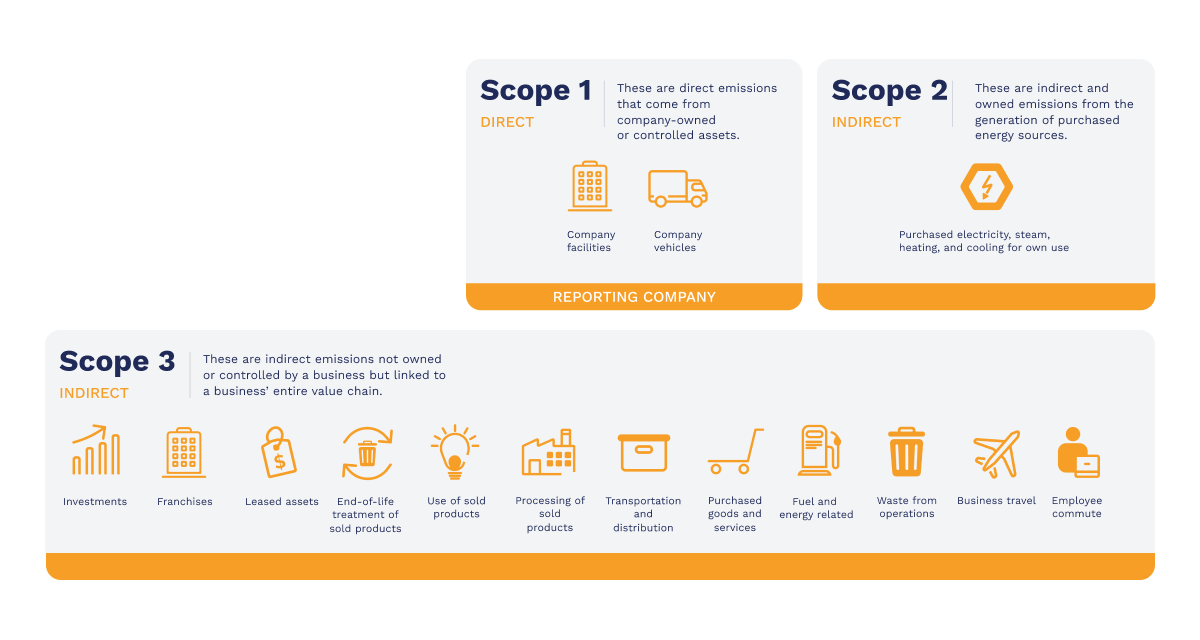
Businesses, particularly large ones, account for a significant share of global carbon emissions. To track and manage these effectively, emissions are grouped into three scopes:
Illustration of 3 scopes.
Scope 1 emissions: Direct emissions from sources the company owns or controls, such as company vehicles or on-site fuel combustion.
Scope 2 emissions: Indirect emissions from the electricity, heating, and cooling the company purchases and consumes.
Scope 3 emissions: Other indirect emissions across the value chain, including the production of goods, business travel, and waste disposal. Scope 3 emissions often comprise the largest share (up to around 90%) but are also the most challenging to address.
Read more: Why scope 3 emissions are your biggest blind spot—and what to do about it
Emissions also vary widely by sector, and the industries with the largest footprints face the most complex reduction challenges across their value chains.
Read more: Industries with the biggest nature footprints and what their decarbonisation looks like
Individual carbon footprints arise from daily activities producing emissions. Although smaller in scale than corporate footprints, their cumulative impact across the global population is significant.
Transportation: Cars, aeroplanes, and other transport methods represent a substantial portion. Switching to efficient vehicles or public transport can make a difference.
A plane flying over the forest. AI generated picture.
Energy use: Heating, cooling, and powering homes, particularly through fossil fuels, contribute significantly. Reducing consumption and using renewable energy can lower emissions.
Waste: Methane from organic waste in landfills is a major contributor. Recycling and composting are effective ways to minimise this.
Read more: Industry carbon footprints: transport, events, and celebrities
Measuring a carbon footprint has become far more accessible, with approaches ranging from simple online calculators to enterprise software that tracks emissions across complex operations. Whichever route a business takes, robust measurement rests on recognised standards and reliable data.
Several international standards give organisations a consistent way to quantify and report emissions. ISO 14064 provides a framework for measuring and reporting emissions at organisational level, and the GHG Protocol is the most widely used standard for measuring and managing emissions in a comparable way.
For products and services, a life cycle assessment (LCA) measures emissions across the whole life of an item, from raw materials to disposal, giving a fuller picture than operational data alone.
Read more: What is a life cycle assessment, and why does it matter?
A range of tools supports this work, from calculators aimed at individuals and small businesses to detailed software platforms for large organisations.
Read more: Our favourite carbon-tracking apps, tools, and plugins (2025 edition)
Measuring a carbon footprint accurately brings a number of practical challenges:
These challenges are steadily being addressed as methodologies, technology, and standardisation improve, making carbon footprint measurement more accurate and more reliable each year. Smaller businesses in particular can now measure and report emissions without a dedicated in-house team.
Read more: Emissions accounting without an ESG team: achieving the best of both worlds for SMEs
For a sense of where your own figures should sit, it helps to compare them against typical results for your sector.
Read more: SME carbon footprints: a practical guide
Green Earth’s CO₂ Expert Tool pairs every client with a dedicated CO₂ expert, calculating total emissions across Scopes 1, 2, and 3 using accurate, up-to-date emission factors. The calculations follow international guidelines, including ISO 14064 and the GHG Protocol, and a comprehensive analysis can be ready within weeks.
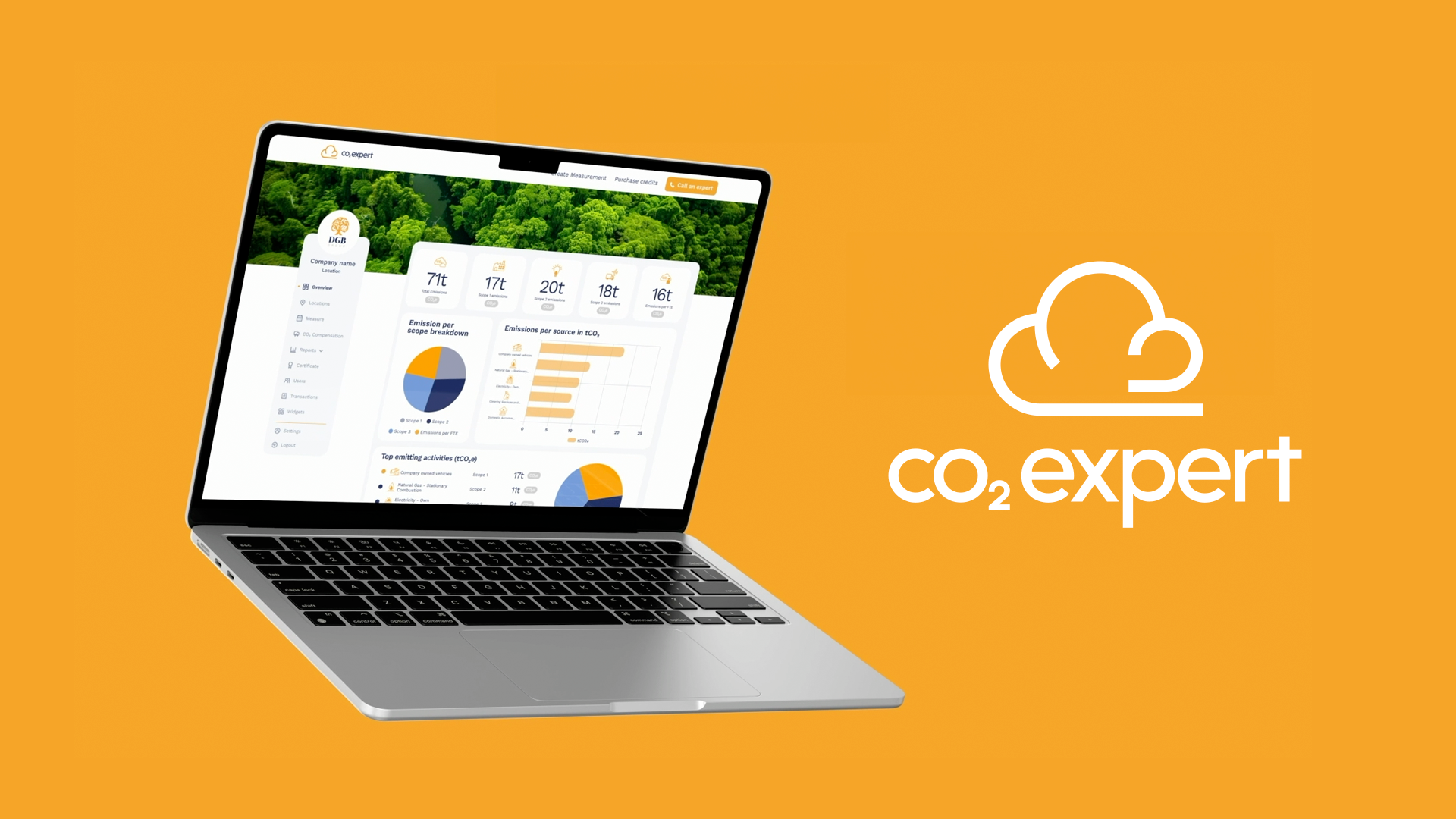
The tool supports every stage of the journey, from compiling data and reporting under the CSRD to compensating for emissions with carbon units and communicating your progress with confidence.
Carbon footprints contribute to increased carbon emissions, which provoke environmental crises. The more carbon dioxide, the greater the disruption to natural ecosystems. This includes:
Ecosystem damage: Rising carbon emissions cause changes in temperature and precipitation patterns, leading to habitat loss, species extinction, and reduced agricultural productivity.
Economic costs: Damage from extreme weather, reduced agricultural yields, and health expenses related to pollution cost the global economy approximately $8 trillion annually, or 6% of global GDP, according to the World Bank. These economic implications highlight the importance of managing carbon footprints to avoid further financial strain.
Read more: How do carbon footprints work?
The most effective way to deal with emissions is to avoid producing them in the first place. Because emissions are an unavoidable by-product of most activity, the focus falls on two complementary actions: reducing emissions wherever possible, and compensating for those that remain, including hard-to-abate Scope 3 emissions.
For businesses, the biggest gains usually come from energy and supply chains. Adopting energy-efficient technologies — from LED lighting to advanced heating and cooling — lowers emissions and costs, and many companies are moving to renewable sources such as solar and wind. Improving supply-chain sustainability is one of the most effective ways to cut Scope 3 emissions, through responsible sourcing, lower-carbon transport, and recycled materials.
Read more: Unveiling hidden carbon footprints: overlooked emissions sources in business operations
Setting credible, science-based targets keeps reduction on track and signals genuine commitment to stakeholders, giving a business a clear framework to measure progress against.
Read more: The new SBTi Corporate Net-Zero Standard: what it means for business
Individuals can reduce their footprint too, by using energy more efficiently at home, choosing lower-carbon transport such as public transit, cycling, or electric vehicles, and cutting waste through recycling and composting.

People riding bikes through the park to work. AI generated picture.
Carbon compensation lets organisations take responsibility for emissions they cannot yet eliminate. It works through carbon units — also known as carbon credits — which represent verified emission reductions or removals elsewhere. Once a unit is used to balance a footprint, it is permanently retired on the registry that records it, so it cannot be counted twice.
Read more: What business leaders need to know before buying carbon offsets
There are two main types of carbon unit, and the difference lies in how they address emissions. Reduction or avoidance units prevent emissions that would otherwise occur. Removal units draw carbon dioxide out of the atmosphere.
Green Earth’s nature-based solutions provide both. The Hongera Energy Efficient Cookstoves Project in Kenya, certified under the Gold Standard, produces reduction and avoidance units by cutting the amount of firewood needed for cooking, preventing significant emissions. The Regenerative Agroforestry Project Cameroon, registered with Verra (VCS 4176) in the Congo Basin, generates removal units by planting cacao and native shade trees on community-owned land, drawing carbon dioxide from the atmosphere as the forest grows.

A Green Earth team member and local community during the distribution of cookstoves in Kenya. Hongera Energy Efficient Cookstoves Project, Green Earth.
Read more: Green Earth’s cookstove projects: How they truly make a difference
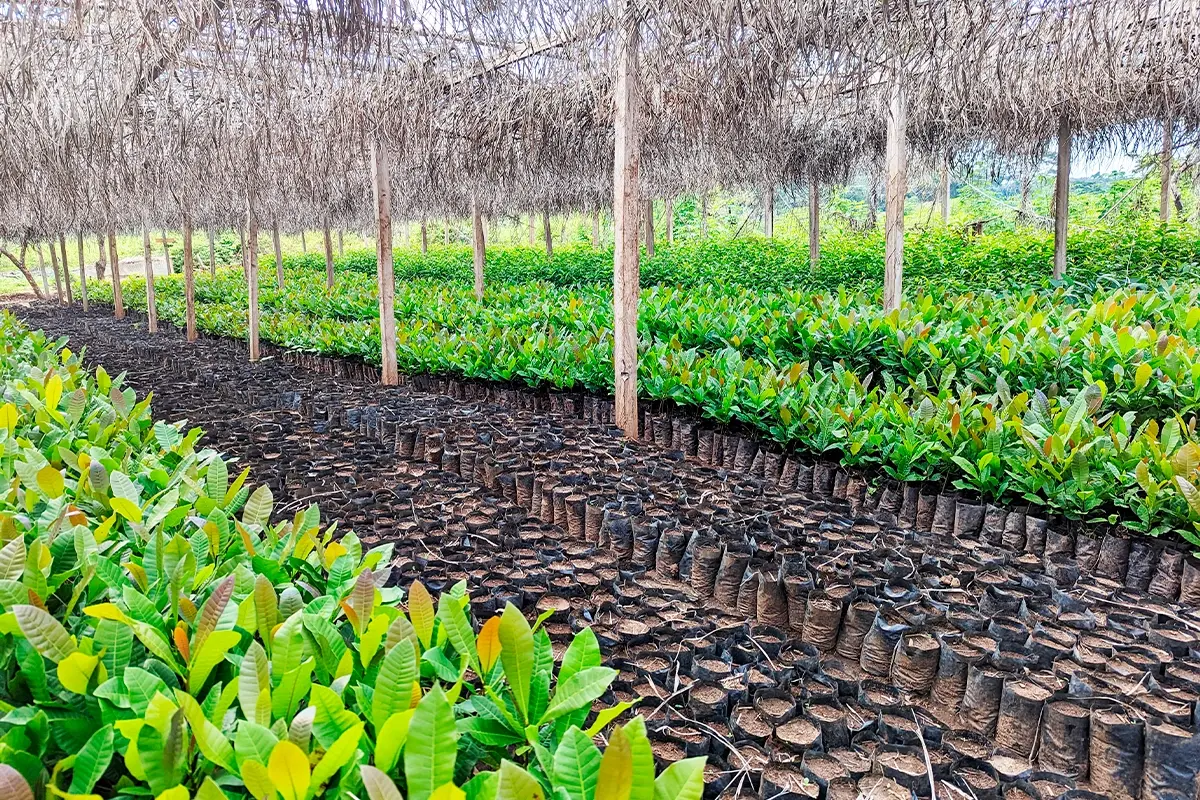
Tree nursery in Cameroon. Greenzone Reforestation Project, Green Earth.
These projects deliver more than carbon mitigation. They restore ecosystems, protect biodiversity, and create lasting social and economic benefits for local communities — the kind of multi-layered impact that sets nature-based projects apart from single-focus alternatives.
Read more: The hidden strength of nature-based credits in corporate decarbonisation strategies
Companies across Europe and beyond are already acting. Leading firms in the Netherlands, Germany, Ireland, Belgium, the UK, and Spain, along with world-famous names in sport, are measuring their emissions and strengthening their strategies through carbon compensation.

Carbon footprint reporting has become an essential business practice, driven by both regulation and voluntary commitment. Companies of every size now track and disclose their emissions to meet legal requirements and to demonstrate genuine progress to investors, customers, and regulators.
Read more: Sustainability simplified: Carbon footprinting for beginners
Many of the world’s largest companies, including Apple, Google, and Unilever, now publish annual sustainability reports covering their Scope 1, 2, and 3 emissions. This reporting complements broader corporate social responsibility (CSR) and environmental, social, and governance (ESG) work, helping build trust with the people a business depends on.
Legislation reinforces the shift. Mandatory frameworks such as the European Union Emissions Trading System (EU ETS) and the United States Environmental Protection Agency (EPA) GHG Reporting Program sit alongside voluntary initiatives like the Carbon Disclosure Project (CDP), which encourage transparency and accountability. The EU’s Corporate Sustainability Reporting Directive (CSRD) requires many businesses, including subsidiaries of non-EU companies, to disclose their environmental and social impacts — a clear signal that sustainability reporting is now a core part of doing business.
Read more: Biodiversity reporting: Why corporates must take a quantitative approach
For companies in the value chains of larger firms, reporting requests are becoming routine, and meeting them well is increasingly a competitive advantage rather than a burden.
Read more: Stay in the game: What CSRD means for supplier carbon footprints in 2026
Reporting is not only about compliance. Understanding its own footprint is the first step for a business to find and act on the biggest opportunities to cut emissions, often revealing inefficiencies that also reduce costs.
Reliable emissions data supports better decisions. With a clear view of where emissions come from, companies can prioritise the actions that deliver the most — cutting emissions, managing risk, and meeting regulatory requirements and staying competitive in a carbon-conscious economy.
Read more: The power of sustainability: Why investing in sustainability drives faster company growth
Reporting also strengthens reputation. Demonstrating environmental accountability resonates with customers who value sustainability, attracts investors focused on responsible growth, and builds trust across the board, positioning a business as a leader as the low-carbon economy grows.
A woman from a local community and a Green Earth team member in a tree planting training. Hongera Reforestation Project, Green Earth.
Achieving an accurate and comprehensive carbon footprint analysis can be a daunting task for businesses, given the challenges of data collection, scope definition, and maintaining consistency in reporting. These complexities can hinder your ability to identify emissions sources, set reduction targets, and align with sustainability goals.
Green Earth’s CO2 Expert tool is designed to address these challenges with precision and ease, offering a user-friendly platform equipped with advanced features to support every step of your carbon management journey. From simplifying data input to automating complex calculations and generating transparent reports, the CO2 Expert tool ensures businesses can confidently manage their carbon footprints while meeting regulatory standards and enhancing stakeholder trust. Here are 10 benefits of using our carbon calculator:
Streamlined data collection: Simplifies the process of gathering accurate data from multiple sources and locations, addressing potential gaps to ensure comprehensive tracking. Plus, the tool automates emission calculations, integrating emission factors for seamless and precise results.
Comprehensive scope inclusion: Helps define emission boundaries, covering all scopes—including the challenging Scope 3 emissions from supply chains—and allows the addition of new locations and emission sources for detailed tracking.
Enhanced data accuracy: Boosts data reliability and consistency through expert-reviewed methodologies, ensuring high-quality, trustworthy results.
Preloaded emission factors: Comes with a robust, up-to-date database of emission factors for a wide range of industries and activities, removing the need for constant manual updates.
Simplified calculations: Automates complex emission calculations, making it easy for businesses of all sizes to manage their carbon footprint.
Verification support: Provides expert validation to ensure compliance with international standards, minimising the verification burden and ensuring accurate reporting.
Customised solutions: Tailors tools and strategies to meet specific business needs and sustainability goals, whether it’s purchasing verified carbon units, obtaining a carbon neutral certification, or setting and achieving meaningful emission reduction targets.
Ongoing support: Provides continuous guidance to help monitor, manage, and improve carbon footprint efforts over time, ensuring that you can maintain consistent reporting year after year, even as your business evolves.
Insightful dashboards: Delivers visually engaging breakdowns of your emissions, allowing you to quickly identify trends and opportunities for improvement.
Shareable reporting tools: Generates engaging, detailed, and easy-to-understand reports to seamlessly share results and progress with investors, customers, and other stakeholders.
Our tool provides businesses with a range of innovative advantages designed to overcome common challenges in carbon footprint measurement and management, enabling you to embark on your sustainability journey with ease while making the process more streamlined and effective.
Read more: How to use Green Earth Group's carbon footprint calculator on your journey to net zero
The timeline for your sustainability journey depends on the ambition of your company’s goals. However, with fast data collection, we estimate that within just four months, your business can make significant progress. This includes measuring its carbon footprint, offsetting emissions, and implementing a carbon reduction strategy aligned with your sustainability objectives. You’ll also be equipped to effectively market these achievements and provide transparent sustainability reports.
Green Earth provides a comprehensive, one-stop solution for your carbon strategy. We help businesses transition to net zero with detailed emissions reports, cost-effective energy-saving insights, customised carbon reduction plans, and reliable carbon compensation solutions.
Close-up of a man planting a tree seedling. Hongera Reforestation Project, Green Earth.
Our large-scale, nature-based carbon projects do more than mitigate emissions. They promote biodiversity restoration, rejuvenate ecosystems, and create socio-economic benefits for communities. By partnering with Green Earth, your carbon mitigation journey goes beyond compliance—it generates measurable environmental and social impacts.
As a direct project developer, Green Earth ensures full transparency, eliminating intermediaries to connect you directly with impactful initiatives.

Meet Wienke, Marco, Esther, and Mare; Green Earth's CO2 Experts.
Start your sustainability journey by measuring your carbon footprint with Green Earth. Contact us to learn how we can help you achieve your goals and thrive as a responsible, sustainable business.
Net zero is often described as a balancing act: cut what you can, account for the rest, and reach ze..
Malawi has lost a striking share of its forests over the past three decades. Woodlands that once cov..
For most businesses, the emissions that matter most sit outside their own walls. Scope 3 emissions, ..
Measuring your carbon footprint and addressing your emissions can have many benefits for your business. From cost savings and improved brand loyalty to aligning with regulations and mitigating risks—it's a win-win for your business and the environment. Discover more benefits in our brochure.