
Carbon credits
Sustainability
Carbon emissions
Carbon footprint
Carbon compensation

Understanding and managing your company’s carbon footprint is an essential first step towards sustainability. At Green Earth, we offer a comprehensive online carbon footprint calculator, the CO2 Expert tool, designed to simplify this process. This tool helps businesses of all sizes measure, validate, and strategise around their carbon emissions—an increasingly vital component as sustainability takes centre stage in corporate responsibility. Here’s an in-depth carbon footprint guide, looking at how our carbon footprint calculator works and how it can support your organisation’s goals.

Why do you measure your carbon footprint?
Carbon footprint measurement is not just about regulatory compliance; it’s a strategic move towards success and growth. By identifying your company’s emissions across all three scopes—direct (Scope 1), energy-related indirect (Scope 2), and value chain emissions (Scope 3)—you gain actionable insights into your environmental impact.
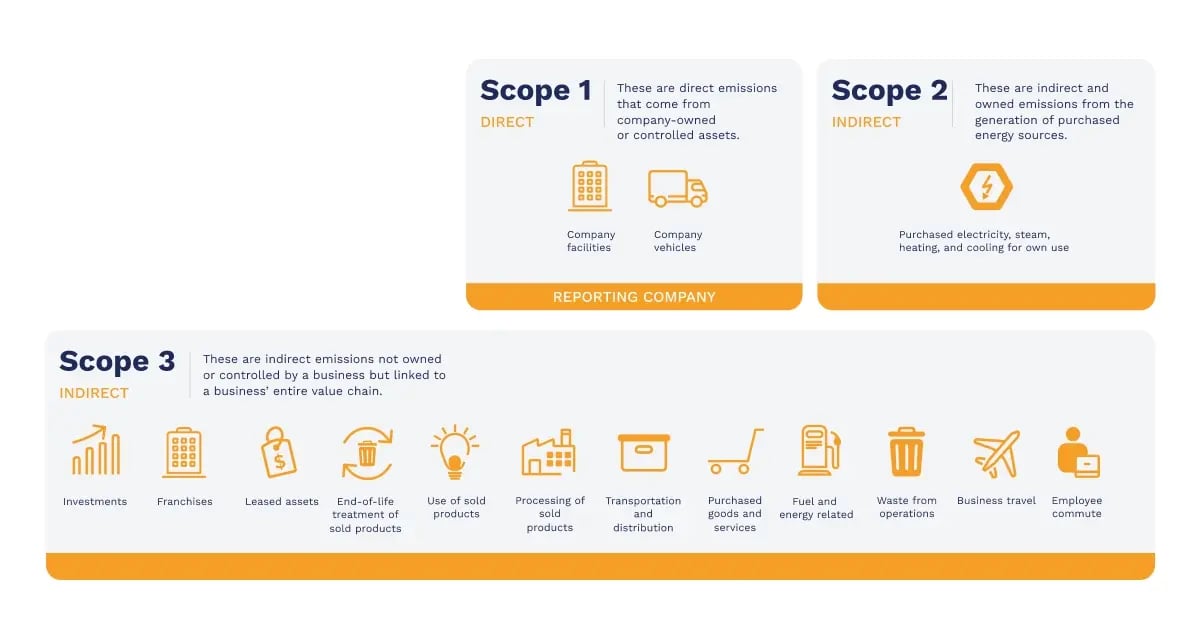 Illustration describing 3 scopes.
Understanding these emissions enables you to create a targeted CO2 reduction plan, meet compliance standards like the CSRD, and boost operational efficiency while aligning with your stakeholders’ sustainability expectations and eco-consumer demands. For suppliers, our guide on what CSRD means for supplier carbon footprints in 2026 explains the impact, and our article on how SME suppliers can turn CSRD data requests into a competitive advantage shows how to respond.
What are Scope 1, 2, and 3 emissions?
Businesses report their carbon footprint by scope. Each scope covers a different source of emissions:
| Scope | What it covers | Examples |
|---|---|---|
| Scope 1 | Direct emissions from sources you own or control | Company vehicles, boilers, and on-site fuel use |
| Scope 2 | Indirect emissions from the energy you buy | Purchased electricity, heating, and cooling |
| Scope 3 | All other indirect emissions across your value chain | Purchased goods and services, business travel, employee commuting, and waste |

How to measure your carbon footprint in 7 steps
To measure your carbon footprint, list your emission sources, collect activity data (energy, travel, and purchases), multiply by emission factors, and total the results in tonnes of CO2e. Businesses report by scope: Scope 1 (direct), Scope 2 (purchased energy), and Scope 3 (value chain).
Our CO2 Expert business carbon footprint calculator guides you through each of the essential steps for carbon footprint calculation, providing clarity and support along the way. You can easily create an account and add users and different company locations. Our experts are also here for you, ready to assist you every step of the way. No ESG team? Read how to approach emissions accounting without an ESG team.
Your carbon footprint measurement can be done in 7 easy steps:
-
Define your scope: Start by selecting the parts of your organisation to include—specific locations, emission sources, and relevant activities.
-
Data collection: Gather data, such as fuel usage or electricity bills. If you don’t have exact data, the calculator can work with approximations based on your spending.
-
Calculate your carbon emissions: Input your data, and the tool will automatically calculate your carbon footprint by applying relevant emission factors to provide your total emissions across Scope 1, 2, and 3.
-
Validation: Choose to have Green Earth's experts review your data and create a validated carbon footprint report, ensuring accuracy and reliability in your measurements.
-
Carbon compensation and reduction: Our experts can help you with a customised carbon reduction plan. For emissions that can’t be reduced immediately, you can purchase carbon credits directly from Green Earth’s portfolio of nature restoration projects. Learn more about the strength of nature-based credits in corporate decarbonisation strategies.
-
Gain insights and set targets: Use your footprint analysis as a baseline to identify impactful changes and other opportunities, from energy-saving measures to supply chain improvements. Not sure where to begin? See where an SME should start with a carbon action plan.
-
Share your progress: With a validated carbon footprint report, a carbon credit certificate, and insights from our tool, you can transparently celebrate and communicate your progress to stakeholders, reinforcing your commitment to sustainability.
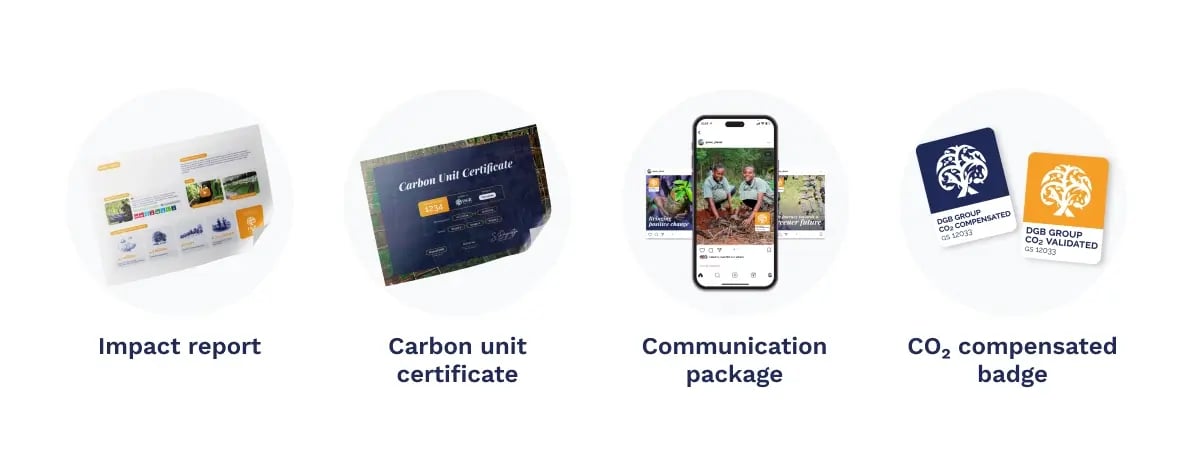 Share your progress with a validated carbon footprint report, carbon credit certificate, communication package, and CO2-compensated badges—highlighting your commitment to sustainability.
What units are used to measure a carbon footprint?
A carbon footprint is measured in carbon dioxide equivalent (CO2e). This expresses different greenhouse gases, such as methane, in terms of the warming effect of CO2, so that all your emissions add up to one figure.
| Unit | What it means | Typical use |
|---|---|---|
| kg CO2e | One kilogramme of carbon dioxide equivalent | Single activities, such as one flight or one product |
| Tonne CO2e (tCO2e) | 1,000 kg of carbon dioxide equivalent | A company’s annual footprint and reporting |
| Carbon credit | Represents 1 tonne of CO2e avoided or removed | Compensating emissions you can’t reduce yet |
For example, a small office that uses 10,000 kWh of electricity a year, with an illustrative emission factor of 0.2 kg CO2e per kWh, emits 2,000 kg CO2e, or 2 tonnes CO2e. Always use emission factors for your own country and year. To see how your result compares, read benchmarking emissions: what’s a good carbon footprint for my industry.
Key features of our CO2 Expert tool
Our CO2 Expert calculator is globally recognised, adhering to standards like the GHG Protocol and ISO, making it a credible choice for companies worldwide. It’s user-friendly and adaptable to companies in any country, with location-specific emission factors. Additionally, this carbon footprint guide is ideal for smaller companies needing to meet large clients' sustainability expectations, as larger corporations increasingly ask suppliers to measure and report emissions. Smaller businesses can also read our SME carbon footprints: a practical guide.
Read more: The power of sustainability: Why investing in sustainability drives faster company growth
The tool also stands out for its ability to handle advanced data categories, offering detailed input options to capture complex emission sources accurately. For example, when calculating air travel emissions, users can input details such as departure, arrival, and layover airports, mark whether the trip was a return flight, and include supporting documentation like ticket overviews. Similarly, freight emissions are calculated based on transportation mode, weight, quantity, and distance travelled, ensuring a precise assessment supported by transport invoices.
Read more: Overcoming sustainability challenges: practical solutions for your business
Emissions from waste streams can also be quantified by specifying the type and volume of waste, such as glass recycling, with contractor waste bills attached to ensure accuracy. Additionally, the tool allows for the inclusion of remote work emissions by adjusting a slider to reflect the percentage of employees working from home, integrating policies to substantiate the data.
Once data is entered, the tool provides a comprehensive overview of your data and footprint on your dashboard, detailing total emissions, efficiency factors, and a breakdown by scope. With options to validate data and save progress, businesses can seamlessly organise their sustainability journey.

These advanced features position the CO2 Expert business carbon footprint calculator as an indispensable resource for companies aiming to understand and act on their carbon footprint, ultimately paving the way for impactful sustainability strategies. Looking to compare options? See our guide to carbon-tracking apps, tools, and plugins.
Read more: The importance of carbon offsetting in achieving net zero
Frequently asked questions
What is CO2e?
CO2e (carbon dioxide equivalent) expresses different greenhouse gases, such as methane, in terms of the warming effect of one tonne of CO2, so they can be added into a single footprint figure.
What are Scope 1, 2, and 3 emissions?
Scope 1 covers direct emissions from sources you own or control, such as company vehicles and boilers. Scope 2 covers emissions from the electricity, heating, or cooling you buy. Scope 3 covers all other indirect emissions in your value chain, such as purchased goods, business travel, and waste.
How often should a business measure its carbon footprint?
Most businesses measure their carbon footprint once a year, so they can compare results and track progress against targets. Measure more often if you need to report during the year or after a major change in operations.
Read more: Carbon footprint offsetting strategies: How leading companies neutralise their emissions
A practical starting point for your sustainability journey
Taking the first step in sustainability can feel daunting, but our carbon footprint calculator makes it achievable, no matter your company’s size. By beginning with carbon footprint measurement, your business can embark on a meaningful path toward reducing its environmental impact and supporting nature restoration.
Learn more with our most popular webinar: Carbon footprinting for beginners
 Meet our experts.
Get started with Green Earth’s CO2 Expert tool today! Our experts are ready to support you in understanding your emissions, setting achievable goals, and making informed decisions on your path to sustainability and growth. Reach out to book a demo and discover how our tool can benefit your business.