
Net zero
Sustainability
Carbon footprint
Carbon calculator
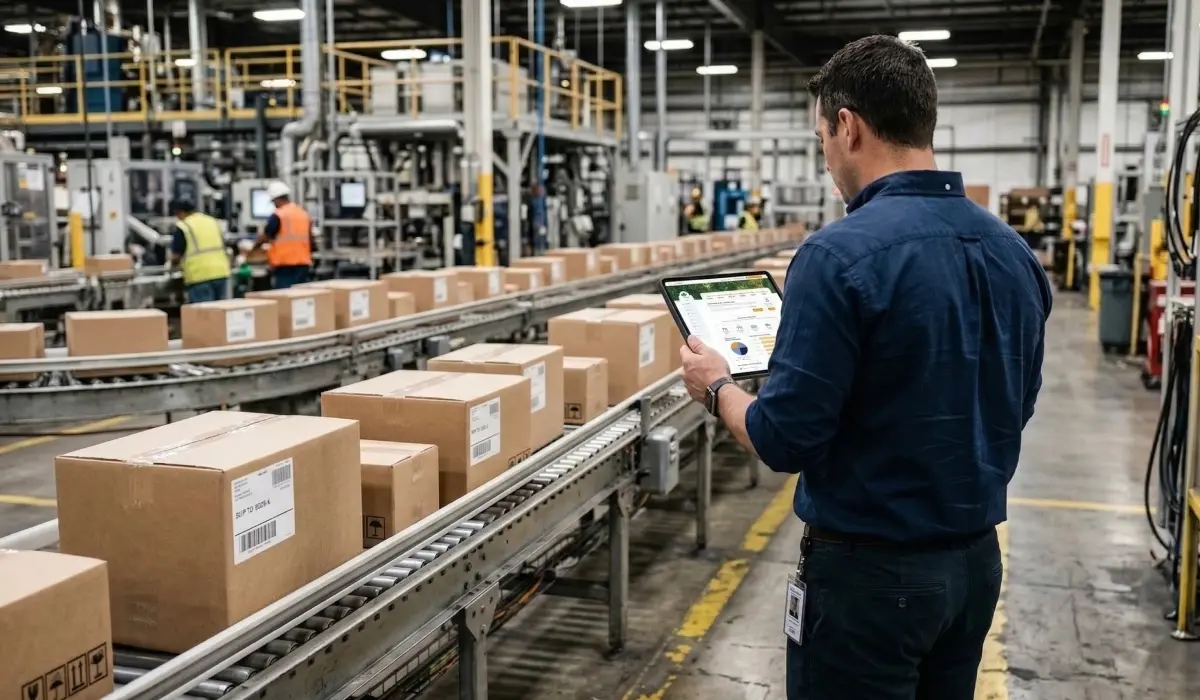
Most businesses have a clear picture of what happens inside their own operations. They track energy consumption, manage waste, and monitor the emissions produced on-site. What they often cannot see is everything that happens before a product reaches their facility, and everything that happens after it leaves.
That gap is significant. Supply chain emissions account for 80–90% of most companies' total environmental footprint, according to research from the World Economic Forum and others. The activities that have the greatest environmental impact are frequently the ones furthest from view.
A Life Cycle Assessment (LCA) is the definitive framework for quantifying a product’s total environmental footprint. By mapping impacts across every stage, from raw material extraction (cradle) through manufacturing, distribution, and consumer use to final disposal (grave), it replaces estimates with a granular, science-based complete picture.
The demand for that picture is growing fast. A PwC analysis found that 96% of companies report their customers have expressed an interest in the sustainability of their products—yet 69% of those same companies had conducted LCAs on less than 25% of their product lines. The gap between expectation and action is wide. Businesses that close it early stand to gain the most.
This article breaks down what a life cycle assessment is, how it works, and why the regulatory and commercial pressure to adopt it is building. It also explains how carbon footprint measurement fits into the process, and where to start if your business has not yet taken that first step.

What is a life cycle assessment?
A Life Cycle Assessment (LCA) is a rigorous, standardised methodology for evaluating the environmental impact of a product, service, or process throughout its entire lifespan. While often referred to as a ‘life cycle analysis’, the term ‘assessment’ highlights its function as a formal evaluation tool.
The process is governed by two foundational international standards: ISO 14040 (Principles and Framework) and ISO 14044 (Requirements and Guidelines). This dual-standard approach ensures that LCA results are not only transparent and consistent but also scientifically comparable across global supply chains and industries.
What physical stages are included in an LCA for a product:
- Raw material extraction (Cradle): Where do the inputs come from, and at what cost? This entails assessing the environmental cost of sourcing inputs, including land use, natural resources, biodiversity impact, and the carbon intensity of mining or harvesting.
- Manufacturing and processing: How much does production consume? Quantify the direct resource consumption, such as energy, water, and chemical inputs, required to transform raw materials into finished goods.
- Distribution and transportation: What are the emissions associated with packaging and moving goods across the supply chain? Account for the logistics-related emissions generated by moving materials to the factory and delivering final products to global markets.
- Use phase: How does the product perform in the hands of the customer? Evaluate the environmental performance during the product’s functional life, including energy requirements, maintenance, and consumable parts.
- End-of-life treatment (Grave): What happens to the product once it leaves the customer? Determine the impact of the product once it is decommissioned, focusing on recyclability, landfill burden (waste), or the potential for circular recovery (reuse).
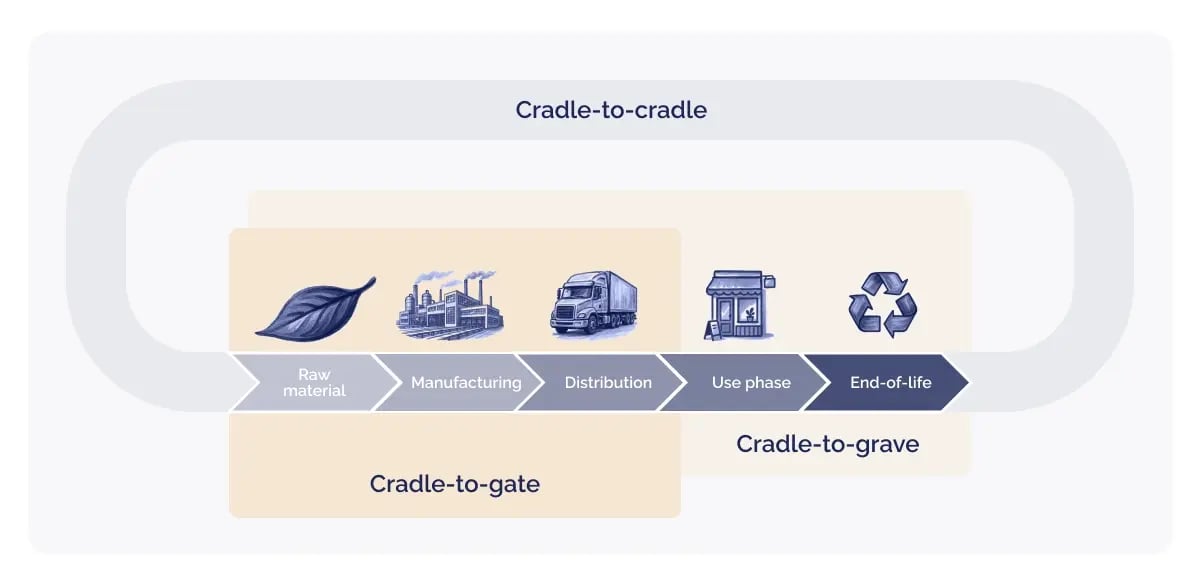 LCA product stages and LCA scope categories.
The scope of an LCA varies depending on its purpose:
- A cradle-to-gate assessment covers the journey from raw material extraction to the point at which a product leaves the manufacturer’s gate.
- A cradle-to-grave assessment extends that coverage all the way to disposal.
- A cradle-to-cradle assessment maps a full circularity loop, including the recovery and reuse of materials.
What distinguishes an LCA from a carbon footprint analysis is its breadth. A carbon footprint focuses specifically on carbon-equivalent emissions. An LCA considers a broader set of environmental indicators, including water use, energy consumption, land use, and ecotoxicity. Think of a carbon footprint as a snapshot: precise, essential, and focused. An LCA is a full-length documentary.
Read more: Emissions accounting without an ESG team: achieving the best of both worlds for SMEs
Why businesses can no longer ignore LCA
Life cycle assessment has existed as a discipline for decades. What has changed is the environment in which businesses operate. Regulatory requirements, customer expectations, and investor scrutiny are all converging, and LCA sits at the intersection of all three.
The regulatory landscape is shifting quickly. The EU's Corporate Sustainability Reporting Directive (CSRD) requires companies to disclose comprehensive sustainability data, including environmental footprint results from life cycle assessments. The first wave of companies subject to CSRD, those previously governed by the Non-Financial Reporting Directive (NFRD), with 500 or more employees, reported for the 2024 financial year, with disclosures due in 2025. Further waves of reporting requirements are to follow in subsequent years.
The Omnibus I Directive (March 2026) significantly streamlined the CSRD, raising mandatory reporting thresholds to focus on entities exceeding 1,000 employees and €450 million in turnover. However, this legislative pivot does not grant SMEs a pass on sustainability; it moves the pressure from direct legal mandates to supply chain transparency.
Large, regulated Wave 1 corporations are now legally required to disclose the footprint of their entire value chain. Consequently, they are prioritising suppliers who provide high-fidelity, LCA-backed data.
Read more: Stay in the game: What CSRD means for supplier carbon footprints in 2026
The EU Ecodesign for Sustainable Products Regulation (ESPR), which came into effect in July 2024, takes the requirement a step further. It mandates lifecycle-based disclosures for a wide range of product categories, establishing minimum sustainability performance thresholds based on lifecycle data. For energy and resource-intensive products, LCAs are already mandatory in some contexts. From 2030, the construction industry will face similar obligations under EU energy efficiency legislation.
The commercial pressure is equally compelling. According to PwC, 80% of customers are willing to pay a premium for sustainably produced products, and 95% of businesses expect that trend to continue. Procurement teams in B2B supply chains are increasingly using LCA data to evaluate suppliers, meaning that LCA performance is becoming a prerequisite for winning and retaining contracts.
The scale of this shift is reflected in market growth. The global LCA market was valued at approximately $765 million in 2024 and is projected to reach $3.37 billion by 2035, growing at a compound annual growth rate of 14.4%. That trajectory reflects both regulatory momentum and a genuine shift in how businesses understand and manage their environmental impact.
What a life cycle assessment actually measures
An LCA is structured around four phases, as defined by the ISO standards. Understanding these phases is the foundation for making the data actionable.
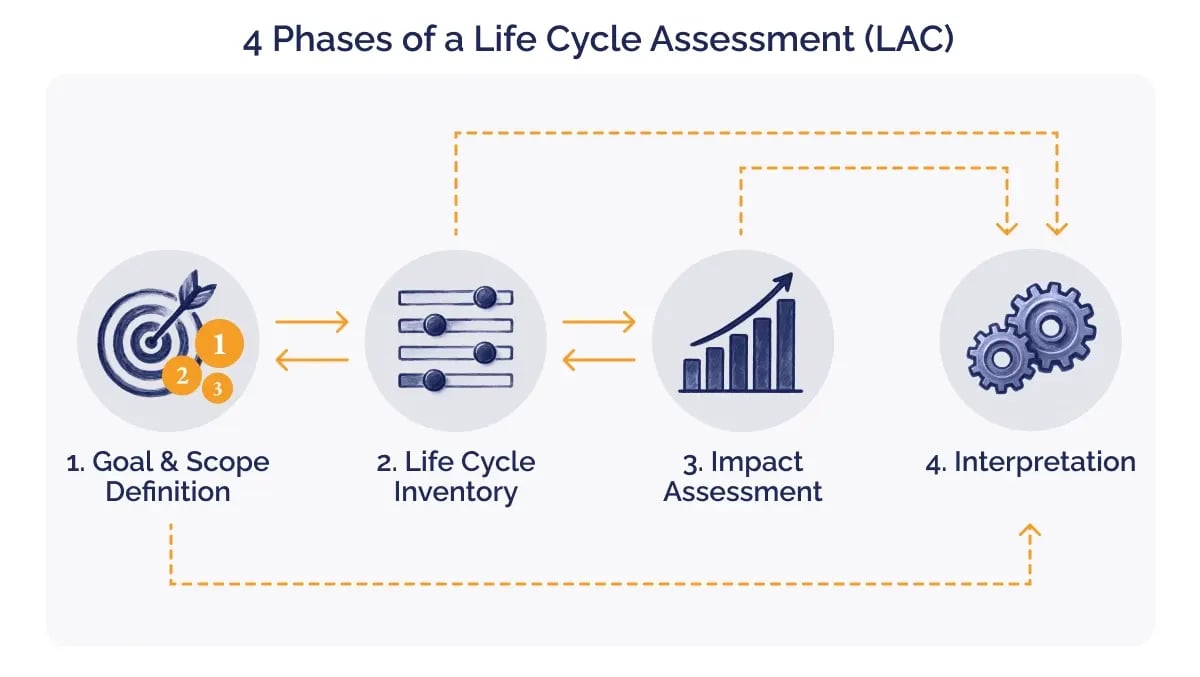 A business’ journey through 4 core phases of a life cycle assessment.
The first phase is goal and scope definition. Before any data is collected, the purpose of the assessment must be established. What decisions will the LCA inform? What are the system boundaries, cradle-to-gate, cradle-to-grave, or cradle-to-cradle? What is the functional unit of measurement, the reference point against which all inputs and outputs will be expressed? Clear answers to these questions determine the relevance and reliability of everything that follows.
The second phase is the life cycle inventory (LCI). This is the data-collection stage: energy consumption, raw material inputs, transportation distances, water use, and waste outputs across every stage of the product's life cycle. Primary data, gathered directly from suppliers, facilities, and operations, is preferred. Where primary data is unavailable, secondary sources and databases supplement the inventory.
The third phase is the life cycle impact assessment (LCIA). Here, the inventory data is translated into environmental impact. Each input and output is assigned an impact factor across a range of categories—carbon impact, water depletion, land use, human toxicity, and others—to produce a multi-dimensional picture of environmental performance.
The fourth phase is interpretation. Results are analysed, hotspots are identified, and conclusions are drawn. This is where the data becomes decisions: Which materials to substitute, which suppliers to engage differently, which stages of the life cycle offer the greatest opportunity for improvement.
Read more: Industry carbon footprints: transport, events, and celebrities
How to measure the emissions of a single product
Product-level emissions measurement starts with defining a functional unit—a precise reference point such as one kilogramme of material produced, one item manufactured, or one unit shipped. Every input and output across the four LCA phases is then mapped against that unit: energy consumed per unit, raw materials used per unit, transport distance per unit, waste generated per unit. This granularity is what makes the results actionable, rather than an organisational average, you have a number that is specific to a product and traceable to every stage of its production.
How to compare the emissions of two products
Because LCA uses a standardised functional unit and follows ISO methodology, results across two products are directly comparable: same scope, same impact categories, same reference unit. A manufacturer choosing between two raw material suppliers, or a procurement team evaluating competing products, can use LCA data to make that comparison on a like-for-like basis. This is also the foundation of environmental product declarations (EPDs), the standardised documents businesses use to communicate verified environmental performance to customers and partners.
LCA vs carbon footprint and PCF: what is the difference?
A carbon footprint analysis (organisational level) and an LCA (product level) are actually two different ways of looking at the same data, rather than one being a prerequisite for the other. And a product carbon footprint (PCF) and an LCA follow the same lifecycle stages. These tools are complementary rather than competing. The key difference is scope:
-
A carbon footprint analysis measures the greenhouse gas emissions (CO2e) for an entire organisation's specific operations across Scope 1, 2, and 3.
- A product carbon footprint (PCF) measures only the CO2e tied to a specific product throughout its life cycle (from raw materials to disposal). It is essentially the carbon-only subset of an LCA.
-
A Life Cycle Assessment (LCA) is a comprehensive, multi-criteria evaluation that measures multiple environmental impacts across a product's entire life cycle (from raw material extraction to end-of-life disposal). It includes the carbon footprint, but also tracks water usage, resource depletion, land use, and pollution (like toxicity and eutrophication).
In short, a general carbon footprint looks at the company's emissions, a PCF looks strictly at a product's carbon emissions, and an LCA looks at a product's total environmental impact.
For most businesses, a carbon footprint analysis is the natural starting point. It establishes a measurable baseline, meets the most common reporting requirements, and provides the data foundation that a full LCA builds upon. Research has shown that LCAs help companies identify improvement opportunities across the full value chain, not just at the point of manufacture, which is why combining both tools produces the most actionable results.
The scale of what a full value chain assessment must account for is considerable. Research suggests that covering 95% of a company's environmental footprint would require mapping up to approximately 12 million individual supply chain contributions. However, there are solutions to simplify and make this process achievable. LCA, combined with structured carbon footprint tools, provides the framework to make that work tractable.
It is also worth noting that as of 2022, only around 30% of US companies reported Scope 3 emissions—the value chain emissions that LCA is specifically designed to illuminate. That figure is rising fast under incoming disclosure requirements, and companies that have not started measuring face a steeper path ahead.

The business case: what an LCA makes possible
LCA is often framed as a compliance exercise. It is more usefully understood as a strategic tool, one that generates operational, commercial, and reputational value alongside its reporting function.
Identify where the impact is concentrated
The most immediate benefit of an LCA is clarity. Before conducting one, most organisations have assumptions about where their environmental impact is greatest. After conducting an LCA, they have evidence. An LCA pinpoints hotspots along the value chain, the stages where impact is highest and where targeted reductions deliver the most value.
Read more: CSRD for SME Suppliers: How to turn data requests into a competitive advantage
This is not a marginal benefit. Without knowing where your impact is concentrated, reduction efforts risk being directed at the wrong places. A manufacturer that focuses exclusively on its own facility emissions may be ignoring a raw material sourcing decision that accounts for the majority of its environmental footprint. An LCA makes that visible.
The investment required to gain this clarity has historically been significant. Manual LCAs can take between 6 and 18 months and cost up to $100,000 for complex products. Modern LCA software and digital carbon footprint tools have substantially reduced this burden, making the process accessible to a far wider range of businesses.

Strengthen supplier relationships and procurement decisions
LCA data gives procurement teams an evidence base that goes beyond price and lead time. It enables the evaluation of suppliers on environmental grounds, factoring in the environmental performance of upstream inputs as part of supplier selection and ongoing relationship management.
This has implications in both directions. For businesses purchasing from supply chains, LCA data enables more informed and defensible procurement decisions. For businesses selling into supply chains, strong LCA performance becomes a commercial differentiator, a concrete demonstration of environmental credibility that procurement teams can verify and act on.
When integrated across ESG, procurement, operations, and R&D, an LCA transcends its role as a compliance checklist to become a cross-functional strategic asset. The insights it generates are relevant to product designers making material choices, operations teams optimising logistics, and leadership teams setting environmental action targets.
Support credible sustainability claims
As regulatory scrutiny of environmental claims increases, the ability to substantiate those claims becomes more important. LCA provides the hard data to back up sustainability statements and defend against accusations of greenwashing, a risk that has grown significantly as national and EU-level regulations on environmental marketing claims tighten.
Read more: Legal challenges in carbon offsetting: What recent lawsuits teach us
 Member of the Green Earth team contributing to regenerative agroforestry initiatives, supporting environmental stewardship and sustainability practices through the Mount Kenya Regenerative Agroforestry Project.
Beyond defensive value, LCA results can be used to pursue sustainability certifications, support eco-labelling, and demonstrate environmental leadership to investors, clients, and the public. Businesses that integrate LCAs into their operations gain a credible, structured basis for the sustainability communications their stakeholders increasingly expect.
Where carbon footprint measurement fits in
While an LCA is a standalone, product-specific study, it is most useful when synchronised with an organisation’s broader climate goals. While Scope 1 and Scope 2 emissions are typically manageable, Scope 3 — encompassing the entire value chain from raw materials to end-of-life — often accounts for the majority (over 80%) of an organisation's total impact.
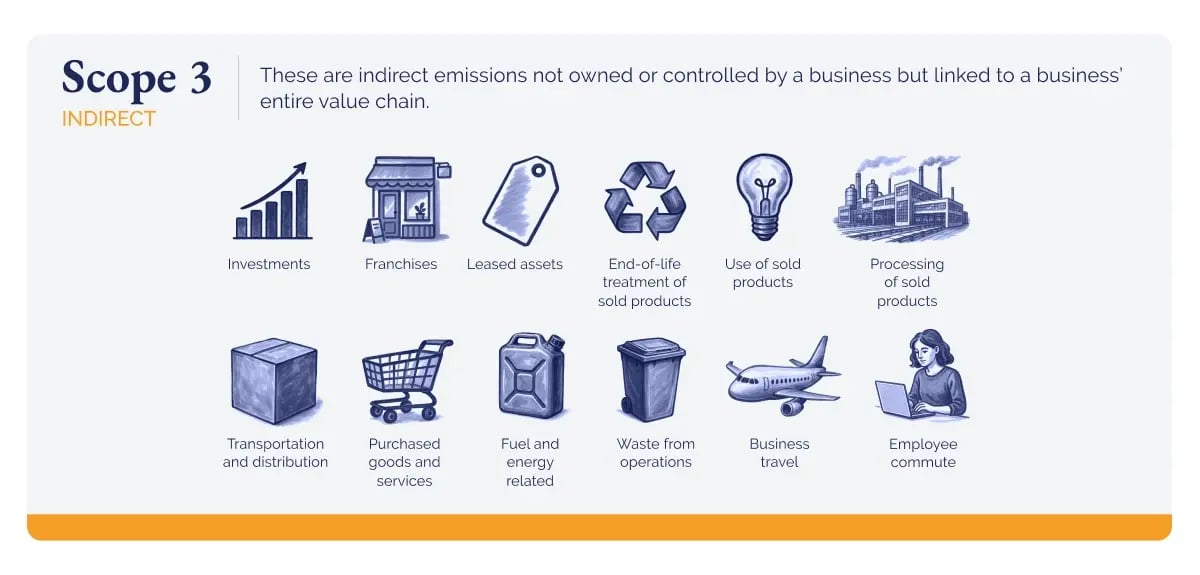 The sources of Scope 3. emissions
Scope 3 is notoriously difficult to quantify using traditional spend-based estimates. This is where an LCA becomes indispensable: It serves as the high-precision lens that illuminates these indirect hotspots. By shifting from broad industry averages to activity-based data, an LCA provides the decision-grade transparency required for modern ESG reporting and decarbonisation.
Read more: Why scope 3 emissions are your biggest blind spot—and what to do about it
The two approaches are complementary. A corporate carbon footprint establishes emissions at the organisational level, providing a clear, aggregated picture of total impact. A product-level LCA maps where those emissions originate, stage by stage, across the value chain. Together, they provide both the breadth and the depth that robust environmental impact assessment requires.
The CSRD's double materiality requirement reinforces the case for both. Companies subject to CSRD must assess not only the impact of sustainability issues on their business, but also their impact on the environment. That dual lens requires data at both the organisational and product level, and it requires that data to be structured, verifiable, and consistent over time.

How to get started
The scale of a full life cycle assessment can make it seem like a distant ambition. In practice, it begins with a single, concrete step: knowing your numbers.
The first task is to define your goal and scope. What decisions will the LCA inform? Regulatory reporting, product design, supplier selection, and procurement strategy all benefit from LCA data, but the scope of the assessment should be matched to the decision at hand. Starting with a clearly defined question produces more actionable results than starting with an open-ended exercise. Note, that an LCA can be done without first completing your GHG emissions accounting.
The second task is to identify where impact is concentrated. Energy use, raw material sourcing, transportation, and end-of-life treatment are the stages most likely to contain the biggest opportunities. Prioritising data collection in those areas produces results faster and makes the overall process more manageable.
The third task is to use the findings. LCA data is most valuable when it informs decisions across procurement, operations, and product development, not when it sits in a report. Cross-functional access to LCA results is what transforms the exercise from compliance documentation into genuine business intelligence.
The fourth task is to report transparently. CSRD and broader stakeholder expectations require that environmental disclosures are verifiable, structured, and consistent. The data gathered through carbon footprint measurement and LCAs provides exactly that foundation.
Read more: Countdown to CSRD: Your 12-month plan for compliance and competitiveness
The tools available to support this process have advanced significantly. AI and machine learning are now integrated into many LCA platforms, simplifying data management, reducing the time required to build a life cycle inventory, and enabling more sophisticated modelling of impact scenarios. The accessibility of life cycle assessments in 2026 is substantially greater than it was a decade ago, and the pace of development continues.
Green Earth and environmental impact measurement
At Green Earth, we work with businesses that understand the connection between measurement and meaningful action. We enable them to turn environmental complexity into a strategic roadmap.
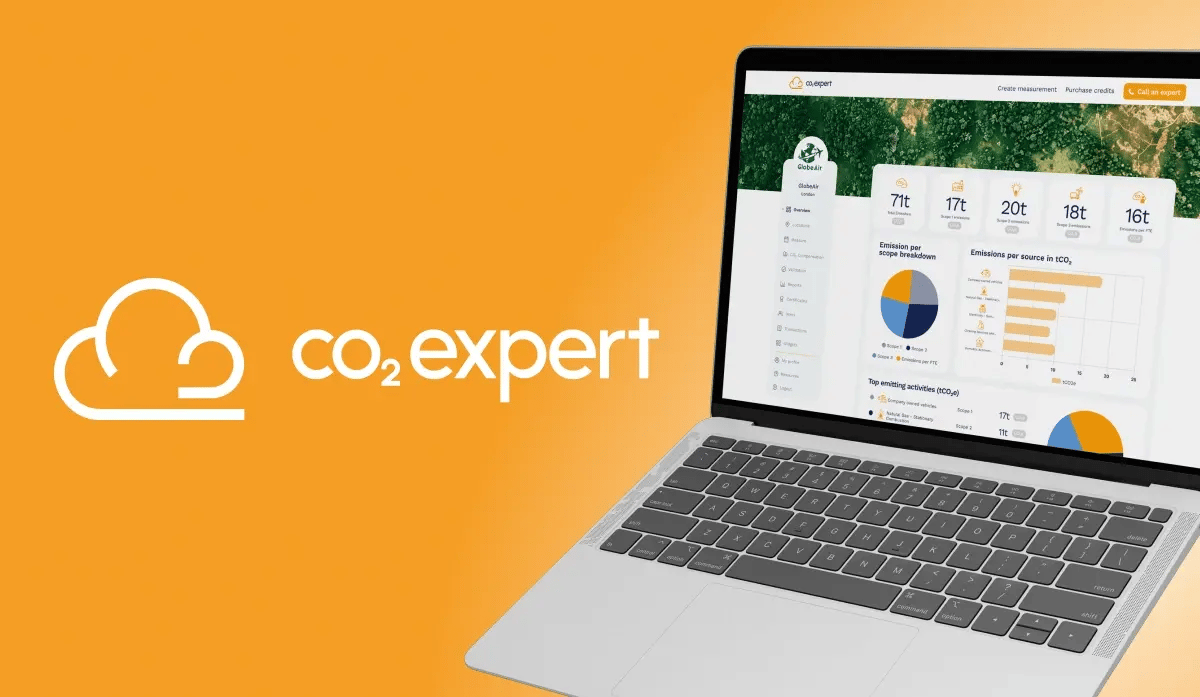
Our CO2 Expert tool manages the big picture, providing audit-ready GHG emissions accounting for Scope 1, 2, and 3 emissions that satisfy current CSRD and VSME standards. To zoom in on technical requirements, we have partnered with OneClick LCA to generate high-fidelity Life Cycle Assessments, Product Carbon Footprints, and third-party verified Environmental Product Declarations.
By integrating these industry-leading tools with our sustainability expertise, we provide more than just data; we deliver a decisive competitive advantage. Our mission is to equip your procurement, R&D, and leadership teams with the scientific proof needed to de-risk supply chains, out-innovate the competition, and lead the transition to a high-performance, low-carbon economy.
Understanding where your environmental impact originates is the first step towards reducing it. Our tools and expertise make that understanding accessible, so that you can move from awareness to action with confidence.