
Carbon credits
Nature conservation
Carbon markets
Nature-based solutions
Voluntary Carbon Market
The voluntary carbon market has matured quickly, but with that growth comes increasing scrutiny. Organisations looking for high-quality carbon credits are recognising that not all credits deliver the same environmental outcomes. Quality is shaped upstream, through rigorous project design, conservative accounting, and long-term management of environmental risk.
This article focuses on how quality is established across the full lifecycle of a carbon project. That includes how projects are designed, how risks such as reversals and measurement uncertainty are managed, and how transparent outcomes are monitored and verified over time. When these fundamentals are in place, carbon credits are far more likely to deliver real, durable environmental benefits that align with nature-first, trust-led sustainable action.

Here is a concise, practical breakdown of the core pillars buyers should consider when choosing credits:
- Environmental integrity (additionality, conservative baselines)
- Permanence and risk management (buffers, long-term stewardship)
- Robust MRV and third-party verification (ongoing measurement and auditability)
- Genuine social and ecological co-benefits (community safeguards and biodiversity outcomes)
 Green Earth team members during cookstoves distribution, supporting the local community in Kenya. Hongera Energy Efficient Cookstoves Project, Green Earth.
Below is a clear explanation of each pillar and a short, actionable checklist buyers can use to assess developer-grade carbon credits.
Carbon credits are built over time—How reliable developers approach quality
A carbon credit represents the culmination of years of planning, data collection, and oversight. The best carbon credit developers treat quality as something that must be built deliberately over time, rather than optimised for short-term issuance.
At a high level, this development process typically includes:
- Early-stage feasibility assessments to determine whether genuine emissions reductions or removals are achievable
- Careful selection of approved methodologies and conservative assumptions
- Long-term monitoring frameworks designed to track outcomes well beyond initial credit issuance
What distinguishes development-led approaches is their emphasis on consistency and durability. Decisions made at the design stage, from how baselines are set to how risks are anticipated, shape the credibility of every credit that follows. Once a project is underway, many of these decisions cannot be meaningfully reversed.
 A newly planted, growing forest in Uganda. Bulindi Agroforestry and Chimpanzee Conservation Project, Green Earth.
This is why experienced developers prioritise transparency and discipline throughout the project lifecycle. Rather than maximising headline volumes, they focus on ensuring that each issued credit reflects a measurable, verifiable environmental outcome grounded in sound project development.
Read more: What business leaders need to know before buying carbon offsets
First pillar: Additionality and project design as core carbon offset quality criteria
At the foundation of any credible carbon project lies additionality: The principle that emissions reductions or removals would not have occurred without the incentive created by carbon finance. Without additionality, a carbon credit cannot credibly claim to represent a real environmental benefit.
In practice, additionality in carbon credits is established through:
- Evidence that the project depends on carbon finance to move forward
- Existing laws or regulations do not already require the project to take place
- Clear, auditable documentation that is reviewed by independent third parties
Project design also plays a critical role in defining broader carbon offset quality criteria. Baselines must be set cautiously, assumptions should err on the side of under-crediting rather than over-crediting, and methodologies must be applied consistently over time. These choices help ensure that credited outcomes reflect real-world impact rather than theoretical projections.
Read more: High-quality carbon credits vs regular carbon credits: what sets them apart?
Strong project design is about creating a credible, defensible link between on-the-ground activity and the climate outcomes those activities are meant to deliver. When additionality and design integrity are treated as non-negotiable, the resulting credits are far more likely to withstand scrutiny over time.

Second pillar: Permanence and long-term risk management in carbon credits
For many carbon projects, particularly those involving nature-based solutions, environmental benefits depend not only on what is achieved today but on how long those benefits last. Permanence in carbon credits refers to the likelihood that emissions reductions or removals will be maintained over time, without being reversed by events such as land-use change, extreme weather, or management failure.
High-quality projects account for these risks from the outset. This typically involves:
- Identifying potential reversal risks specific to the project context
- Applying conservative crediting and buffer mechanisms
- Long-term monitoring and management responsibilities
 Green Earth team members conducting agroforestry training for local farmers. Mount Kenya Regenerative Agroforestry Project, Green Earth.
Crucially, permanence is not a one-time calculation. It is an ongoing obligation that extends well beyond the initial issuance period. Projects designed with long-term stewardship in mind are better equipped to manage uncertainty and adapt to changing environmental conditions, helping ensure that credited climate outcomes remain intact over decades rather than years.
By contrast, weak approaches to permanence can undermine otherwise sound projects. This is why durability and risk management are widely regarded as central indicators of carbon credit quality, particularly in markets seeking lasting environmental impact.
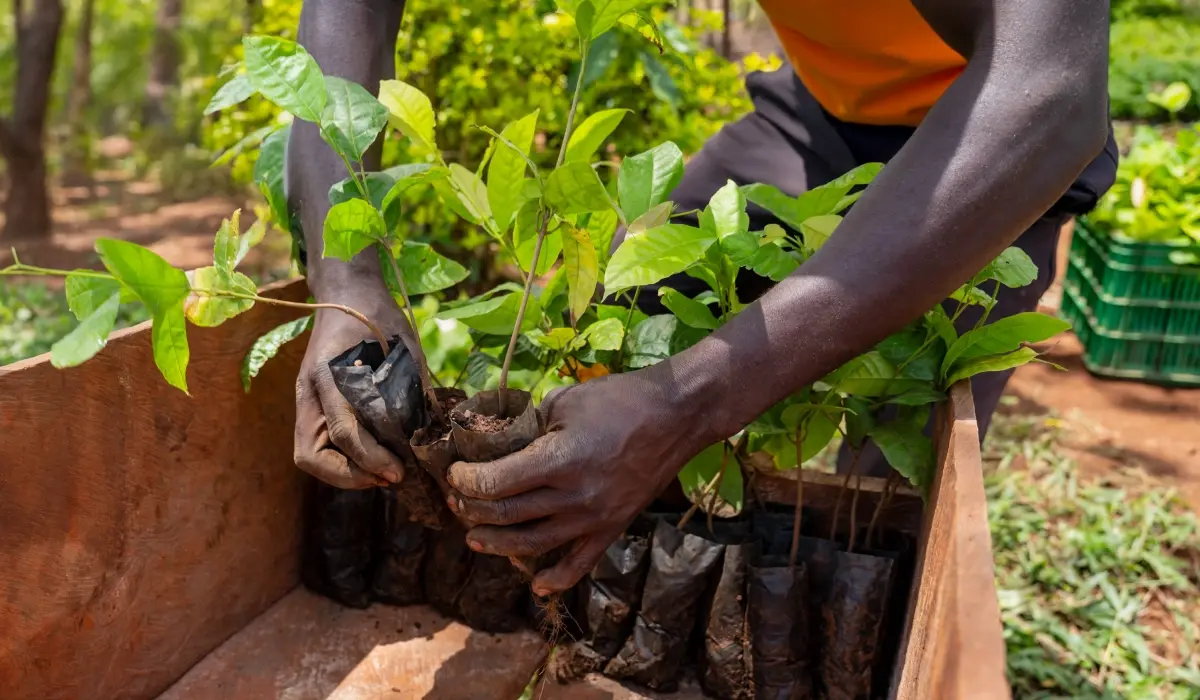
Read more: Planting the future: Building a nursery for Bulindi’s forests
Third pillar: Measurement, monitoring, and carbon credit transparency
Reliable environmental outcomes depend on the ability to measure them accurately and to demonstrate those results over time. Robust measurement, monitoring, and reporting frameworks, commonly referred to as MRV, are therefore essential to delivering carbon credit transparency.
High-quality carbon projects rely on MRV systems that are:
- Aligned with recognised standards and approved methodologies
- Applied consistently throughout the project lifecycle
- Subject to independent, third-party verification from leading standards like Verra and the Gold Standard
 Verra and the Gold Standard.
Transparency is not only about data availability; it is about traceability and credibility. Buyers should be able to understand how outcomes are calculated, how often they are reviewed, and how discrepancies are addressed. Ongoing verification and public documentation help ensure that credits remain defensible as methodologies evolve and expectations increase.
Read more: Exploring carbon credit certification and issuance
When measurement and transparency are treated as core quality requirements rather than compliance exercises, carbon credits are better positioned to withstand scrutiny and retain their credibility over time.
Fourth pillar: Social and ecological co-benefits embedded with care
While the primary purpose of carbon credits is climate mitigation, well-designed projects can also deliver meaningful social and ecological benefits. When approached responsibly, these outcomes strengthen project resilience and contribute to long-term environmental integrity.
High-quality projects treat co-benefits as part of project design rather than only marketing claims. This often includes:
- Engagement with local communities to ensure projects respect land rights and livelihoods
- Additional income for local farmers, agroforestry training, and improved soil health, supporting long-term participation in sustainable land management and higher yields
- Improved community health and livelihoods through more efficient cookstoves and water boreholes
- Clear social safeguards and grievance mechanisms
- Creating and protecting wildlife habitats, increasing biodiversity and enhancing ecosystem health and resilience
 A female Bulindi chimpanzee and her baby in their natural habitat in Uganda, protected through Green Earth’s conservation efforts. Bulindi Agroforestry and Chimpanzee Conservation Project, Green Earth.
Crucially, co-benefits should be measurable, context-specific, and transparently reported. Projects that embed social and ecological considerations from the outset are more likely to maintain community support and ecological stability over time, reinforcing the durability of environmental outcomes.
Read more: Beyond tonnes: How carbon credit co-benefits elevate value
How to choose carbon credits for businesses
For many organisations, assessing carbon credits can feel technically complex. However, buyers do not need deep expertise to make informed decisions. Understanding how to choose carbon credits for businesses starts with knowing which questions reveal the quality of a project behind each credit.
Rather than focusing solely on volume or availability, buyers should look for clear evidence of disciplined, transparent project design and long-term management.
Five questions to ask when choosing carbon credits for your business:
- How is additionality demonstrated, and what assumptions underpin the baseline?
- How are permanence risks identified, managed, and monitored over time?
- What measurement and verification processes are in place, and how frequently are they applied?
- How is project data made accessible to support carbon credit transparency?
- How are social and ecological considerations embedded and safeguarded throughout the project lifecycle?
These questions help buyers move beyond surface-level claims and assess whether a credit reflects genuine, developer-grade quality.
Why developer quality matters for high-quality carbon credits
High-quality carbon credits are not defined by labels, pricing, or marketing language. They are the result of careful project design, conservative accounting, long-term risk management, and transparent verification carried out over the full lifecycle of a project.
For organisations pursuing credible environmental action, it is important to know where to buy high-quality carbon credits, and to choose providers that have end-to-end oversight.
At Green Earth, this approach underpins how our nature-based carbon projects are selected, developed, and monitored. As an end-to-end project developer with oversight across the full lifecycle, from project design and financing through to monitoring, verification, and credit issuance, Green Earth maintains responsibility for environmental integrity at every stage.
 A local woman in Uganda holding a tree seedling as part of a project improving the quality of life in her community and benefiting the local environment. Bulindi Agroforestry and Chimpanzee Conservation Project, Green Earth.
This integrated model helps ensure that our credits are grounded in additionality, permanence, and robust monitoring, delivering high-quality, verifiable credits that provide real, lasting nature-positive outcomes and support responsible sustainability strategies.
For companies committed to credible environmental action, understanding how carbon credits are developed, not just how they are presented, is essential. Quality is not an attribute added at the end of the process, but a commitment sustained throughout it. This is the principle that guides Green Earth’s work and the verified carbon credits we provide to buyers seeking measurable, trustworthy impact.