
Agroforestry
Agriculture
Kenya
Nature-based solutions
Project updates
Nature restoration
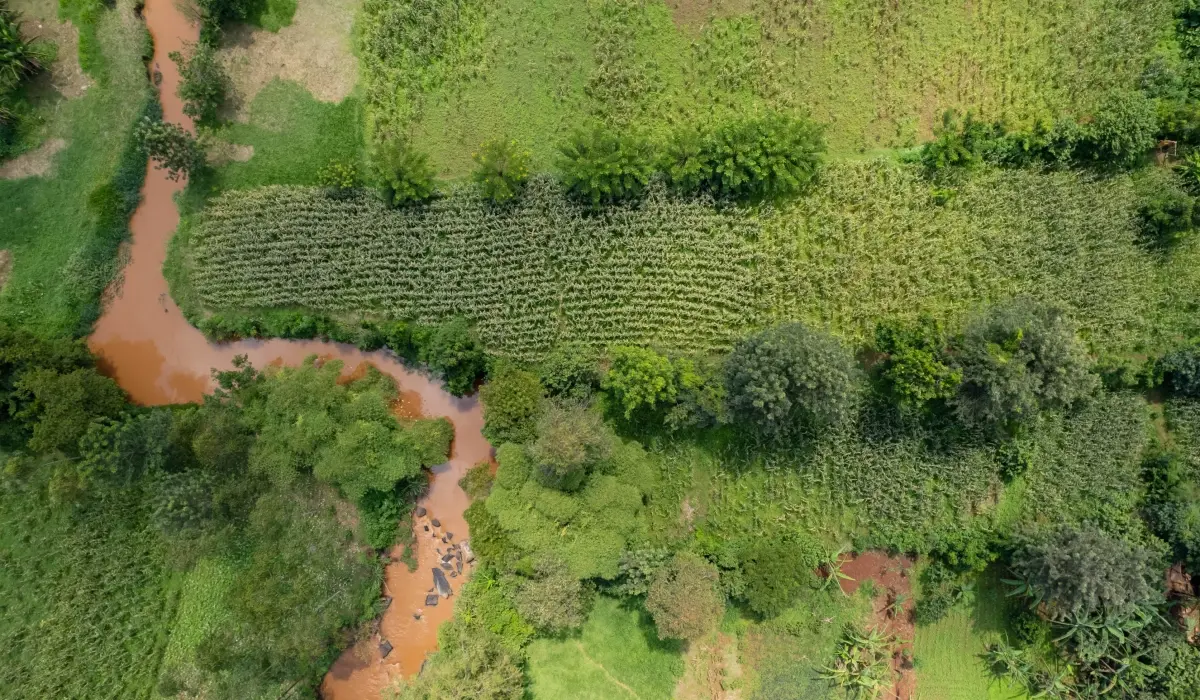
Green Earth has recently concluded the signing of an agreement for a new food forest initiative in Bungoma County, western Kenya. The project involves collaborating with local farmers using agroecological methods (mixing trees and cash crops) to enable farmers to get the most out of their land.
Unlike conventional carbon projects, Green Earth builds systems that last: economically, socially, and ecologically. High-integrity carbon credits are only credible if the underlying project remains viable for decades. Where land users are unable to generate consistent income, projects inevitably falter, leading to land degradation, disengagement, or renewed pressure on surrounding forests. Ensuring that farmers can make a stable living from their land, without exhausting soils or expanding into forested areas, is therefore a prerequisite for any long-term environmental outcome.
 A Green Earth team member planning in the field with local farmers. Bungoma food forest initiative, Green Earth.
The Bungoma food forest initiative has been designed with this reality in mind. We recognise that the longevity of any land-based climate solution depends on the people who manage and depend on the land itself. It’s key to the project’s success. From the outset, emphasis is therefore placed on active community engagement to build mutual trust and shared ownership, ensuring that farmers clearly understand the structure and objectives of the project and the role they play within it.
Read more: Three steps driving Kenya’s forest comeback
The food forest agroecological approach is a proven regenerative model within the broader agroforestry framework. It applies agroforestry principles in a structured, multi-layered system designed to mirror natural forest ecosystems. By diversifying production across multiple crops, food forests increase income per hectare while spreading risk, reducing dependence on a single harvest. This diversification helps protect farmers against weather variability, pest outbreaks, and market fluctuations, key factors that can otherwise undermine project continuity.
 Newly planted trees, lined up and ready to grow. Bungoma food forest initiative, Green Earth.
Food forest systems are built around a number of core principles that link land restoration with long-term livelihoods:
- Diversified production: Trees, food crops, and income-generating plants are grown together on the same land, increasing overall productivity per hectare and reducing reliance on a single crop or income stream.
- Soil and ecosystem regeneration: Integrating trees into farmland improves soil structure, increases organic matter, enhances water retention, and builds biomass over time, supporting long-term land productivity rather than short-term extraction.
- Livelihood-led permanence: Agroforestry systems are designed to remain economically viable for farmers over decades, ensuring that restored land continues to be maintained, protected, and productive.
 A Green Earth team member inspecting trees with local farmers. Bungoma food forest initiative, Green Earth.
Beyond economic resilience, agroforestry and food forest systems play a critical role in restoring ecological function. Over time, this leads to long-term carbon storage in soils and perennial vegetation, alongside improved biodiversity and ecosystem stability.
 A Green Earth team member speaking with a local farmer. Bungoma food forest initiative, Green Earth.
Importantly, by making existing farmland more productive and resilient, these systems remove the economic incentive for deforestation or further land degradation, reinforcing conservation outcomes through livelihoods rather than enforcement alone.
Read more: The social impact of Green Earth’s projects
By investing in land productivity before the carbon phase, Green Earth is establishing long-term farmer partnerships, reducing delivery and permanence risk and significantly improving the credibility and quality of any future carbon issuances. This is how we create the sustainable infrastructure of a carbon project that supports both livelihoods and ecosystems.
 A Green Earth team member checking the state of a tree. Bungoma food forest initiative, Green Earth.
Agroforestry systems like food forests are therefore foundational to our nature-based solutions. Carbon benefits are not the goal, but the outcome of successful community collaboration rooted in strong ecological and economic foundations. Our approach ensures that farmer benefits are long-lasting and sustainable and that the carbon credits generated are credible and of high-quality.
 A Green Earth team member with local farmers. Bungoma food forest initiative, Green Earth.
This is the basis for this initiative in Bungoma County. At Green Earth, we prioritise nature-based solutions that align ecological restoration with long-term community prosperity.