
Nature conservation
Nature-based solutions
Sustainable investing
Private capital committed to nature projects has grown roughly fivefold over the past decade, reaching more than $14 billion in 2025, up from $2.8 billion a year in 2016. The figures come from Gaining Ground: State of Private Investment in Nature 2026, a report from Forest Trends and The Nature Conservancy. More than $60 billion has been deployed across the decade, and over $180 billion is targeted for the years ahead.
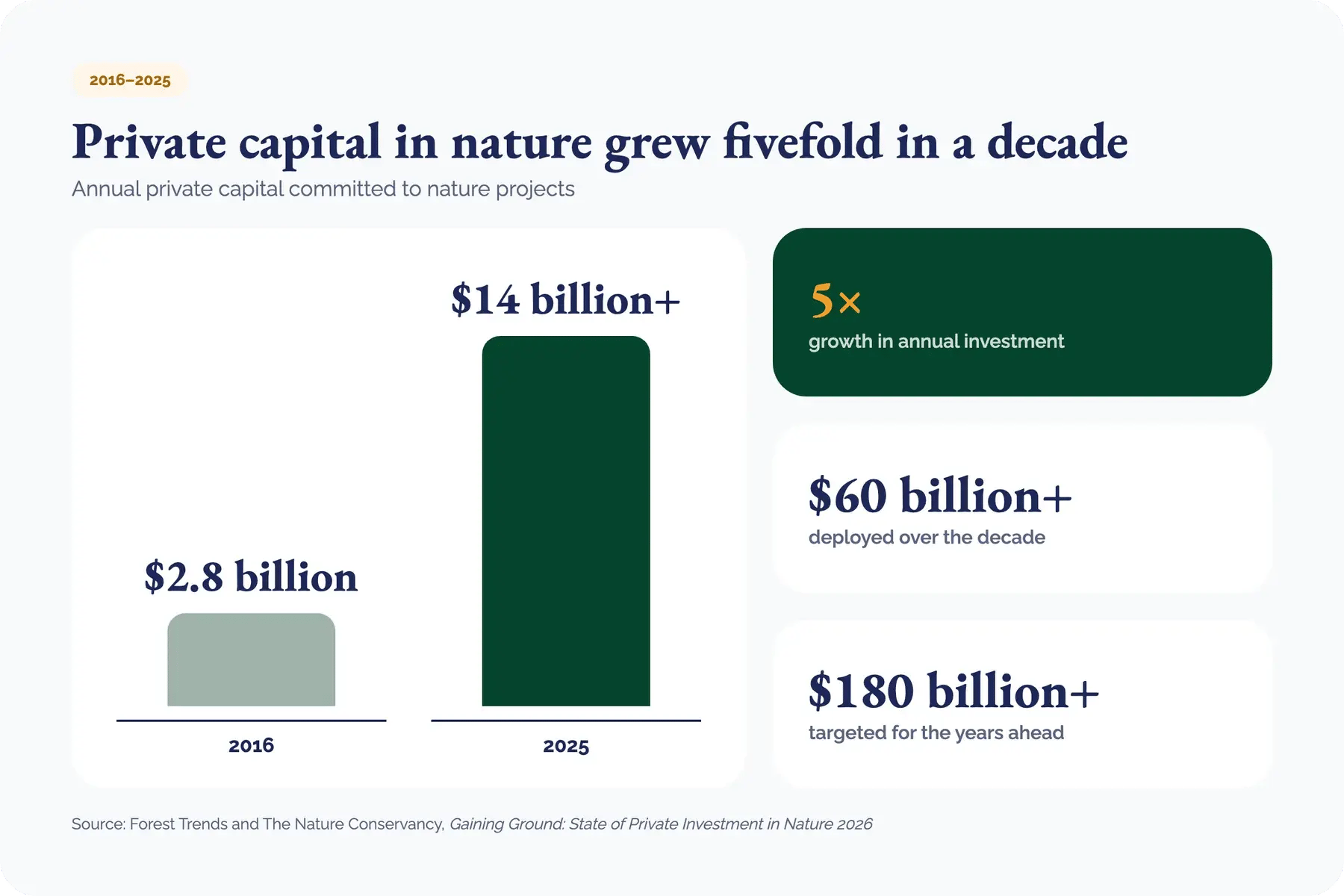 Annual private capital committed to nature grew fivefold between 2016 and 2025. Source: Forest Trends and The Nature Conservancy.
The scale of the growth matters, and its shape matters more. A decade ago, working landscapes such as sustainable agriculture and forestry dominated allocations. Sustainable agriculture alone accounted for 68% of investment in nature-based projects between 2016 and 2020. By 2024 and 2025, that share stood at 36%. Agriculture allocations kept rising in absolute terms, and the range of nature investments around them grew faster.
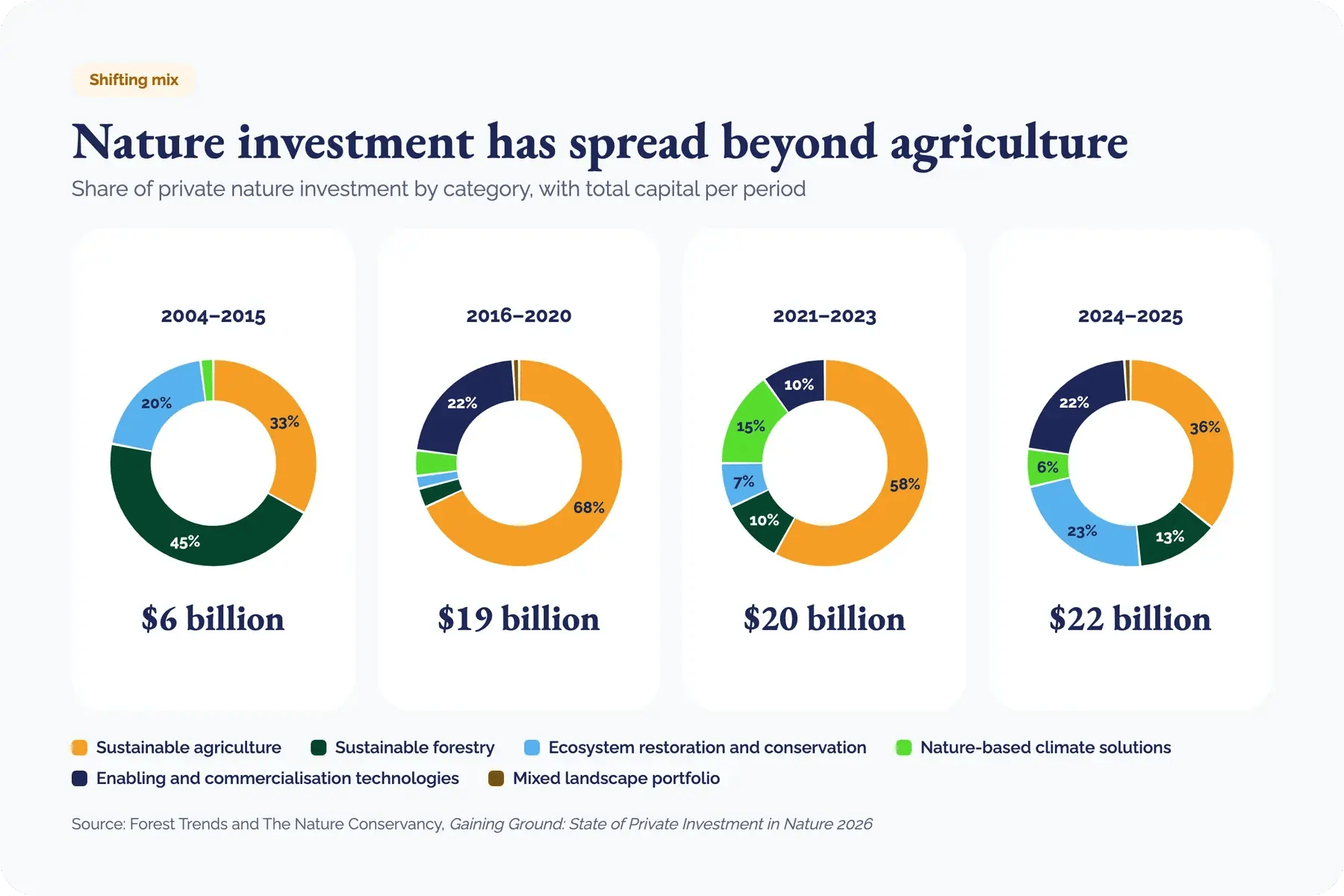 Share of private nature investment by category, 2004–2025. Source: Forest Trends and The Nature Conservancy.
The report identifies four areas drawing new capital. Ecological restoration in the United States has become a pension-grade asset, supported by clear regulatory demand for wetland and stream credits. Ecosystem Investment Partners backed a single US pension in 2016. Today it has at least 10 pensions committed across 5 funds.
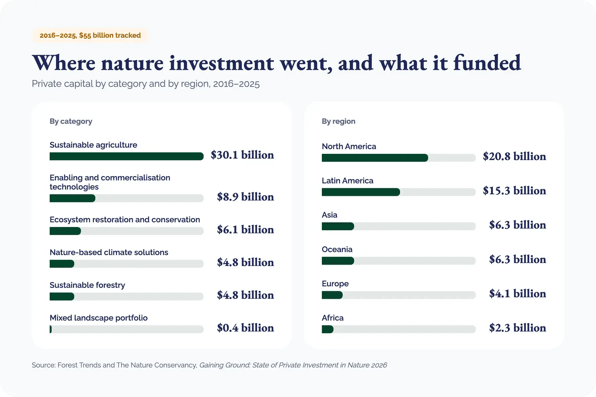 Private capital in nature by category and by region, 2016–2025. Source: Forest Trends and The Nature Conservancy.
Latin America has attracted 28% of global nature capital over the decade. In April 2026, BTG Pactual’s Timberland Investment Group closed a $1.24 billion fund for the region — the largest reforestation fund of its kind — with around 133,500 hectares set aside for restoration with native species and long-term protection.
Read more: How decarbonisation is becoming a competitive advantage
Regenerative agriculture is emerging as the next opportunity within farmland, an asset class investors already favour for its stability. Deal volume in sustainable agriculture more than tripled after 2020, and investment doubled from $10.8 billion to $22.2 billion.
Institutional capital’s arrival may be the clearest signal in the data. Average deal sizes led by institutional investors rose from $70 million in 2017 to $167 million in 2025. “We’re seeing a stronger presence of institutional capital who see that nature impact and financial performance can go hand-in-hand,” said Michael Jenkins, CEO of Forest Trends.
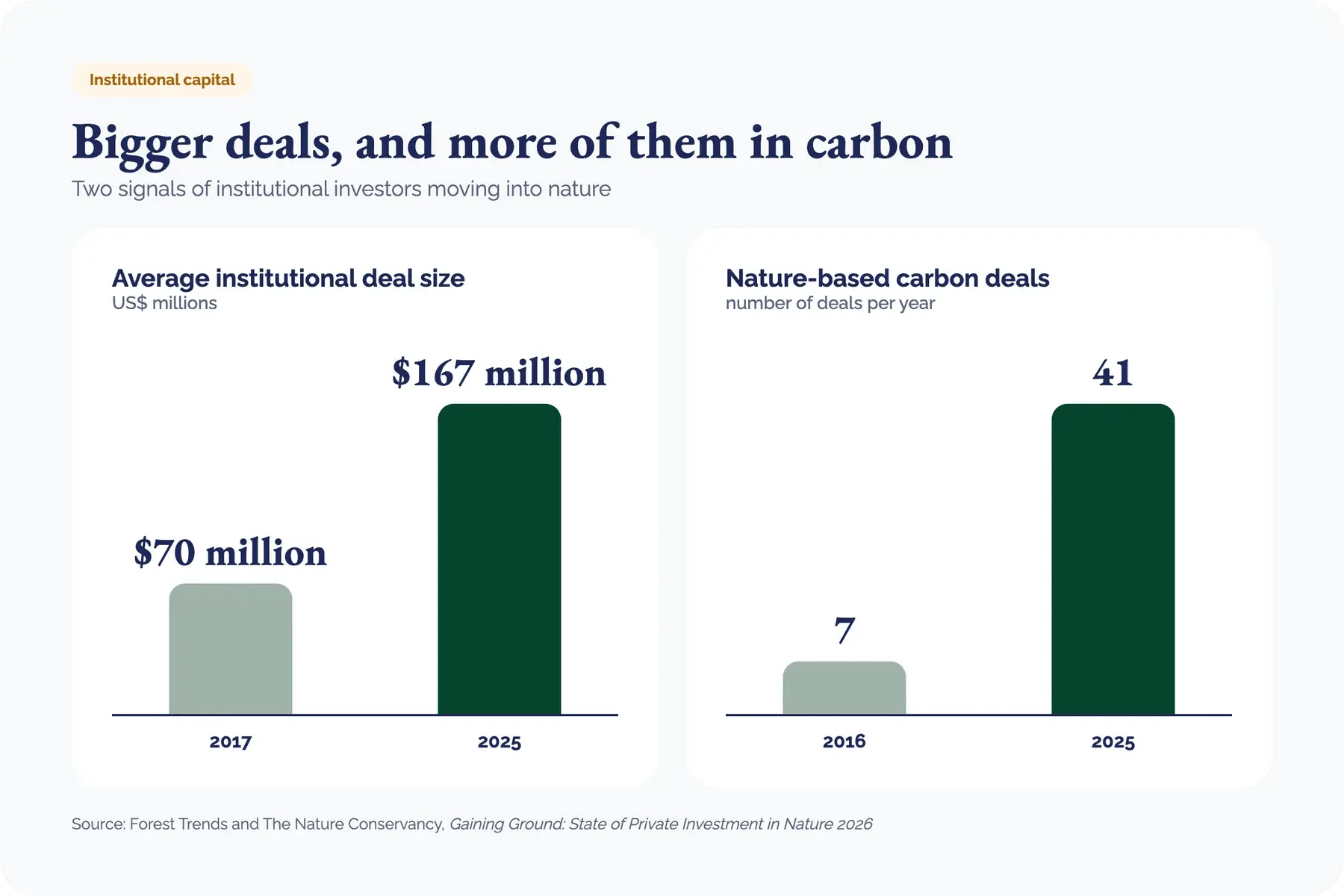 Average institutional deal size and the number of nature-based carbon deals, then and now. Source: Forest Trends and The Nature Conservancy.
Nature-based carbon is drawing steadier institutional interest, with deal count rising from 7 in 2016 to 41 in 2025. The demand outlook is strengthening: the Carbon Offsetting and Reduction Scheme for International Aviation (CORSIA) enters its mandatory phase in 2027, and the Science Based Targets initiative requires signatories to purchase carbon credits from 2035 to address residual emissions. The supply of high-quality credits remains comparatively thin.
Read more: Net zero needs nature: a carbon credit guide
As the business case for reducing emissions strengthens, demand for credible, nature-based carbon credits grows alongside it. Even disciplined decarbonisation leaves hard-to-abate emissions, and businesses preparing for this shift need a dependable supply they can stand behind: credits that are verified, traceable, and backed by real environmental results. Green Earth provides that supply, giving businesses access to high-integrity carbon credits from nature-based carbon projects that restore ecosystems and support local communities, so you can meet rising expectations for quality with confidence.