
Sustainability
Nature-based solutions
Nature restoration

Every $1 invested in cutting emissions and improving air quality together can return around $15 in economic benefits, according to a new assessment from the UN Environment Programme (UNEP) and the Climate and Clean Air Coalition (CCAC). Published on 7 September, Hidden assets: The economic and health case for climate and clean air action is the first comprehensive global economic assessment of the two challenges tackled as one.
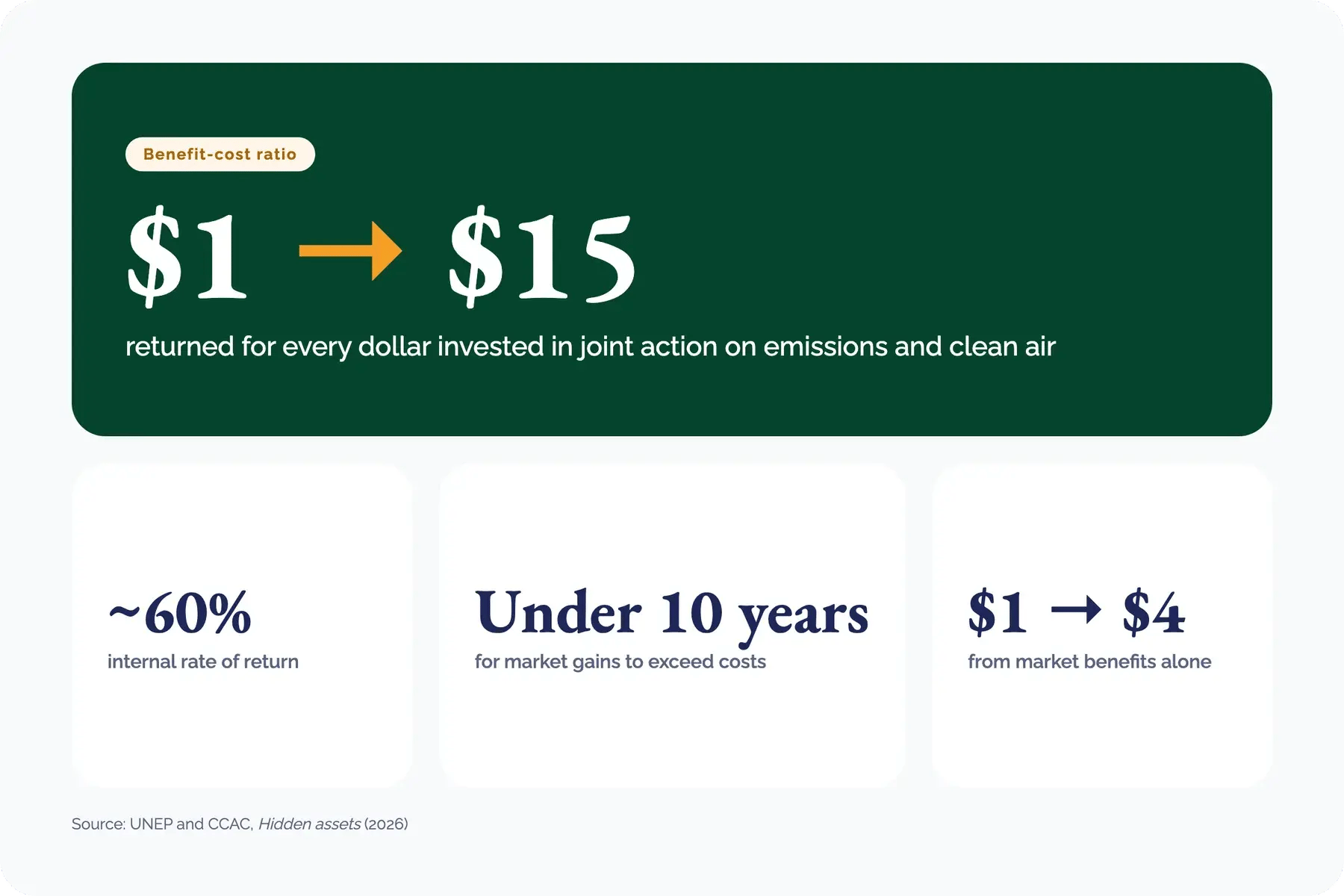 Every $1 invested in joint action on carbon emissions and clean air can return around $15. Source: UNEP and CCAC.
The return holds across a package of 25 proven measures, delivering benefits worth 2.8% of global GDP in 2035, rising to 4.5% by 2050 and 11.4% by 2100. The assessment puts the internal rate of return at about 60%, with market gains alone exceeding implementation costs within a decade. Even setting aside non-market welfare benefits, every $1 invested returns around $4.
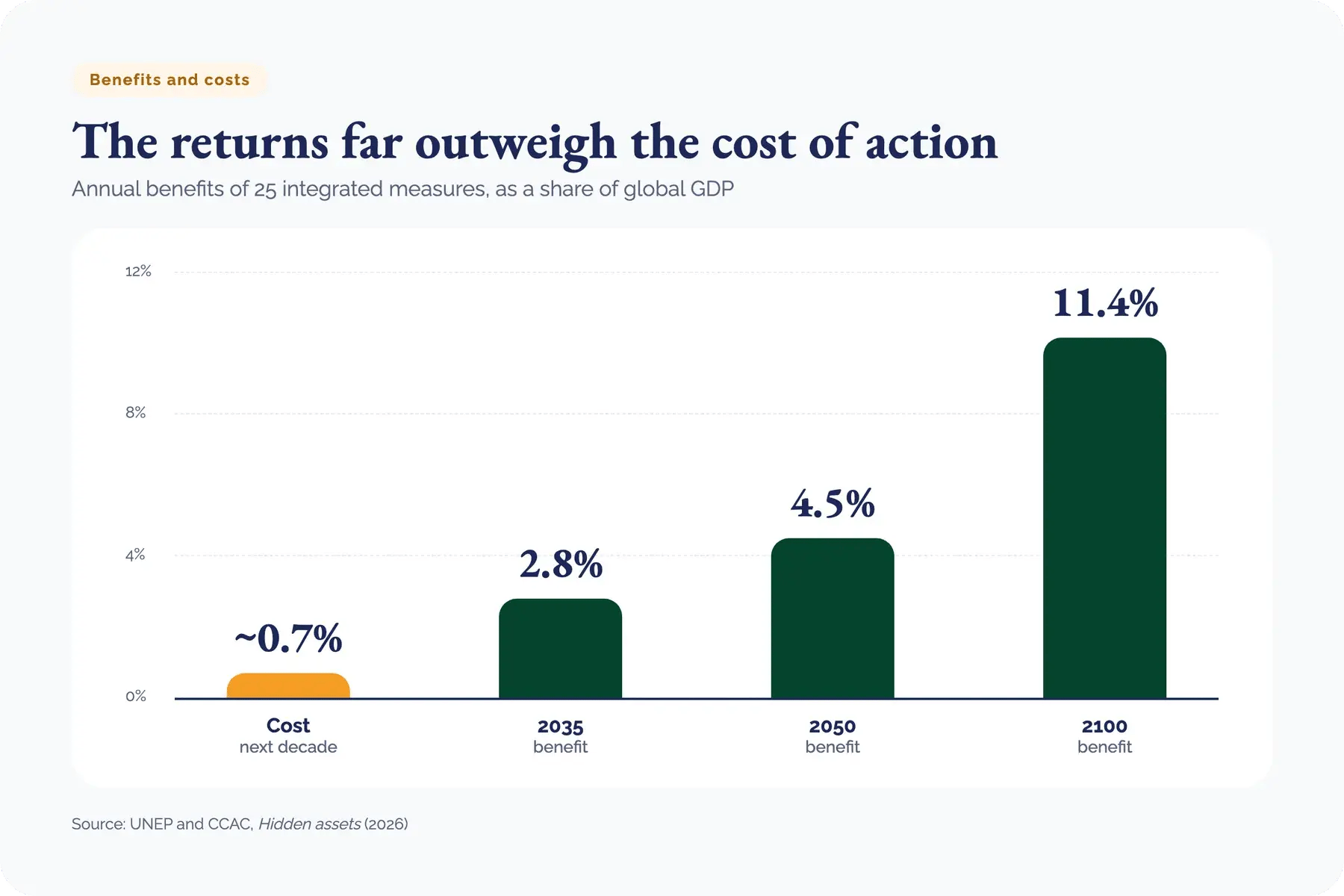 Annual benefits as a share of global GDP compared with the cost of action. Source: UNEP and CCAC.
The 25 measures span six sectors: energy and fossil fuel systems, industry, transport, agriculture and food systems, residential cooking and heating, and waste management. They combine long-term emissions reductions with targeted action on super pollutants such as methane, black carbon, and hydrofluorocarbons (HFCs), from renewable power and cleaner cooking to tighter vehicle standards, better fertiliser use, and improved waste management.
Read more: Beyond tonnes: How carbon credit co-benefits elevate value
For too long, we have treated climate action as a cost to be managed and air pollution as the unfortunate outcome of development. This report shows the opposite: clean air is a key driver of development, health, food and energy security, and climate stability – an asset we must invest in.
Inger Andersen, Executive Director of UNEP.
The health returns are central to the case. Full implementation of the measures could prevent 144 million premature deaths linked to air pollution by 2050, alongside hundreds of millions of cases of chronic disease. The assessment is the first to factor in the wider economic weight of air pollution-related illness, from pressure on health services to lost labour productivity. In 2025, exposure to outdoor air pollution was linked to an estimated 6.4 million premature deaths worldwide.
The environmental gains are equally clear. Set against the assessment’s baseline, immediate action would halve global carbon dioxide (CO2) emissions by 2050, cut methane by 60%, and reduce major air pollutants by around 70%. Together, the measures would avoid around 0.34°C of warming by 2050 and 1.4°C by 2100.
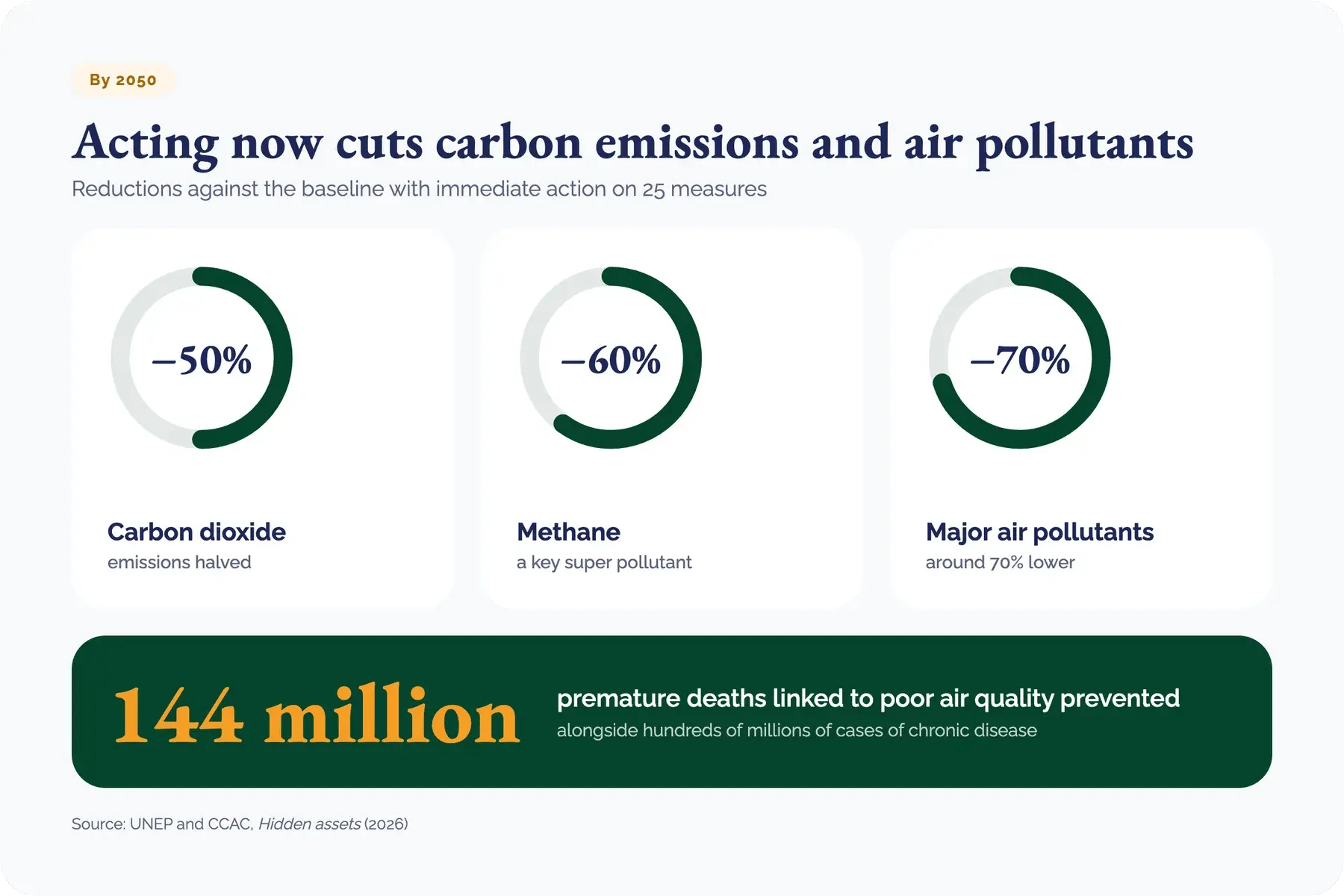 Projected reductions by 2050 with immediate action on 25 measures. Source: UNEP and CCAC.
Acting early carries the greatest reward. Each year of delay forgoes more than US$1.5 trillion in benefits, and institutional barriers risk pushing full implementation back by almost eight years. The assessment closes with a call for better alignment of public and private finance to close that gap.
Read more: New study shows the significant returns of investing in nature
As the business case for cutting emissions strengthens, demand for credible, nature-based carbon credits grows alongside it. Even disciplined decarbonisation takes time and leaves hard-to-abate emissions, while the supply of genuinely high-integrity credits is limited: verification, permanence, and real community benefit take years to establish, and demand is rising faster than new supply becomes available.
Businesses that move early secure a dependable, traceable supply they can stand behind. Green Earth provides that supply today, with high-integrity carbon credits from nature-based carbon projects that restore ecosystems and support local communities, so you can meet rising expectations for quality with confidence.