
Carbon credits
Sustainability
Carbon compensation
TotalEnergies spent $30 million on carbon credits in the third quarter of 2026. The figure appears under "Expenditures related to carbon credits" in the French energy company's third-quarter results, published on 29 October 2026. It is the company's largest third-quarter spend since it began buying credits in 2021.
The result marks a strong return to buying. Spending stood at $28 million in the first quarter and $1 million in the second, bringing the total for the first nine months of 2026 to $59 million. A year earlier, in the third quarter of 2025, the company spent $2 million.
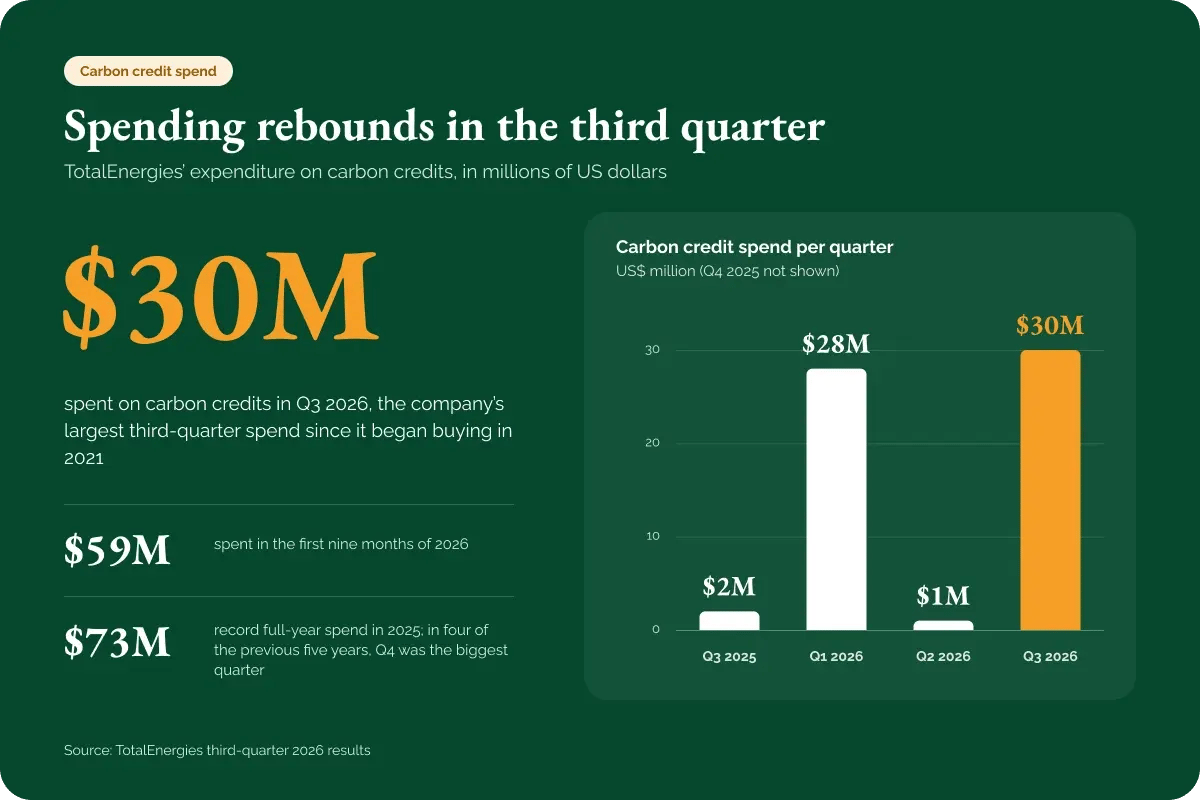 Spending rebounds in the third quarter infographic.
Year-end buying shapes the pattern. In four of the previous five years, TotalEnergies recorded its largest quarterly carbon credit spend in the final three months of the year. Full-year spending reached a record $73 million in 2025.
Read more: TotalEnergies posts record Q1 carbon credit spend
The purchases feed a long-term portfolio strategy. TotalEnergies aims to build a book of 50 million tonnes of CO₂ equivalent (tCO₂e) in carbon credits by 2030. It had bought 17.9 million credits by the end of 2025, according to its annual ESG reporting. That leaves around 32.1 million tCO₂e to secure between 2026 and 2030, or roughly 8 million a year.
The company targets a portfolio delivering at least 5 million tCO₂e of credits a year by 2030. It plans to use these credits "from 2030 onwards to voluntarily offset part of its remaining direct Scope 1 & 2 emissions", according to a July 2025 company release. The strategy supports its goal of net zero by 2050.
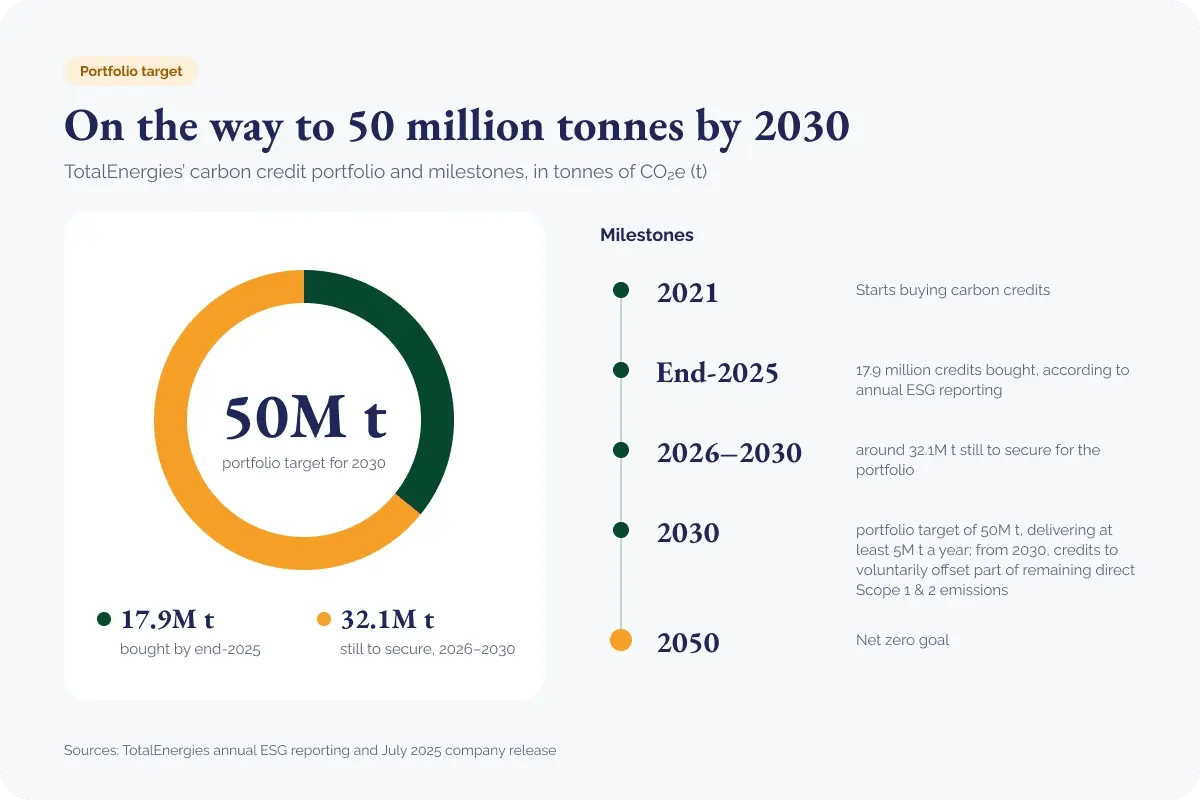 On the way to 50 million tonnes by 2030 infographic.
Nature-based projects sit at the centre of this pipeline. In July 2025, TotalEnergies partnered with a US developer on 13 improved forest management (IFM) projects. They cover 100,000 hectares owned by more than 280 family forest landowners in Arkansas, Louisiana, Mississippi, and Tennessee. The company plans to invest $100 million a year to build its nature-based solutions portfolio.
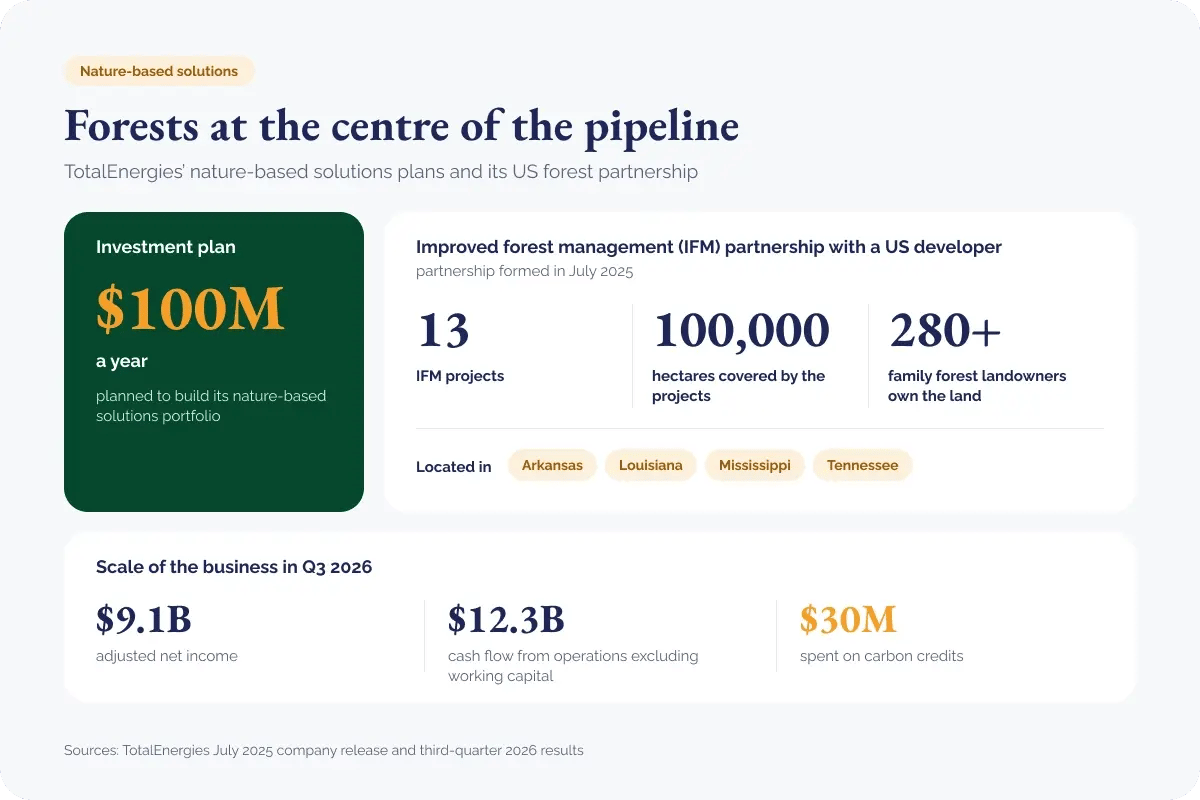 Forests at the centre of the pipeline infographic.
The same results show the scale of the business behind this buying. TotalEnergies reported third-quarter adjusted net income of $9.1 billion and cash flow from operations excluding working capital of $12.3 billion.
Read more: Carbon footprint offsetting strategies: How leading companies neutralise their emissions
TotalEnergies' portfolio target turns a long-term commitment into steady, recurring demand for nature-based credits, with around 8 million tCO₂e still to secure each year to 2030. Green Earth operates at the supply end of this demand as an end-to-end developer of nature-based carbon projects, with oversight from project design through to credit issuance. For businesses building their own compensation strategy, Green Earth's verified carbon credits link each tonne to measurable benefits for ecosystems and the communities that depend on them.