
Carbon sequestration
Nature restoration
Carbon trading
Google

Google and McKinsey have contracted 320,000 tonnes of carbon removal credits in a recent deal signed over 10 years. The offtake agreements, signed through the Symbiosis Coalition and announced on 19 October 2026, will finance the restoration of 8,700 hectares of degraded and semi-degraded pasture in Brazil.
 Google and McKinsey’s offtake at a glance infographic.
The restored land forms part of a 50,000-hectare project spanning the south-eastern Amazon and the central Cerrado. Google accounts for 270,000 tonnes of the total, according to its own announcement. The purchase price and delivery schedule remain undisclosed.
The Symbiosis Coalition is an advance market commitment launched in 2024 by corporate buyers of nature-based carbon removal. It aims to contract up to 20 million tonnes of carbon removal credits by 2030.
Read more: Nature-based methods lead new wave of carbon standards
Silvopasture integrates trees into active grazing land. The targeted project will plant rows of native and commercial timber species on working pastures, so cattle grazing continues alongside restoration. Ranchers gain additional income from timber and carbon revenue. The trees provide shade for cattle and improve soil health and drought resilience.
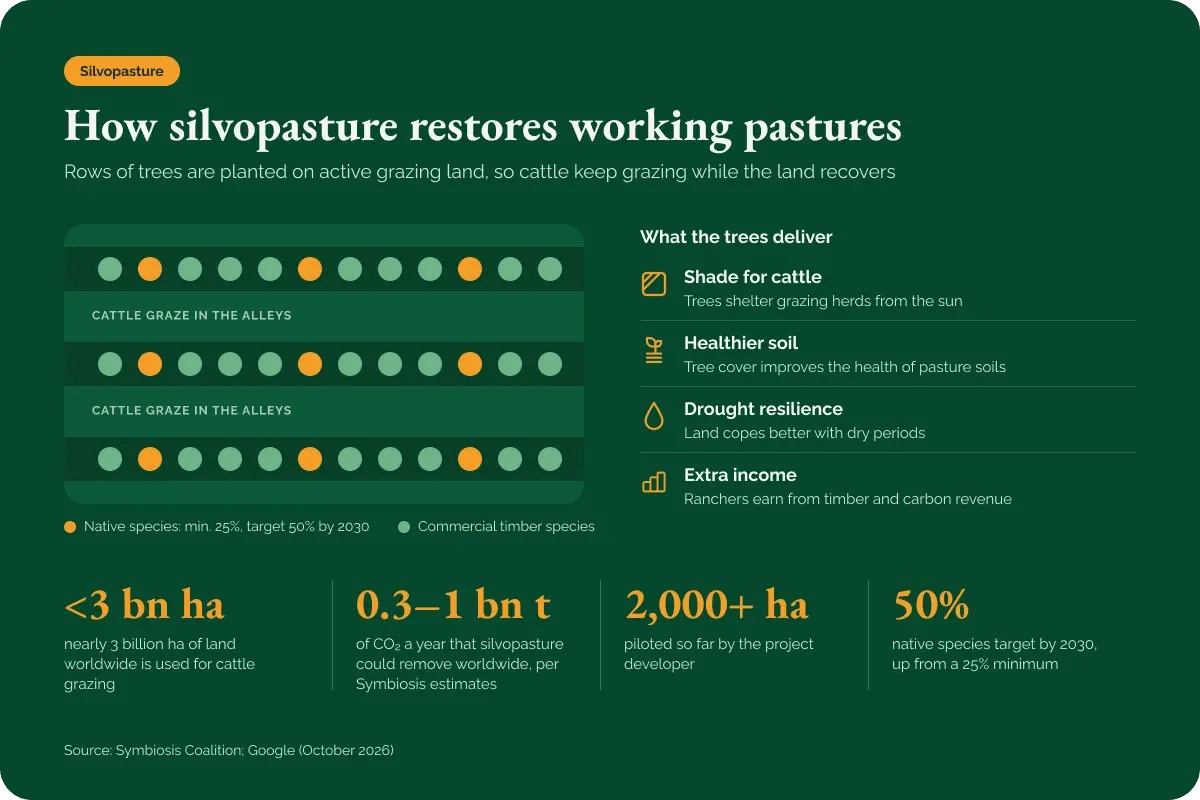 How silvopasture restores working pastures infographic.
The wider opportunity is large. Cattle grazing covers nearly 3 billion hectares globally, and Symbiosis estimates that silvopasture could remove 0.3 to 1 billion tonnes of CO₂ a year worldwide. The project developer has piloted the approach across more than 2,000 hectares. The project aims to raise the share of native species from a minimum of 25% to 50% by 2030.
Julia Strong, Executive Director of the Symbiosis Coalition, described silvopasture as "one of the most underused tools we have for nature-based carbon removal". Isabelle Schuhmann, Global Director of Environmental Sustainability at McKinsey & Company, pointed to the value of "unlocking large carbon sinks while strengthening the resilience of local economies".
Read more: Carbon farming: How it's good for the environment, farmers and biodiversity?
Decade-long contracts of this size show corporate buyers committing to nature-based removals that restore working land at landscape scale. Green Earth operates in this segment as an end-to-end developer of nature-based carbon projects, including agroforestry, with oversight across the full supply chain. For businesses planning their compensation strategy, Green Earth’s verified credits pair carbon removal with measurable benefits for ecosystems and the communities that depend on them.