
Carbon offsetting
Carbon credits
CORSIA
Trading and buying activity under the Carbon Offsetting and Reduction Scheme for International Aviation (CORSIA) is building. Prices for credits eligible in the scheme’s first phase reached their highest level since April this week, and trading in the futures market set a fresh record.
The CORSIA Phase 1 (CP1, 2024–2026) December 2026 assessment added $0.05 on Tuesday to reach $13.15 per tonne of CO₂ equivalent (tCO₂e), with the December 2027 assessment at the same level. Futures activity kept pace: open interest in CP1 contracts hit a record 2.5 million CORSIA Eligible Emissions Units (EEUs), two months after first passing 1 million. On 29 September, single-day volume reached its highest since the contract launched, at 358,000 EEUs, part of a record week of 1.2 million EEUs.
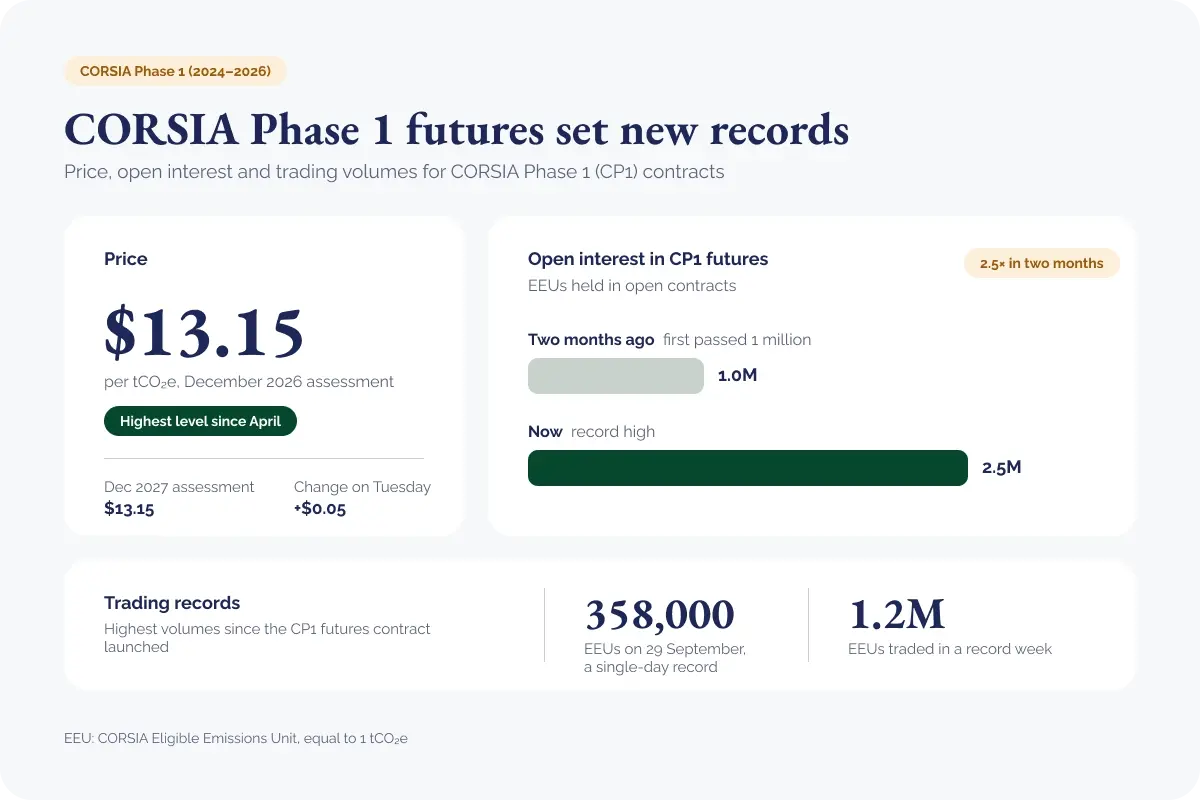 CORSIA Phase 1 futures set new records infographic.
The activity coincides with the 10th anniversary of CORSIA’s adoption. The International Civil Aviation Organization (ICAO), the UN body that oversees the scheme, urged member states and stakeholders to “renew and strengthen their commitment to CORSIA”.
Read more: Cargo airline logs its first CORSIA retirement
New airlines continue to enter the compliance market. Malaysia Aviation Group, parent of Malaysia Airlines, retired around 70,000 credits from Cambodian and Rwandan clean cookstove projects, and South Korean budget carrier Trinity Airways made its first retirements at 20,000 tCO2e. The two join Singapore Airlines, Japan Airlines, and Thai Airways among Asian carriers using CORSIA. Corporate buyers remain active across the wider market, led by EY with 649,000 tCO2e spanning forestry, agriculture, and methane projects. Salesforce, Nestlé, and Microsoft each added further volumes.
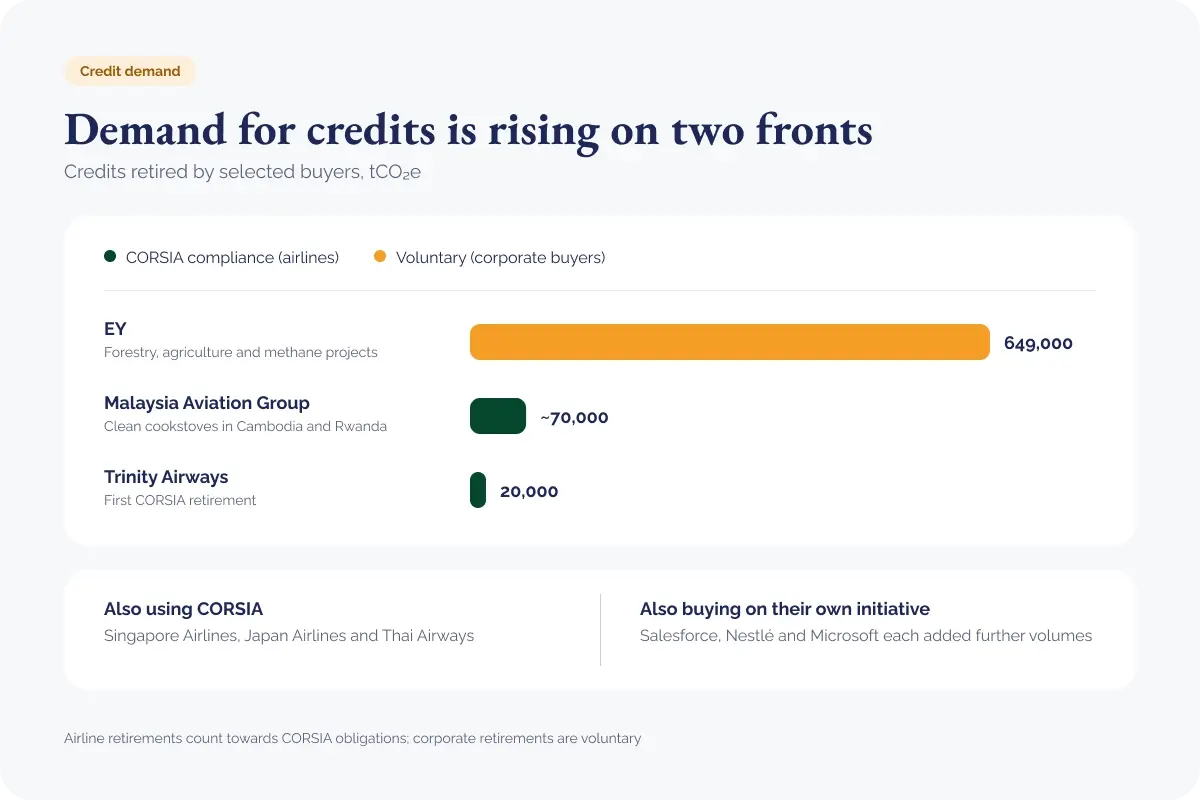 Demand for credits is rising on two fronts infographic.
Supply is widening too. Chile is updating its carbon market regulations to authorise developers to sell credits to airlines under CORSIA and to Singapore under Article 6 of the Paris Agreement. “We are looking to change that to authorise it,” a Chilean official said. The government has in principle cleared developers in reforestation, soil carbon, and forest conservation to sell to international buyers, opening nature-based projects to the scheme ahead of COP31 in Antalya this November. A Chilean developer put a possible sale price into Singapore at $35 per tonne, with other sources pointing to around $28 as more realistic.
The European Commission has set the timing for its final rules on which credits EU airlines can use. The expected adoption of the Implementing Act now sits in the first quarter of 2027, moved back from the final quarter of this year. European airlines bought limited volumes of EEUs during CP1, and clearer rules would give them a firmer signal to buy. One adviser on EU and UN aviation policy expects the direction to become clear once a draft appears: “There will be no reason for airlines to delay buying.”
Read more: Net zero needs nature: a carbon credit guide
This week’s activity shows demand rising on two fronts at once: airlines meeting compliance obligations under CORSIA, and companies buying on their own initiative. Verification, permanence, and genuine community benefit take years to build, and demand is now outpacing the arrival of new supply. Businesses that act early secure a dependable, traceable supply they can stand behind. Green Earth offers that supply today, with high-integrity carbon credits from nature-based projects that restore ecosystems and support local communities, so you can meet rising expectations for quality with confidence.