Farming
Agroforestry
Kenya
Project updates
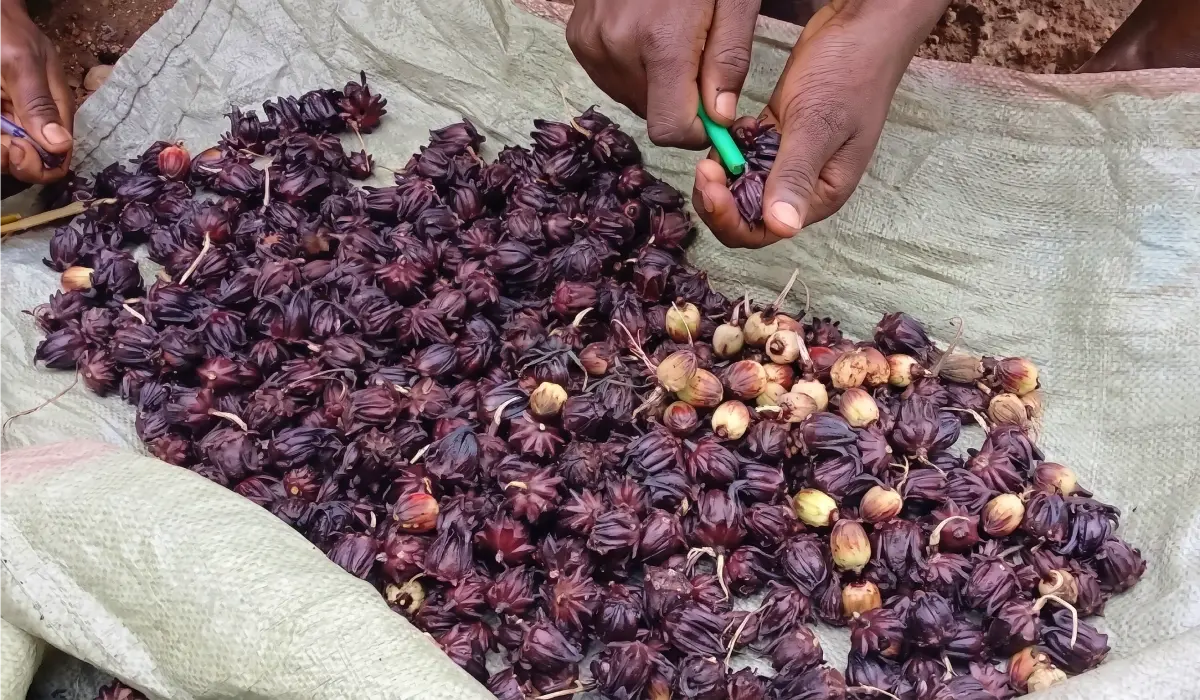
The roselle harvest is under way at the Bungoma food forest in western Kenya. Outside Malakisi in Bungoma County, the harvest team is clipping the ripe red flower cups (calyces) of roselle (Hibiscus sabdariffa) by hand, and picking will continue until March 2027. In the same area, farmers have brought in the Nyota beans they planted with Green Earth.
Roselle calyx being harvested, Bungoma food forest, Kenya, Green Earth.
Roselle is grown for its calyx, the fleshy red cup that wraps around the seed pod once the flower fades. The team cuts only the ripe calyces with secateurs and leaves the young buds on the plant to flower. Regular picking prolongs flowering, so the same plants keep producing for several months.
The calyces travel in gunny sacks to the farm store. There, the team pushes the hard seed pod out of each calyx by hand with the tip of a pen, then spreads the calyces out to dry in the sun. Dried calyces are used as the base of a red drink known as zobo in Nigeria, karkadé in Egypt and Sudan, sorrel in the Caribbean, and agua de Jamaica in Mexico.
Read more: Agroforestry explained: a guide to regenerative farming
In parallel, farmers harvest their Nyota beans as dry pods and threshes them by hand on a tarpaulin. Threshing means beating the dried pods with a stick until they split and the beans fall loose. Winnowing comes next: The beans are tossed or poured using airflow, which separates off the light husks, known as chaff, from the heavier beans, which are then ready for planting in bags.
Nyota beans being processed, Bungoma food forest, Kenya, Green Earth.
Nyota is a bean variety developed by the Kenya Agricultural and Livestock Research Organization (KALRO) and released in 2017. Its name means “star” in Kiswahili, Kenya’s national language. It is rich in iron and zinc and ready to harvest 65–75 days after planting. As a legume, the bean also adds nitrogen to the soil through bacteria in its roots, which feeds the trees and crops growing alongside it.
The Bungoma food forest is part of Green Earth’s wider agroforestry work in Kenya. It covers approximately 8 hectares (20 acres) across 21 registered plots (as of August 2026). The system layers crops by how long they take to produce. Coffee and fruit trees form the long-term layers, and quick crops such as beans and roselle supply harvests through the seasons as the trees grow.
Read more: Bungoma food forest readies its plots for the short rains
Together, the two harvests show the food forest model at work. Each layer produces at a different time of year, which spreads a farmer’s risk across crops and seasons. Steady harvests give farmers a lasting reason to maintain their land and its trees, and that permanence underpins long-term carbon storage in agroforestry.
Green Earth develops its agroforestry projects end to end, from planting with farmers through to harvest. Our nature-based solutions in Kenya and Uganda combine productive farmland, stable farmer livelihoods, and tree cover that stores carbon. Businesses can support this farmer-led approach to restoring land through our verified agroforestry carbon credits.