
Carbon credits
Investment
cop31
Countries closed COP31 in Antalya, Türkiye, on 22 November with a carbon credit pipeline worth $70.9 billion on the table. The State of the Article 6 Carbon Market 2026 report, released at the summit on 13 November, puts known supply under Article 6 of the Paris Agreement at 2.36 billion tonnes by 2030. Governments have contracted about 53 million tonnes of that supply, valued at about $1.6 billion at the report's assumed price of $30 per tonne.
The summit ran nearly 50 hours past its scheduled end, the longest COP on record. Parties adopted decisions on carbon markets, the Just Transition Work Programme, the Adaptation Fund and transparency. The overarching cover text was set aside after the EU, Panama, the Marshall Islands and other countries rejected the final draft.
On carbon markets, parties took note of technical reviews of national Article 6.2 reports and requested a technical paper on fees and funding arrangements. The Adaptation Fund completed its transition to serve the Paris Agreement, which gives it access to a share of proceeds from the Article 6.4 crediting mechanism.
Read more: Article 6 credit pipeline set to reach $70.9 billion by 2030
Political backing for credit markets broadened. The Antalya Statement on growing carbon credit markets now has 17 supporting countries, after Colombia, Ghana and Peru signed during the summit, according to the Coalition to Grow Carbon Markets. The coalition, co-chaired by Kenya, Singapore and the UK, reached 18 member countries, with Colombia and the Philippines among the latest to join.
Grace Fu, Singapore's Minister for Sustainability and the Environment, said: "The Antalya Statement is a key outcome of COP31."
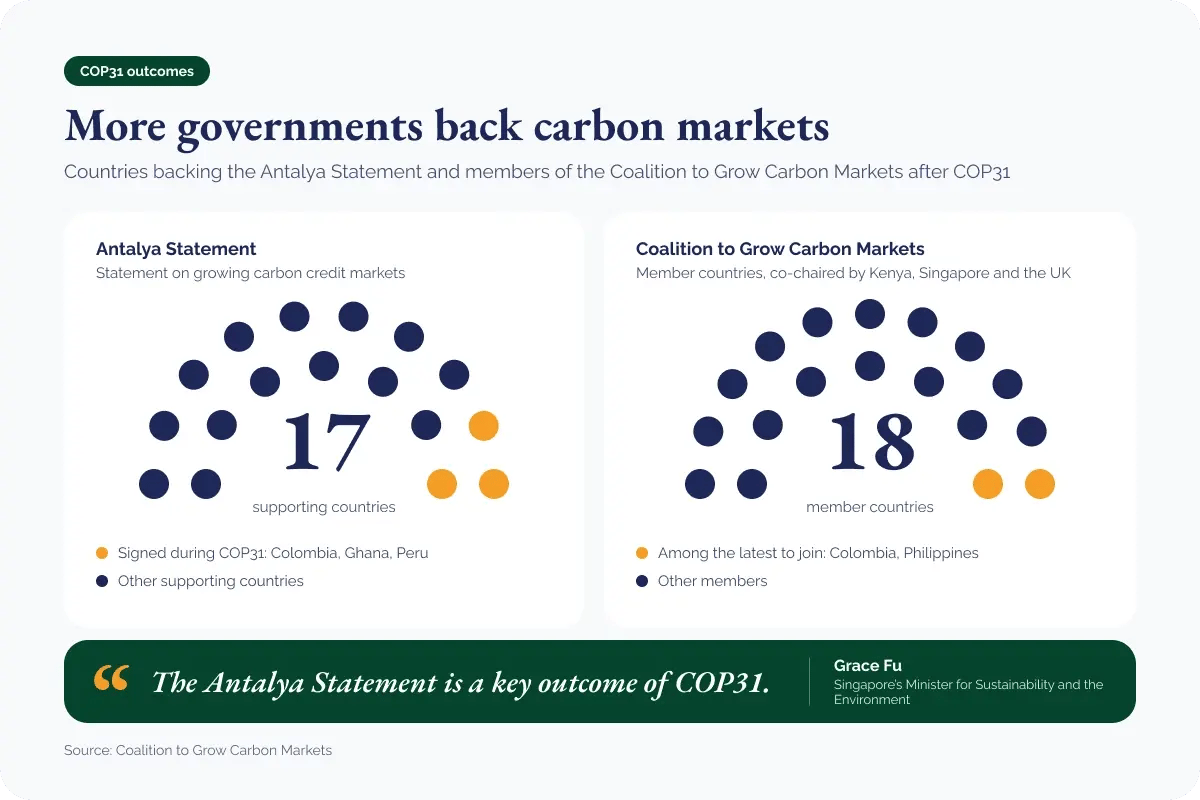 More governments back carbon markets infographic.
Sovereign purchase deals added volume. Norway signed an Article 6.2 agreement to buy up to 12 million tonnes of emission reductions from Indonesia over 10 years, supporting a shift from coal to solar power. Ghana received 6.57 million jurisdictional forest credits under the ART TREES standard, with about $43 million in initial payments expected from buyers including the LEAF Coalition.
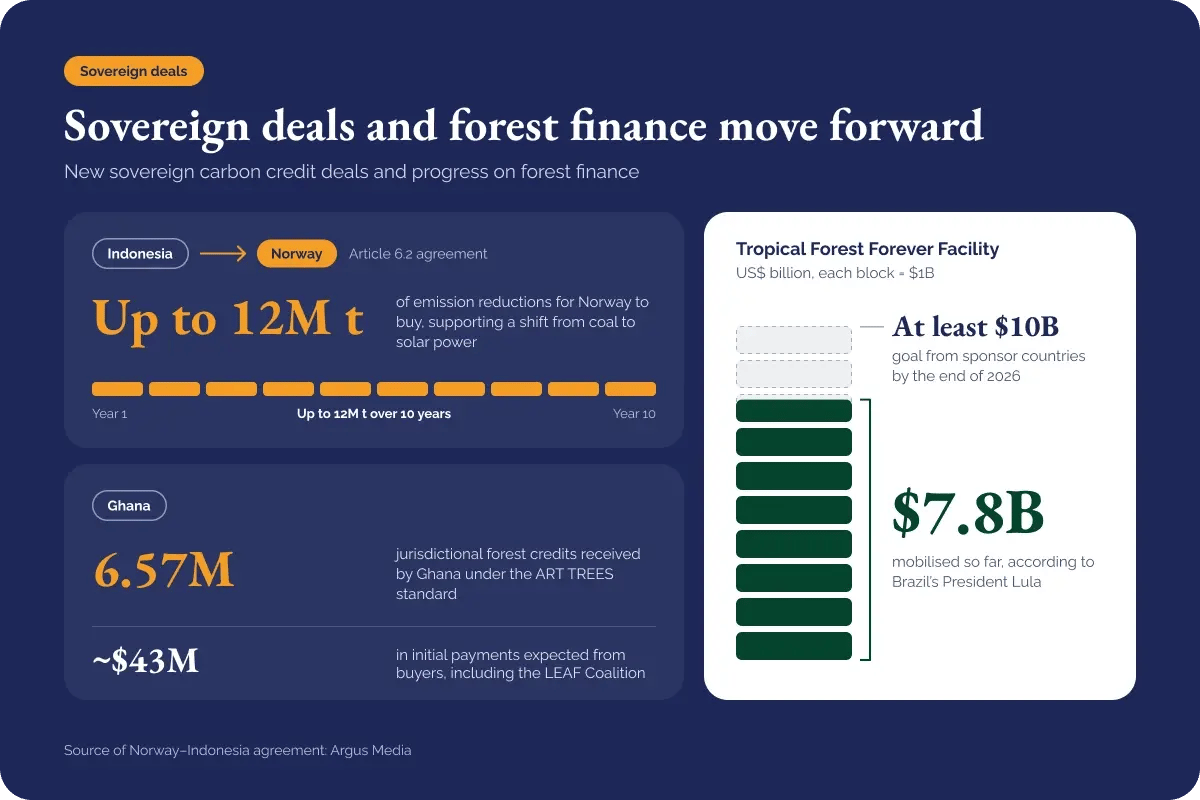 Sovereign deals and forest finance move forward infographic.
Forest finance also moved forward. The Tropical Forest Forever Facility has mobilised $7.8 billion, according to Brazil's President Lula, against a goal of at least $10 billion from sponsor countries by the end of 2026. Lindy Fursman, Executive Director of the Coalition to Grow Carbon Markets secretariat, said: "COP31 has marked a decisive turning point for carbon credit markets."
Read more: Exploring Article 6.4 of the Paris Agreement: a post-COP29 analysis
COP31 widened the group of governments ready to buy, authorise and champion carbon credits, from new sovereign deals to an 18-member coalition. Green Earth manages its nature-based carbon projects from design through to credit issuance, creating the verified supply these frameworks depend on. Businesses shaping a compensation strategy can source credits that deliver measurable benefits for forests, biodiversity and local communities.