
Voluntary Carbon Market
Paris Agreement
Article 6
COP29
The approval of Article 6.4 during COP29 in Baku marks a turning point for global environmental action. As part of the broader Article 6 framework under the Paris Agreement, this mechanism establishes a United Nations-supervised global carbon market, providing a system for countries and private entities to trade verified emissions reductions and removals. This milestone comes at a critical juncture for international carbon markets, which have faced growing scrutiny over credit quality and transparency.
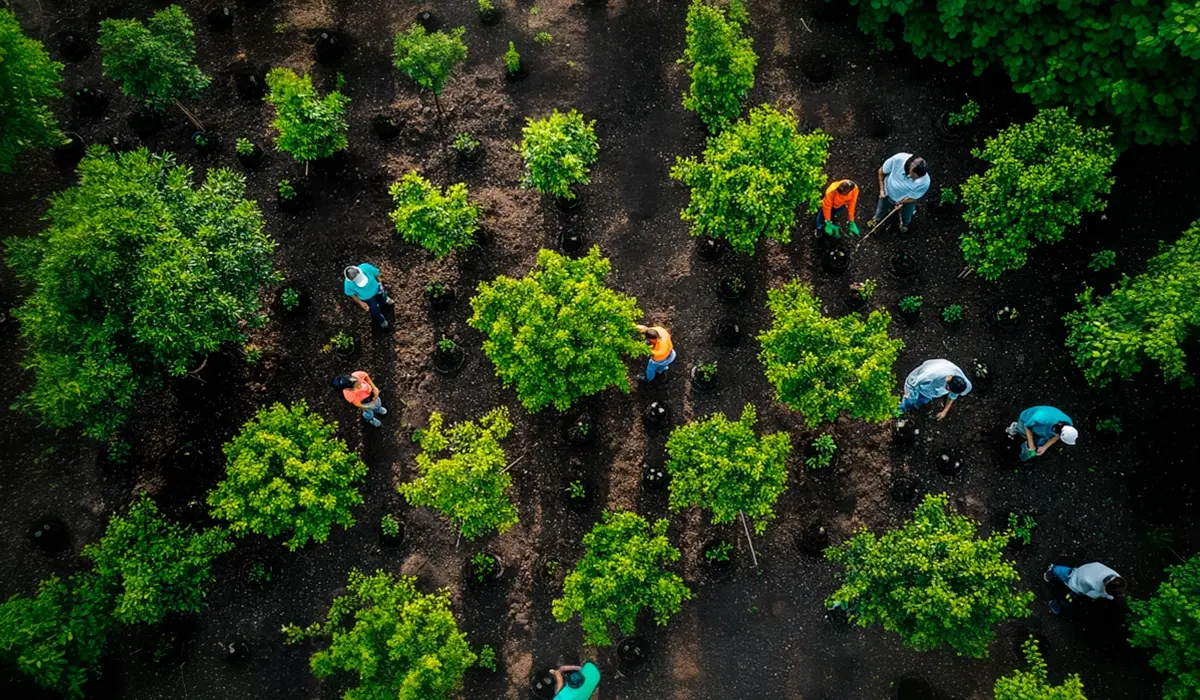
 An aerial view showcasing participants engaged in a tree-planting event in a park. AI generated picture.
In this blog, we’ll delve into the mechanics of Article 6.4, highlight the progress achieved at COP29, and explore the implications for nature-based solutions (NCS)—a critical, yet underfunded, tool for mitigating climate change.
Understanding Article 6 and its three mechanisms
Article 6 of the Paris Agreement provides a framework for countries to collaborate on achieving their environmental goals. Its three mechanisms are:
- Article 6.2: Supports bilateral and multilateral agreements through the transfer of Internationally Transferred Mitigation Outcomes (ITMOs). This allows countries to trade emissions reductions directly, following their own policies.
- Article 6.4: Establishes a centralised global carbon market to support verifiable emissions reduction projects, enabling nations to trade standardised carbon credits, referred to as Article 6.4 Emissions Reductions (A6.4ERs).
- Article 6.8: Focuses on non-market approaches, such as technology transfer and capacity building, enabling countries to support each other’s nature-centric efforts without the need for credit trading.
 A distant satellite image capturing the Earth from space. AI generated picture.
The mechanism outlined in Article 6.4 stands out for its ambition to operationalise a global carbon market, offering a standardised framework with the potential to address issues of transparency, quality, and trust that have plagued voluntary markets.
Read more: Carbon footprint measurement: a practical guide
The role of Article 6.4: building a global carbon market
Article 6.4 introduces a mechanism for generating, trading, and utilising emissions reduction credits under the supervision of the United Nations. Its scope includes:
- A centralized system: Overseen by the Article 6.4 Supervisory Body, responsible for approving methodologies, accrediting verification bodies, and managing the registry for A6.4ERs.
- Global reach: Open to countries, companies, and even individuals, enabling a wide range of participants to engage in environmental action.
- Transparency and trust: The requirement for corresponding adjustments ensures that emissions reductions are not double-counted, bolstering the credibility of carbon credits.
- Mandatory contributions: Mechanisms like the Share of Proceeds (SOP) and Overall Mitigation of Global Emissions (OMGE) ensure adaptation funding and net emissions reductions globally.
This mechanism aims to drive financial flows from high-emitting economies to countries with underutilised carbon sinks, fostering equitable environmental action.
 A close-up of tree seedlings in soil bags, with many people planting trees in the background during an environmental action in the park. AI generated picture.
Achievements at COP29: progress on Article 6.4
COP29 in Baku marked a significant step forward for Article 6.4 with the approval of key standards for its implementation. These include:
- Operational guidelines: Clear methodologies for verifying emissions removals and assessing projects were finalised, paving the way for developers to begin registering projects.
- Alignment with voluntary markets: The standards align with existing initiatives like the ICVCM, creating a pathway for voluntary markets to integrate with compliance markets.
- Increased financial flows: By enabling standardised credit trading, Article 6.4 could channel significant funding toward developing countries, addressing a critical gap in environmental finance.
However, the negotiations were not without controversy. Procedural concerns were raised regarding the fast-tracking of standards, while disagreements over project eligibility, particularly for emissions avoidance and REDD+ activities, remain unresolved.
Linking Article 6.4 with nature-based solutions
Nature-based solutions are among the most promising tools for supporting nature restoration, yet they remain severely underfunded. Ecosystems like forests, wetlands, and grasslands currently absorb roughly 30% of global annual CO₂ emissions and have the potential to deliver up to one-third of the emissions reductions needed to keep global warming within 1.5–2°C.
The role of Article 6.4 in scaling nature-based solutions
- Increased investment: By providing a mechanism for standardised, verifiable credits, Article 6.4 can attract investment into nature-based projects that deliver both carbon and biodiversity benefits.
- Inclusion of REDD+ activities: Avoided deforestation and reforestation projects could gain traction under Article 6.4, addressing a critical area of emissions reductions.
- Overcoming barriers: The framework offers an opportunity to address concerns about permanence and additionality, which have historically limited NBS in carbon markets.
At COP29, negotiators deferred discussions on emissions avoidance activities under Article 6.4 to future meetings, leaving the door open for REDD+ and other NCS methodologies to be considered.
Read more: DGB’s Impact Investments, revolutionising responsible investing
Challenges ahead: bridging the gaps
While the approval of Article 6.4 standards marks a significant milestone, challenges remain:
- Unresolved disputes: Disagreements over project types and authorisation processes could delay the full operationalisation of the mechanism.
- Capacity building: Developing countries must build the infrastructure and capacity needed to engage with the global carbon market effectively.
- Trust in carbon markets: Ensuring that credits represent real, verifiable emissions reductions will be critical to restoring trust in carbon markets.
The road ahead for Article 6.4 and carbon markets
The implementation of Article 6.4 is poised to transform carbon markets, offering a more transparent and standardised framework for emissions reductions. For stakeholders like DGB Group, which focuses on nature-based solutions, this presents an opportunity to scale impactful projects that deliver both nature and biodiversity benefits.
 A Bulindi chimpanzee in its natural habitat within the forests of Uganda. Bulindi Chimpanzee Habitat Restoration Project, DGB.
To fully realise its potential, negotiators must prioritise:
- Approving methodologies for NCS and REDD+ activities to unlock their full potential.
- Strengthening transparency and monitoring requirements to ensure the integrity of carbon credits.
- Expanding access to finance for developing countries, enabling equitable participation in the global carbon market.
DGB Group pushing for greater transparency in the carbon market
The approval of Article 6.4 during COP29 represents a critical step toward achieving the goals of the Paris Agreement. By establishing a global carbon market, this mechanism promises to accelerate environmental action, foster international cooperation, and drive investment into underfunded areas like nature-based solutions.
As we look to the future, the success of Article 6.4 will depend on the collective effort of countries, companies, and organisations committed to high-quality nature solutions. At DGB Group, we remain dedicated to advancing sustainable projects that align with this vision, driving meaningful change for the planet.
Read more: DGB Group prepares for Article 6 approval in Kenya
At DGB, we provide comprehensive solutions to support your journey toward net zero and a more sustainable future. From detailed emissions reporting and energy-saving strategies to tailored carbon reduction plans and compensation options, we help you create a carbon strategy that fits your goals and budget.
Our large-scale, nature-based carbon projects go beyond offsetting emissions—they drive meaningful environmental and socio-economic change. By choosing DGB, you contribute to initiatives that restore ecosystems, enhance biodiversity, and support local communities, ensuring your sustainability efforts leave a lasting positive impact.
As a project developer, we connect you directly to your carbon offset initiatives, eliminating intermediaries and prioritising transparency and measurable outcomes. With DGB, your sustainability efforts are not just promises; they are impactful actions backed by reliability and integrity.
Let’s work together to address your sustainability challenges and unlock the benefits of environmental responsibility. Join us in creating a greener, more sustainable world—one project at a time.