
Carbon credits
Nature conservation
Nature-based solutions
Nature restoration
Carbon methodology development gathered pace in recent weeks, with three separate bodies approving new and revised standards for forestry, agroforestry, rice, and biochar projects across voluntary and national markets.
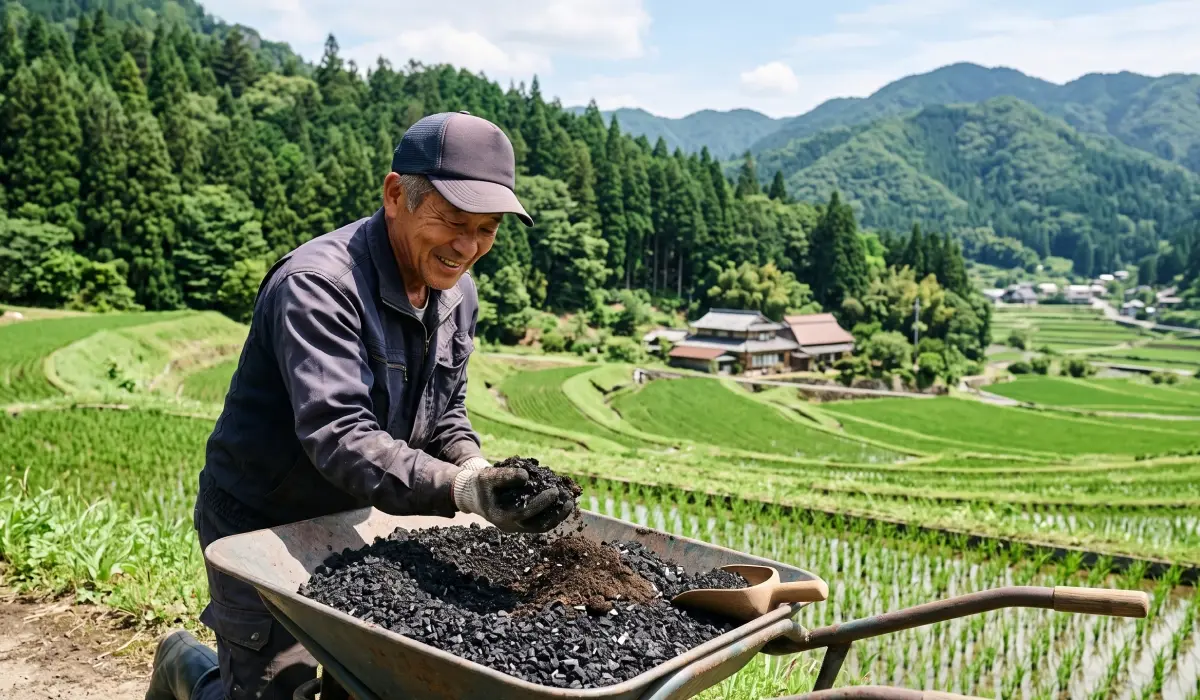
 A farmer applying biochar to agricultural land in Japan, with a beautiful rural landscape and forest in the background. AI generated picture.
The Integrity Council for the Voluntary Carbon Market (ICVCM), the main arbiter of carbon credit quality in the voluntary market, awarded its Core Carbon Principles (CCPs) quality label to four more methodologies. Two come from Verra, and one each from ACR and Isometric.
Under Verra's Verified Carbon Standard (VCS), the CCP label now covers VM0051, a rice methane reduction method, and VMR0016, which governs the flaring or use of landfill gas. VM0051 credits projects that improve water and crop management in flooded rice systems, replacing a Clean Development Mechanism method that Verra inactivated in 2023. It becomes the second rice methane methodology to earn a CCP label, following one from Gold Standard.
The label also extends to two land-based pathways: ACR's Improved Forest Management (IFM) on Non-Federal US Forestlands, which brings together silvicultural activities that raise the carbon stored in forests, and Isometric's Agroforestry Protocol, covering systems that support sustainable production, ecosystem services, and local livelihoods.
Read more: Gold Standard's new framework tackles ongoing emissions
Japan advanced its own crediting rules in parallel. The country released updated versions of five methodologies for its domestic J-Credit scheme, among them AG-004, which credits biochar applied to agricultural land. Version 2.6 adds guidance on verifying biochar application sites. The remaining revisions cover livestock feed, biomass fuel switching, high-efficiency refrigeration, and low-emission marine vessels.
Vietnam completes the trio with a national forest carbon standard. TCVN 14682:2026, the National Standard on Forest Carbon Credits, was issued by the Ministry of Science and Technology on 11 August 2026 and feeds credits into the Vietnamese emissions trading system (V-ETS).
“This standard serves as ‘the benchmark’ for developing and implementing carbon projects within the forestry and land-use sectors, facilitating the exchange and trading of carbon credits on the Vietnamese carbon market (V-ETS),” the Vietnam Forest Certification Centre said.
The standard covers REDD+, afforestation, reforestation, and improved forest management, and allows projects to generate both emission reductions and carbon removals.
Read more: Net zero needs nature: a carbon credit guide
Taken together, the three moves point to a maturing market. Forestry and land-use methods now sit at the heart of higher-integrity carbon standards across both voluntary and national schemes.
As demand grows for high-integrity carbon credits, the methodologies and standards behind every credit matter more than ever. Green Earth develops large-scale, nature-based carbon projects accredited by leading international standards, with full oversight of every stage of the project lifecycle — from design and implementation through to long-term monitoring and credit issuance. Our projects restore ecosystems, strengthen biodiversity, and improve community livelihoods, delivering verified environmental impact that stands up to scrutiny. For businesses meeting their environmental goals, that integrity is what counts.