
Sustainability
Carbon footprint
CSRD
Carbon compensation
SME

For most businesses, the emissions that matter most sit outside their own walls. Scope 3 emissions, everything generated across your value chain, from the suppliers who make your inputs to the customers who use your products, typically make up the majority of a company's total carbon footprint. Under the Corporate Sustainability Reporting Directive (CSRD), those value-chain emissions now have to be measured and disclosed with a rigour that spend-based estimates alone struggle to satisfy. This guide sets out how to improve Scope 3 data accuracy for CSRD: the calculation methods open to you, how to move from estimates to verified supplier data, and how to govern that data so it holds up to audit.
The through-line is simple: accurate measurement comes first, and for Scope 3 that means moving steadily from broad estimates towards real supplier data. Scope 3 emissions dominate most corporate footprints, so getting them right is central to CSRD compliance and any credible reduction plan. The main barriers are predictable — supplier data gaps and inconsistent methodologies across the value chain — and the fix is a deliberate progression through spend-based, activity-based, and supplier-specific data, prioritised by where your emissions actually sit. Embedding emissions requirements into procurement, applying strong data governance, and measuring your footprint with an audit-ready tool such as CO₂ Expert turns a compliance obligation into reliable, decision-grade information.

Why Scope 3 data accuracy matters for CSRD compliance
Scope 3 emissions represent everything that happens beyond your direct operations: the footprint of your suppliers, the transport of your products, and the emissions generated when customers use what you sell. For most businesses, this category is the largest part of the total — in many cases over 70%, and sometimes even more than 90%.
 Aerial view of a distribution warehouse, highlighting the logistics operations that contribute to Scope 3 emissions across the value chain. AI generated picture.
Under the Corporate Sustainability Reporting Directive (CSRD), companies must disclose detailed information about their value-chain emissions, including what proportion of reported Scope 3 data comes from primary data rather than secondary estimates, that is, from real, source-specific measurements such as a supplier's own reported figures, rather than industry averages. Regulators and investors now look closely at how those numbers are produced.
Getting Scope 3 data right does more than satisfy compliance. It shows where your real environmental impact sits and points to the most effective opportunities for reduction. Accurate data is what makes a meaningful target possible, and what lets you track genuine progress towards it.
Read more: Why scope 3 emissions are your biggest blind spot—and what to do about it
What are Scope 3 emissions, and how do they differ from Scope 1 and 2?
The GHG Protocol Corporate Value Chain Standard divides emissions into three groups. Scope 1 covers direct emissions from sources you own or control, such as company vehicles and on-site fuel use. Scope 2 covers indirect emissions from purchased energy, mainly electricity and heat. Scope 3 captures everything else across your value chain — organised into 15 categories spanning upstream activities (purchased goods, capital equipment, business travel) and downstream activities (product distribution, customer use, end-of-life treatment).
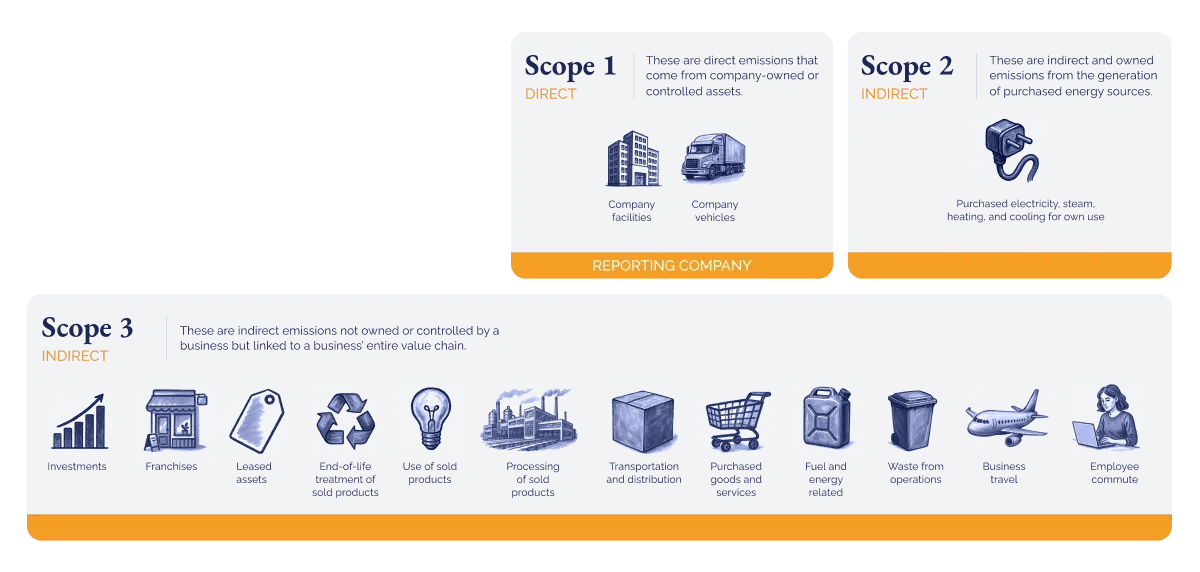 3 scopes of emissions
The scale is the reason Scope 3 has become a regulatory priority. The latest analysis from CDP and Boston Consulting Group found that upstream supply-chain Scope 3 emissions are, on average, 26 times a company's direct operational emissions, and even higher in retail. For most companies, Scope 3 is where the footprint actually lives.
Read more: Industries with the biggest nature footprints and what their decarbonisation looks like
Why is Scope 3 data so difficult to measure accurately?
The core challenge is that the data you need lives in other companies' systems. It sits in the operations of hundreds or thousands of partners across multiple tiers of your supply chain, each with different capabilities, methodologies, and appetite for sharing information.
Many suppliers have yet to measure their own emissions. Others have calculated a footprint using different boundaries or emission factors, which makes direct comparison hard. Even with GHG Protocol guidance, companies interpret and apply the standard in different ways, so two suppliers in the same industry can report emissions that are difficult to compare on a like-for-like basis. This patchwork of data quality is what creates the gaps in a Scope 3 inventory.
Read more: Uncovering the impact of Scope 3 emissions
Supplier data gaps and limited engagement
Survey fatigue is a growing barrier. A supplier serving many large customers receives numerous sustainability questionnaires each year, each asking for similar information in a different format. When your request lands alongside twenty others, it rarely rises to the top of the pile.
Read more: The VSME Standard for SMEs: Simplified ESG reporting in the EU
Response rates stay low, particularly among smaller suppliers with limited sustainability resources. That pushes companies back onto estimates for large parts of their Scope 3 footprint, which caps both accuracy and the ability to track improvement over time.
Inconsistent methodologies across the value chain
Even when supplier data arrives, it may often lack the transparency needed for meaningful use. You might receive a single emissions figure without understanding how it was calculated, what boundaries were applied, or what emission factors were used. Without this context, validating the data becomes nearly impossible.
Read more: The VSME Standard for SMEs: Simplified ESG reporting in the EU
Different suppliers may report using different base years, different scopes (some including only Scope 1 and 2, others attempting Scope 3), and different allocation methods for shared facilities or services. Aggregating this information into a coherent inventory requires careful normalisation and clear documentation.
How does the GHG Protocol categorise Scope 3 emissions?
The GHG Protocol organises Scope 3 into 15 distinct categories. Upstream categories (1–8) cover emissions that occur before your operations, including purchased goods and services, capital goods, fuel and energy activities, transportation, waste, business travel, employee commuting, and upstream leased assets.
Downstream categories (9–15) cover emissions that occur after your operations, including distribution, processing of sold products, product use, end-of-life treatment, downstream leased assets, franchises, and investments. Most companies find that a small number of these categories account for the majority of their Scope 3 footprint.
For a typical manufacturing company, Category 1 (purchased goods and services) often represents the largest share. For retailers, Categories 1 and 11 (use of sold products) tend to dominate. Identifying your material categories is the first step towards focused, accurate measurement.
What calculation methods can you use for Scope 3 emissions?
The GHG Protocol recognises several methods for calculating Scope 3 emissions, each with different data needs and accuracy levels. Understanding them helps you build a practical roadmap for improving data quality over time.
-
Spend-based method
The spend-based approach estimates emissions from the monetary value of purchased goods and services, multiplied by industry-average emission factors. It gives broad coverage with minimal data collection, which makes it an accessible starting point.
The trade-off is accuracy. Spend-based estimates reflect industry averages, so they treat a supplier running on renewable energy the same as one running on fossil fuels. The method is ideal for a first baseline and for finding your material categories, and it is a foundation to build on rather than an endpoint.
-
Activity-based method
Activity-based calculations use physical data from your own operations — material weights, distances travelled, energy consumed — multiplied by more specific emission factors for each activity using a standard conversion figure, such as the average emissions per kilogram of steel, or per tonne-kilometre of freight.
This is a step up from the spend-based method, because the activity data is your own and specific to you, in place of a monetary proxy. Working from real quantities also gives you something to act on: knowing your actual tonne-kilometres and transport modes points to the routes or carriers where reductions are possible.
The limit sits in the factor. It stays an industry average, so it treats your supplier as a typical one: the steel from a mill on renewable power and the steel from a mill on coal are multiplied by the same figure. Your activity is measured directly, and the emissions per unit remain a sector norm.
-
Supplier-specific method
The supplier-specific data method uses emissions data provided directly by your suppliers, from their sustainability reports, certified product carbon footprints, or environmental product declarations. This is the highest tier of data quality in the GHG Protocol hierarchy and the preferred method.
It is best understood as the activity-based method at its highest quality: You use the same physical activity data (units purchased, kilograms of material, kWh consumed), and the step up lies in the emission factor you apply to it. That factor now comes directly from the specific supplier that provided the goods or service, drawn from its own measured, product-level data in place of an industry average. Your activity data is primary and the factor is primary too, so the result reflects that supplier's actual performance instead of a sector norm.
It captures actual performance, so when a supplier cuts its emissions, that improvement flows straight through to your inventory. That direct link between supplier action and your reported footprint is what makes it the foundation of real reduction.
Read more: Stay in the game: What CSRD means for supplier carbon footprints in 2026
Hybrid approach
Most companies use a hybrid: supplier-specific data where it exists for material categories, with activity-based or spend-based estimates filling the gaps. The GHG Protocol Scope 3 Calculation Guidance supports exactly this, recommending that you focus primary collection on your most material categories and suppliers. It lets you start with full coverage and raise accuracy over successive reporting cycles. It’s the progression that both CSRD and Science Based Targets initiative (SBTi) standards reward.
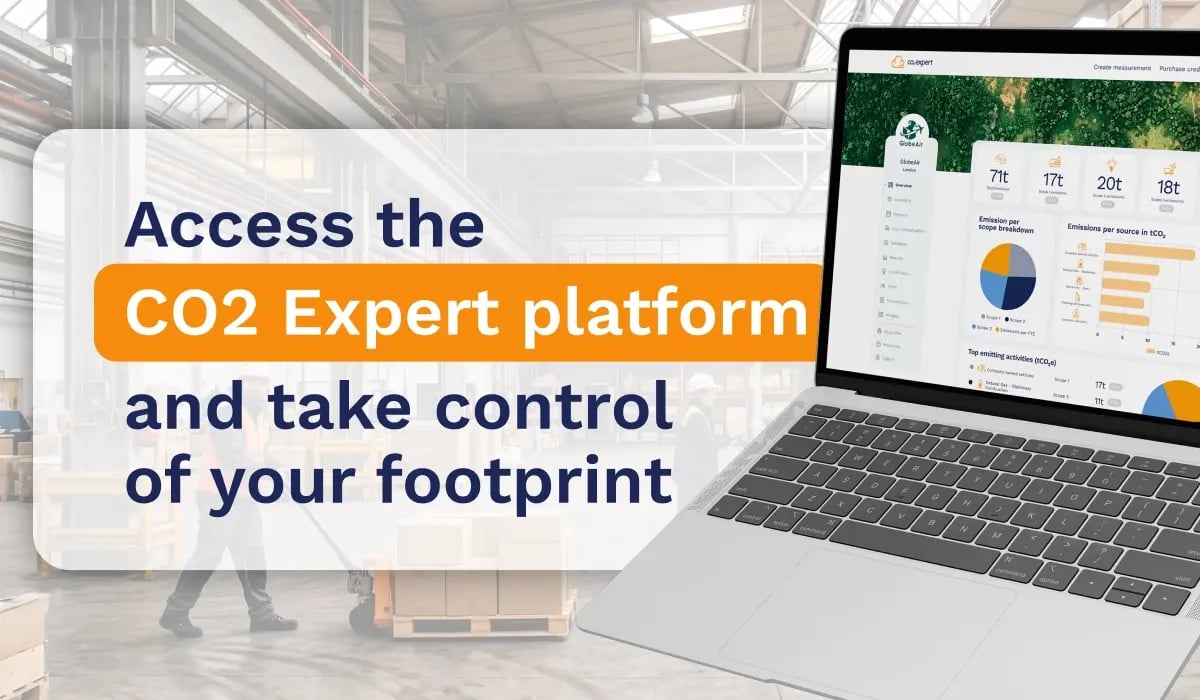
This is where measurement software earns its keep. CO₂ Expert — Green Earth's business carbon footprint calculator — automatically calculates Scope 1, 2, and 3 emissions using an annually updated emission-factor library, and lets you combine data types across locations as you move from estimates towards primary data. It is aligned with the GHG Protocol, ISO 14064, and ISO 14068-1, so the methodology matches what auditors and regulators expect.
How can you improve supplier data collection for better accuracy?
Effective supplier engagement requires more than sending questionnaires. It demands a structured approach that prioritises the right suppliers, frames requests around your sustainability goals, and embeds data collection into procurement operations rather than treating it as a sustainability side project.
Segment suppliers by emissions impact
Before any outreach, rank your suppliers by their contribution to your emissions footprint and their strategic importance to your operations. If you have already completed a spend-based assessment, that baseline identifies which suppliers warrant focused engagement.
For most companies, the top 20–30 suppliers by emissions exposure account for a substantial majority of Scope 3 Category 1 emissions. Concentrating your data collection efforts on these relationships will move the needle far more than attempting broad coverage across your entire supply base.
Frame requests around your goals
Generic data requests get ignored. Suppliers respond more completely when they understand why the data is being requested and how it connects to your organisation's sustainability commitments. A request framed around your net-zero targets carries more weight than a compliance checkbox.
Explaining the business context helps suppliers see the request as an opportunity rather than a burden. Some will proactively highlight lower-carbon alternatives you were not previously aware of. Others will recognise that their carbon performance increasingly influences sourcing decisions.
Match data requests to supplier capabilities
Not all suppliers can provide the same level of detail. Match your data request to what each supplier can realistically deliver. For major raw material suppliers, request certified product carbon footprints or life cycle assessment data. For manufacturing partners, their published Scope 1, 2, and 3 figures may suffice.
For smaller suppliers without dedicated sustainability resources, simpler activity data like material weights or energy consumption may be all you can obtain. Treat the absence of data as information about where that supplier is on their sustainability journey, and direct them to accessible resources rather than demanding what they cannot yet produce.
How should you integrate emissions data into procurement decisions?
The most reliable way to lift Scope 3 data accuracy is to make it a procurement function. When category managers own supplier engagement and emissions data feeds sourcing decisions, response rates rise sharply.
- Embed requirements into contracts. Build submission deadlines, data formats, and reporting obligations directly into supplier contracts and codes of conduct. Clear contractual expectations turn an optional request into a commercial obligation suppliers take seriously.
- Apply internal carbon pricing. A notional price per tonne of CO₂e changes the relative cost of suppliers: a higher-emitting supplier becomes materially more expensive on a carbon-adjusted basis, even at a lower invoice price. That reframes the conversation as a financial one and makes it far easier to secure attention and resources for data collection.
- Use supplier scorecards. Track emissions performance alongside cost, quality, and delivery in regular reviews. This signals that carbon data is an ongoing expectation that shapes the commercial relationship, and it surfaces which suppliers offer the greatest reduction potential.
Read more: CSRD for SME Suppliers: How to turn data requests into a competitive advantage
What role does data governance play in Scope 3 accuracy?
Collecting better data is only valuable if you can trust it, document it, and defend it to auditors. Strong data governance ensures that your Scope 3 inventory can withstand the scrutiny that CSRD and other frameworks increasingly require.
Establish clear data quality criteria
Define in advance what data quality you will accept into your emissions inventory. This might include requirements for GHG Protocol alignment, third-party verification, transparent methodology documentation, or minimum scope coverage. Clear criteria ensure consistency across your supplier base and over time.
Watch for red flags in supplier submissions: zero emissions reported in categories that should be material for that supplier type, or no disclosed calculation methodology. Both are signs the data will not survive audit scrutiny and should trigger follow-up questions.
Document methodology transparently
For each category you report, document the calculation methods used, the data sources relied upon, and any assumptions or allocations applied. This documentation is essential both for CSRD compliance and for enabling year-over-year comparisons that distinguish genuine reductions from methodology changes.
When you transition from spend-based to supplier-specific data, your reported emissions may change significantly. Accurate documentation helps you explain these changes to stakeholders and demonstrate that apparent increases reflect better accounting rather than worse performance.
Plan for continuous improvement
CSRD and SBTi both expect clear plans for improving data quality over successive reporting cycles. This means setting targets for increasing the proportion of primary versus secondary data, expanding supplier coverage, and moving up the accuracy hierarchy over time.
A practical timeline: If your near-term reduction target is 2030, your top 50 suppliers should be providing verified data by 2027. This allows two reporting cycles to refine and validate before your target year, giving you confidence that your progress is real and measurable.
How can nature-based solutions support your Scope 3 strategy?
Improving data accuracy is essential. But addressing Scope 3 emissions then calls for reduction, and, for residual emissions, compensation with high-quality carbon credits from verified nature-based projects which have a defined role in a credible strategy.
 Green Earth nature-based projects.
Green Earth develops large-scale reforestation, agroforestry, and efficient cookstove projects that generate carbon credits verified to leading international standards. These deliver measurable carbon sequestration alongside biodiversity and community benefits that strengthen your sustainability reporting. The key is sequencing: credits compensate for residual emissions, and they complement genuine reduction rather than standing in for it — the approach both CSRD and SBTi set out.
Read more: The hidden strength of nature-based credits in corporate decarbonisation strategies
What are the proposed 2026 GHG Protocol changes for Scope 3?
The GHG Protocol is evolving to meet rising expectations for data quality and completeness. Proposed changes will affect how companies approach Scope 3 measurement and disclosure in the coming years.
The 95% completeness rule
The proposed 95% completeness threshold would require companies to account for at least 95% of their total relevant Scope 3 emissions to claim conformance with the standard. This effectively ends the era of selective disclosure, where companies could report only on a few easily measured categories.
Meeting this threshold will require comprehensive screening of all 15 categories (now potentially 16, with the proposed Category 16 for other value chain activities) with much higher rigour than many companies currently apply.
Mandatory data disaggregation
The proposed requirement to disaggregate emissions by data type (primary versus secondary) puts a direct spotlight on data quality. Companies relying heavily on spend-based estimates will appear significantly less climate-mature than those engaging directly with their supply chain.
This creates both pressure and opportunity. While it raises the bar for what constitutes credible disclosure, it also rewards companies that invest in supplier engagement and primary data collection.
Stock-based accounting for product emissions
The shift from lifetime accounting to stock-based accounting for product use emissions aligns carbon accounting with circular economy goals. Instead of reporting the total lifetime emissions of products sold in a given year, companies would account for the annual emissions of all products currently in use.
This rewards product durability and repairability. Companies that design products to last longer will benefit from lower annual emissions allocations compared to those producing short-lived goods requiring frequent replacement.
A greener path to compliance
At Green Earth, we help businesses turn Scope 3 reporting from a compliance burden into reliable, decision-grade information. CO₂ Expert, our audit-ready carbon footprint platform, takes you from measurement through reduction to compensation, with expert validation at every step. Where emissions remain, we offer verified projects around the globe that lets you take responsibility for your footprint while restoring ecosystems and supporting local communities.

FAQs about improving Scope 3 data accuracy
What is the best starting point for Scope 3 measurement?
Start with a spend-based assessment to identify your material categories and highest-impact suppliers. This gives you broad coverage quickly and highlights where to focus your data improvement efforts. Green Earth helps businesses measure their carbon footprint across all scopes as a foundation for targeted reduction strategies.
Do I need primary data from every supplier to comply with CSRD?
No. CSRD requires disclosure of what proportion of your Scope 3 is primary versus secondary data, not that you have achieved 100% primary coverage. Focus your primary data collection on the suppliers and categories that represent the largest share of your emissions footprint.
How can I improve supplier response rates to emissions data requests?
Frame your request around your own sustainability targets rather than regulatory compliance. Assign responsibility to category managers with existing supplier relationships rather than sustainability team members. Embed data requirements into contracts and procurement processes. Green Earth connects carbon data to transparent reporting that helps both you and your suppliers communicate environmental progress.
What is the difference between spend-based and activity-based Scope 3 calculations?
Spend-based calculations estimate emissions from the monetary value of purchases using industry-average emission factors. Activity-based calculations use physical quantities like material weights or distances travelled with more specific emission factors. Activity data offers greater accuracy and enables tracking of real improvements over time.
How do I handle inconsistent data from different suppliers?
Establish clear data quality criteria before collecting information. Document the methodology, boundaries, and emission factors each supplier uses. Normalise data where possible and be transparent in your reporting about the mix of data sources and quality levels in your inventory.
What should I do if a supplier cannot provide emissions data?
Treat this as information about their sustainability maturity. Use spend-based or activity-based estimates for that supplier while directing them to resources that can help them begin measuring. Consider whether carbon performance should influence future sourcing decisions as you build relationships with more capable suppliers.
How does Green Earth support businesses with CSRD Scope 3 reporting?
Green Earth offers carbon footprint measurement services, ESG reporting support, and verified carbon credits from nature-based projects. This combination helps businesses understand their value chain emissions, report transparently to stakeholders, and address residual emissions through high-integrity environmental projects with full traceability and independent verification.