
Pakistan
Nature-based solutions
Paris Agreement
Article 6
Pakistan has taken a significant step in entering global carbon markets by granting its first-ever approvals under Article 6 of the Paris Agreement to two distinct carbon projects. The approvals mark a new chapter in the country’s environmental finance landscape, signalling readiness to engage in high-integrity international carbon trading.
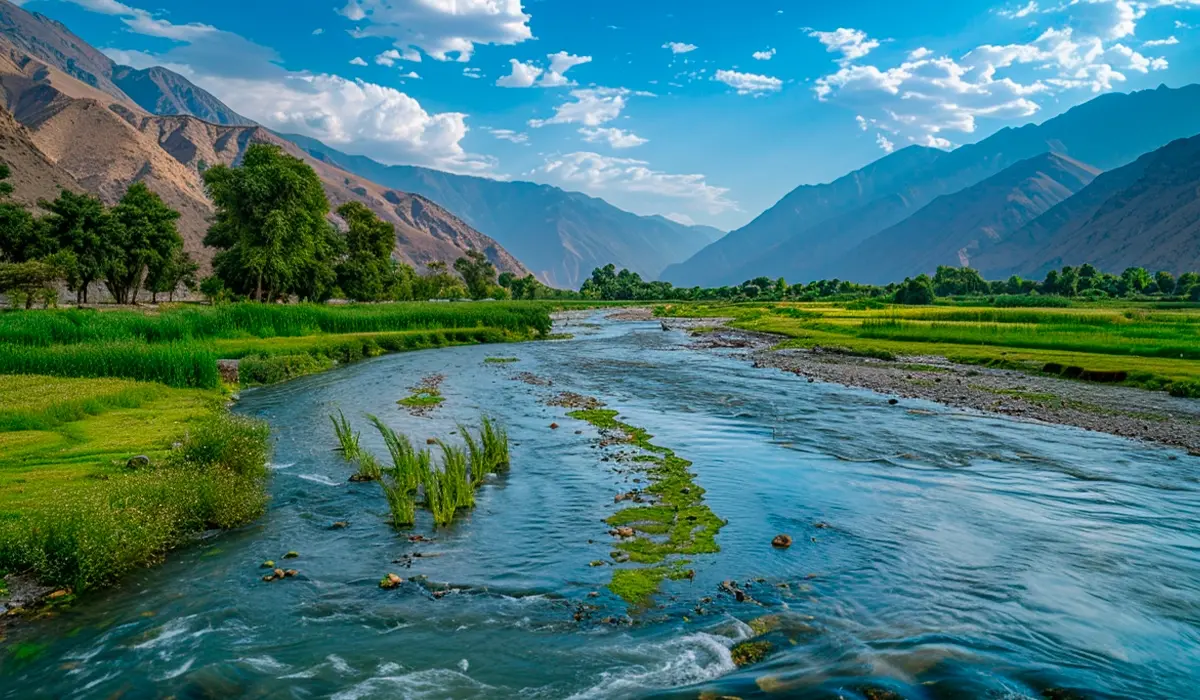
 Landscape view of the Indus River flowing through green fields in Punjab. AI generated picture.
On 15 April, the Ministry of Climate Change and Environmental Coordination (MoCC&EC) announced it had issued a Host Country Approval (HCA) to a clean water initiative led by South Korean firm ATR Inc, and a Letter of Intent (LoI) to a landfill rehabilitation project spearheaded by the Ravi Urban Development Authority (RUDA).
‘These developments mark a historic milestone in Pakistan's efforts to operationalise a transparent, credible, and high-integrity carbon market under the Paris Agreement's Article 6 framework’, the MoCC&EC stated.
ATR Inc’s project will focus on the WASH (Water, Sanitation and Hygiene) Sector Plan in Punjab. Between 2026 and 2035, the initiative will see the installation of 250 water filtration systems aimed at providing free, safe drinking water to more than 4 million people. The project is expected to reduce the need for biomass burning, which contributes significantly to greenhouse gas emissions through deforestation and inefficient combustion. Over its lifecycle, the project is projected to generate 1.5 million tonnes of CO2 reductions in the form of Article 6.4 Emission Reductions (A6.4ERs), eligible for trade under the Paris Agreement’s Crediting Mechanism.
Read more: Brazil launches major restoration drive for Indigenous Amazon lands
Simultaneously, RUDA's Mehmood Booti Dumpsite Rehabilitation Project was granted a Letter of Intent, allowing it to pursue the generation of Internationally Transferred Mitigation Outcomes (ITMOs) under Article 6.2. The $18 million initiative will convert a 43-acre landfill into an urban green space featuring a forest and solar energy park. It is expected to yield around 930,000 tonnes of CO2 equivalent credits by 2040, using United Nations Framework Convention on Climate Change (UNFCCC)-approved methodologies.
‘[The] MoCC&EC welcomes global developers and partners to invest in Pakistan's carbon market, confident that early movers will help define the high-integrity standards for future climate finance in the region’, the ministry added.
Additional projects are currently undergoing review, suggesting continued momentum in Pakistan’s push to establish itself as a credible player in the evolving global carbon market.
Read more: From the ground up to space: seeing DGB’s impact in Uganda
Pakistan’s leap into Article 6 carbon trading highlights a global shift: credible environmental action now depends on verifiable impact, local benefit, and scalable solutions. With countries opening their markets to high-integrity projects, nature-based initiatives that deliver measurable carbon reductions and community value are becoming the gold standard. At DGB Group, we develop large-scale restoration projects that produce premium carbon units—backed by biodiversity gains, social progress, and environmental trust. For businesses ready to shape the future, the time is now. Learn how your business can be at the forefront of environmental stewardship and best prepared for the future.