
Carbon offsetting
Carbon markets
Airlines
CORSIA
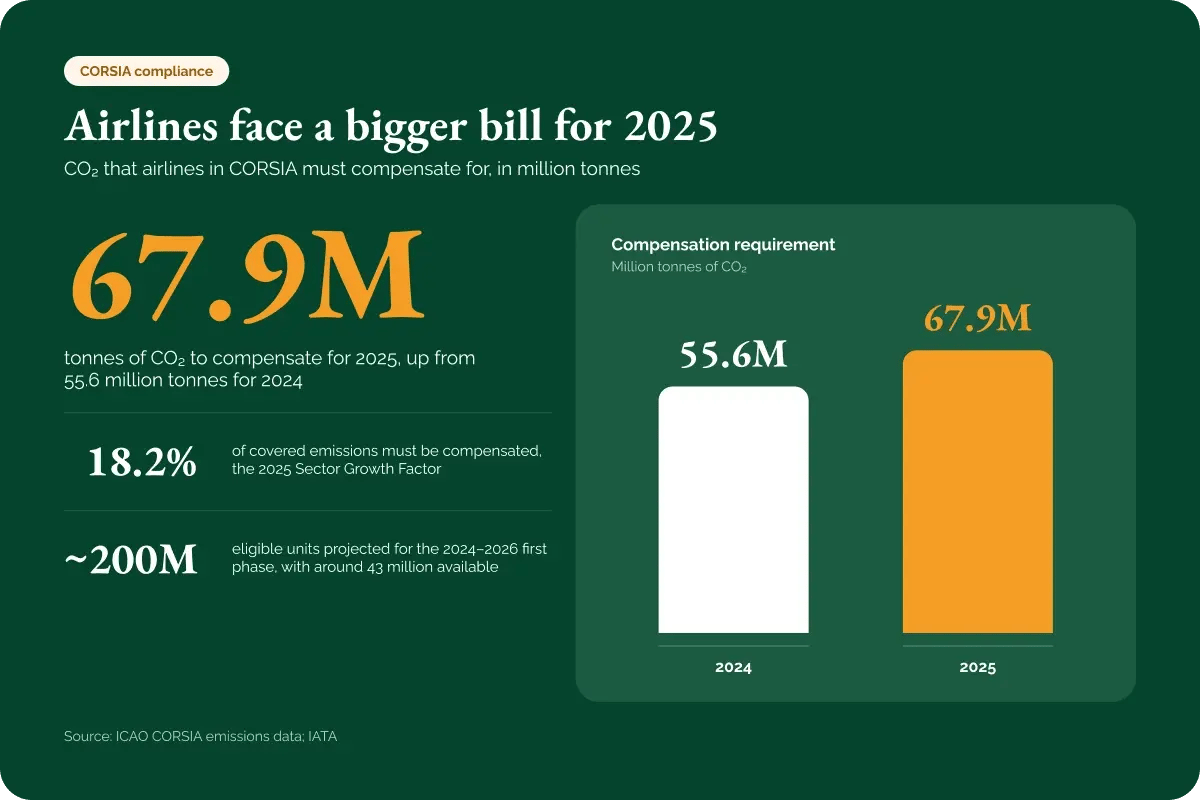
Airlines in the Carbon Offsetting and Reduction Scheme for International Aviation (CORSIA) must compensate for around 67.9 million tonnes of CO₂ for 2025. The figure follows new emissions data from the International Civil Aviation Organization (ICAO). CORSIA Eligible Emissions Units (EEUs), the carbon credits approved for the scheme, will cover the vast majority of this volume.
ICAO set the 2025 Sector Growth Factor (SGF) at 0.18157674, up from 0.15405257 for 2024. The SGF sets the share of each airline's emissions it must compensate. In practice, an airline must buy 18,157 credits for every 100,000 tonnes of CO₂ it emits.
Emissions on the routes covered by the scheme reached 373,795,420 tonnes of CO₂ in 2025. That is 3.5% more than the 361,159,641 tonnes recorded in 2024. Airlines compensate for every tonne above the scheme's baseline of 305,922,865 tonnes. Higher airline emissions and the addition of two more countries lifted this year's figure.
Read more: CORSIA activity builds across prices, airlines and supply
The 2025 figure follows 55.6 million tonnes confirmed for 2024. Together, the two years give airlines data for two-thirds of the first compliance phase, which runs from 2024 to 2026. The International Air Transport Association (IATA) projects first-phase demand of approximately 200 million eligible units. Around 43 million tagged units are currently available, according to IATA.
Price shapes how airlines meet the requirement. EEUs trade at between $12.85 and $13.75 per tonne, depending on credit type, according to Quantum data. Quantum puts the abatement cost of sustainable aviation fuel (SAF) at around $316 per tonne of CO₂. Certificates for low-carbon fuels such as SAF are expected to cover a small remainder of the 2025 total.
Market activity is picking up. A procurement event co-organised by IATA and Xpansiv began offering 2.5 million EEUs on 2 November. Exchanges expect further volume as intermediaries and buyers plan for 2027, the final compliance year of the first phase. Airlines must cancel eligible units for the phase by January 2028.
Read more: Who's who in the carbon market: Key institutions and frameworks and what they do
CORSIA makes international aviation a recurring compliance buyer, with tens of millions of tonnes required for each year of the first phase. Green Earth develops nature-based carbon projects end to end, with oversight from project design through to credit issuance, building the kind of verified supply this demand draws on. For businesses planning their compensation strategy, Green Earth's verified carbon credits connect each tonne to measurable benefits for ecosystems and local communities.