
Carbon footprint
Governments
United Kingdom
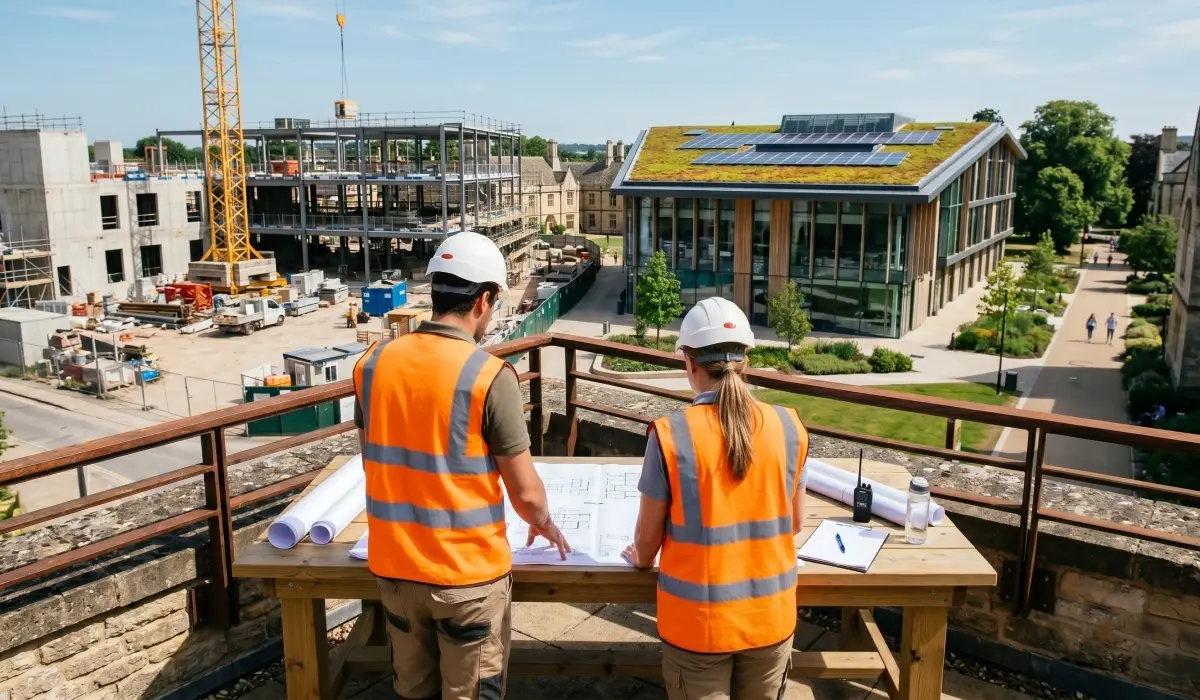
The UK's Department for Science, Innovation and Technology (DSIT) is procuring carbon credits to address the embodied emissions from constructing a new headquarters for the European Centre for Medium-Range Weather Forecasts (ECMWF). The department has set a budget of up to £2.5 million ($3.35 million) for the exercise.
 Two construction professionals reviewing plans while overseeing the construction of a new net-zero carbon building on the Whiteknights Campus. AI-generated picture.
The new building will be located at the University of Reading's Whiteknights campus and is required to meet the UK Net Zero Carbon Buildings Standard. DSIT is looking to procure credits covering approximately 5,165 tonnes of CO2 equivalent, resulting from construction activity expected to run from December 2026 to March 2027.
DSIT has launched a one-off tender to source and retire high-integrity carbon removal credits. The department prefers UK-based projects and expresses a preference for a portfolio approach covering engineered solutions, nature-based solutions, or a combination of the two.
For overseas projects, the tender document specifies that credits must hold Core Carbon Principles (CCP) accreditation—the quality label issued by the Integrity Council for the Voluntary Carbon Market (ICVCM). On project suitability, the document states: 'Projects should not compete with arable land, should offer exceptional value for money, and, for overseas options hold CCP accreditation.'
Credits are to be delivered and retired by 1 March 2028, and must be no more than five years old at retirement. Suppliers will also be required to demonstrate experience in 'delivering high-integrity carbon removal credits at scale, ideally for construction or public-sector clients'. The tender closes on 18 May, with a contract award expected on 22 June.
Read more: Tokyo expands carbon credit support scheme for businesses in 2026
The procurement comes as the UK continues to make measurable progress on reducing its territorial emissions. According to provisional government estimates, total net emissions in 2025 reached 367 million tonnes of CO2 equivalent—a 2% decrease from 2024 and a 54% reduction from 1990 levels. The shift away from coal-based electricity generation, towards gas and more recently renewables, accounts for much of this long-term decline.
Even so, hard-to-abate emissions from sectors such as construction continue to present a challenge. This procurement signals growing government engagement with the verified carbon market as a practical tool for addressing residual emissions where direct reduction is not immediately feasible.
ECMWF is an intergovernmental research institute with its current headquarters in Shinfield, UK, and additional sites in Bonn, Germany, and Bologna, Italy. It contributes to Copernicus, the Earth observation component of the EU Space Programme, and Horizon Europe.
Read more: What is a life cycle assessment, and why does it matter?
As governments begin to look to the verified carbon market to address residual construction and infrastructure emissions, the demand for high-integrity carbon credits is set to grow—and the bar for quality is rising with it. At Green Earth, we develop and manage nature-based carbon credit projects across Africa and Asia, giving businesses and public-sector buyers direct access to verified carbon units that are rigorously monitored and independently certified. Whether you are sourcing credits for a specific project or building a long-term portfolio strategy, our transparent, high-integrity offering is built to meet the standards the market now demands.