
Carbon credits
European Union
Asia
Article 6
Norway and Pakistan have formalised a bilateral cooperation agreement on carbon markets under Article 6.2 of the Paris Agreement, marking Pakistan's first such deal.
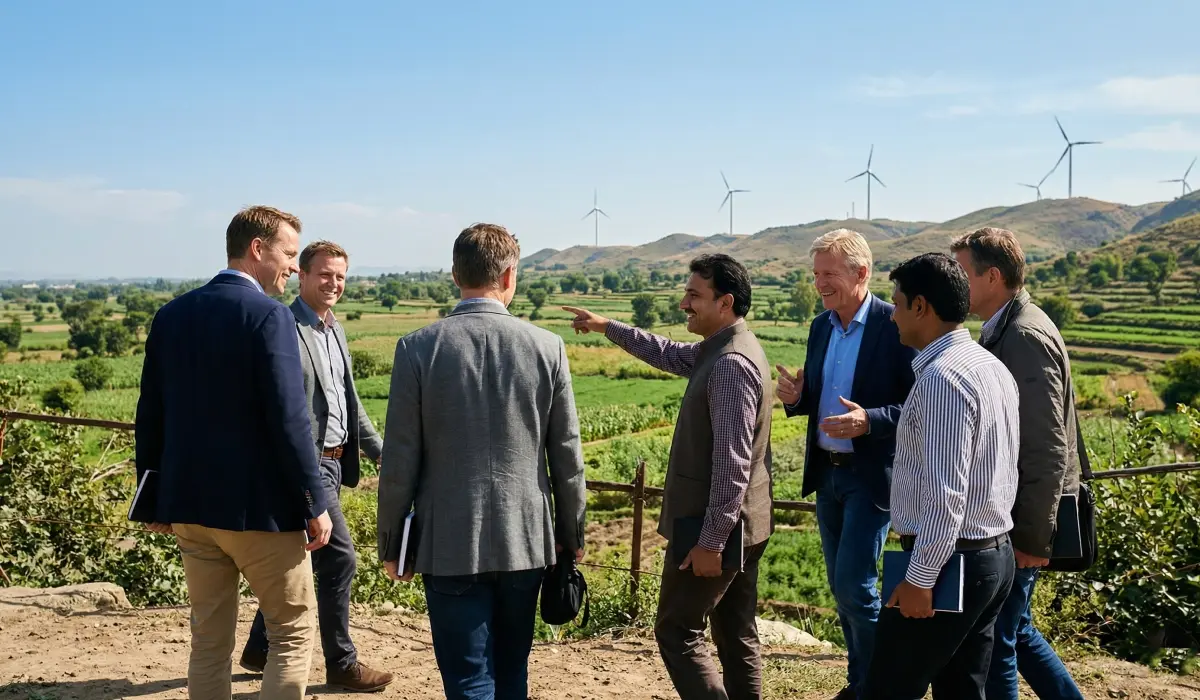
 Norwegian and Pakistani business leaders discuss sustainable agriculture projects in Pakistan, with wind turbines in the background, highlighting international climate collaboration. Ai generated picture.
The memorandum of understanding (MoU) was signed in Islamabad and covers potential carbon credit projects across Pakistan's clean energy, agriculture, transport, and waste management sectors. The agreement provides a structured framework for international investment in these areas.
'This is Pakistan's first bilateral agreement under Article 6.2 and an important step towards implementation. It creates a credible pathway for international cooperation and investment in Pakistan's climate priorities,' said Musadik Mali, Pakistan's Federal Minister for Climate Change and Environmental Coordination.
For Norway, the agreement is part of a broader Article 6 strategy. The country has set aside NOK 15 billion ($1.56 billion) to purchase up to 15 million carbon credits by 2030, and has already signed comparable MoUs with Benin, Indonesia, Zambia, Jordan, and Senegal. Norway's Ambassador to Pakistan, Per Albert Ilsaas, confirmed these details at the signing.
Read more: A shifting carbon border: The EU eyes Article 6 recognition as South Korea mobilises exporters
Norway's Minister of Climate and Environment, Andreas Bjelland Eriksen, outlined the dual purpose of the agreement: 'The agreement with Pakistan allows us to work together on measures that reduce emissions in Pakistan, contributing to Norway's 2030 green target, should it not be fully achieved through environmental cooperation with the European Union. The agreement will also help trigger private investments and create green jobs in Pakistan.'
The deal arrives as Norway reaffirms its commitment to the Article 6 market. Last month, the country confirmed it remains an active participant in the mechanism, following the decision to scrap its standalone 2030 carbon neutrality goal.
Agreements of this kind signal growing institutional appetite for government-backed carbon credit procurement—a development that strengthens demand and long-term confidence across the verified carbon market.
Read more: Nature-based solutions vs carbon capture technology: Which is most effective?
As governments establish bilateral frameworks to scale carbon credit procurement, the demand for high-integrity carbon assets is set to grow. Green Earth is positioned at the centre of this market: combining ecological science, data intelligence, and financial expertise to develop nature-based projects that generate certified carbon credits meeting the highest global standards. For businesses looking to act on their sustainability goals, that means measurable environmental and socio-economic outcomes, and long-term value backed by rigorous verification.