
Tree planting
Rainforest
Deforestation
Nature conservation
Forest
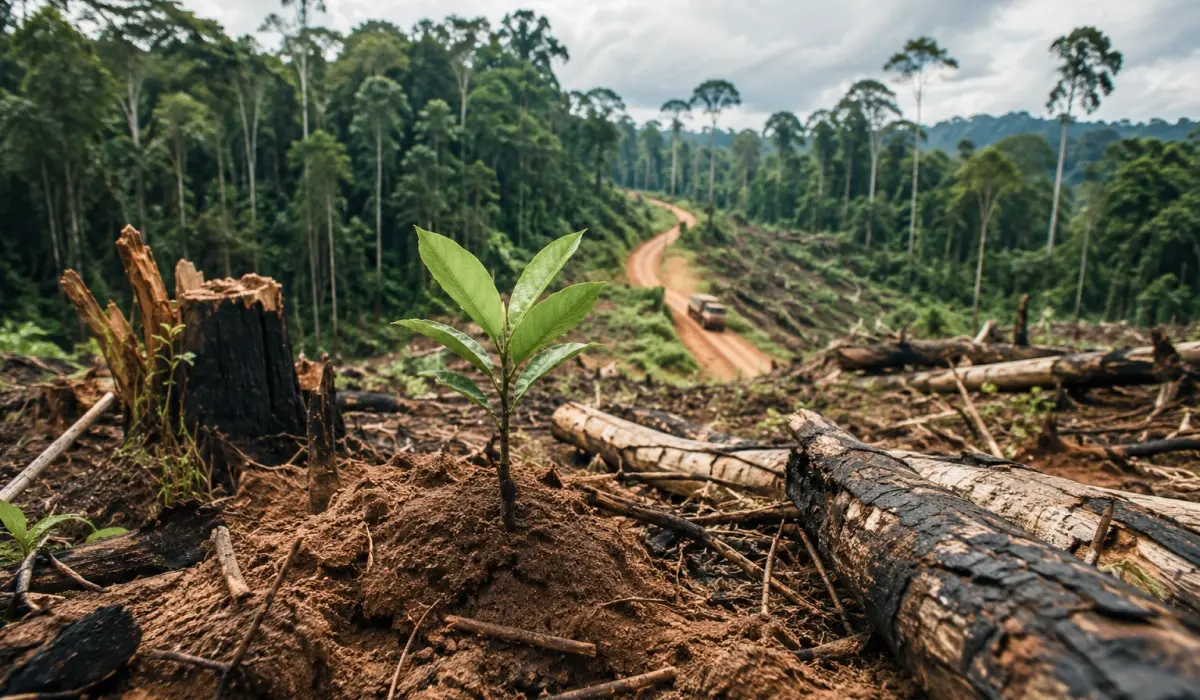
Two new studies have delivered urgent findings about the world's most important rainforests, and the conclusions point in the same direction. Deforestation and inadequate land management are pushing both the Amazon and the Congo Basin closer to irreversible ecological thresholds.
 A seedling growing amid logging damage in the Congo Basin, highlighting how deforestation is pushing tropical forests toward critical tipping points. AI generated picture.
The Amazon rainforest is more vulnerable than scientists previously believed. New research from the Potsdam Institute for Climate Impact Research (PIK) in Germany finds that deforestation weakens the forest's ability to generate its own rainfall, accelerating its decline at a rate faster than earlier models had projected.
Up to half of the Amazon's rainfall is produced by the forest itself. Trees release water vapour into the atmosphere, which falls again as rain across the basin. Deforestation disrupts this process, and the effects do not stay local.
'When deforestation interrupts moisture transport in one area of the Amazon, entire regions hundreds or even thousands of kilometres away can also lose resilience through cascading drought effects,' said Arie Staal, Assistant Professor at Utrecht University and co-author of the study.
The research, published in Nature, warns that total deforestation of 22%–28% of the Amazon could trigger a tipping point beyond which recovery becomes impossible. The forest has already lost 17%–18%.
A shift of this scale would reduce rainfall across South America, one of the world's largest agricultural regions, with consequences stretching from Bolivia to the Río de la Plata basin in Argentina.
The study acknowledges restoration as a critical tool to build resilience, including Brazil's plan to restore around 12 million hectares of forest. It also calls on governments in the region to deliver on pledges to achieve zero deforestation by 2030, noting that 'it is unclear whether and to which extent they will be fulfilled.'
Read more: Major coffee traders deploy satellite mapping to meet EU deforestation rules
A parallel study published in Nature Communications reveals a similarly precarious picture for the Congo Basin, the world's second-largest tropical rainforest, covering approximately 200 million hectares across six countries in Central Africa.
Researchers at CTrees analysed above-ground carbon (AGC) stocks across the Congo Basin from 1990 to 2020. They found that managed forests, including areas with selective logging, were responsible for 98.7% of the region's net carbon sink. Unmanaged forest, which holds 54% of the region's total AGC, was carbon neutral over the same period.
'Currently, nearly half of the Congo Basin's forest carbon is stored in unmanaged areas, placing it at significant risk of rapid loss from small-scale clearings, mostly associated with smallholder agriculture and urban expansion,' said lead author Le Bienfaiteur Sagang, research scientist at CTrees.
The findings show that selectively logged forests held, on average, 7.5% less AGC than old-growth forests. Areas affected by slash-and-burn agriculture showed up to 50% less carbon density. Unprotected forests accounted for 79% of the region's total carbon emissions over the study period.
The Congo Basin stores an estimated 32.3 billion tonnes of total above- and below-ground carbon, equivalent to around 21% of all carbon stocks in tropical moist forests worldwide.
Read more: Why a forest with more species stores more carbon
As the world's most critical rainforests edge closer to ecological tipping points, the case for science-led, ecosystem-focused forest protection has never been stronger. At Green Earth, we develop nature-based carbon projects built on a deep understanding of the ecosystems we work in — combining on-the-ground ecological expertise, precise land-use oversight, and rigorous third-party verification to ensure every project delivers measurable, lasting impact. For businesses looking to contribute to forest resilience and biodiversity protection, the quality and traceability of the carbon credits they rely on matters as much as the targets they set. We combine data intelligence and end-to-end project oversight to engineer possibilities at scale.