
Tree planting
Deforestation
Agroforestry
Agriculture
Green tech
Forest
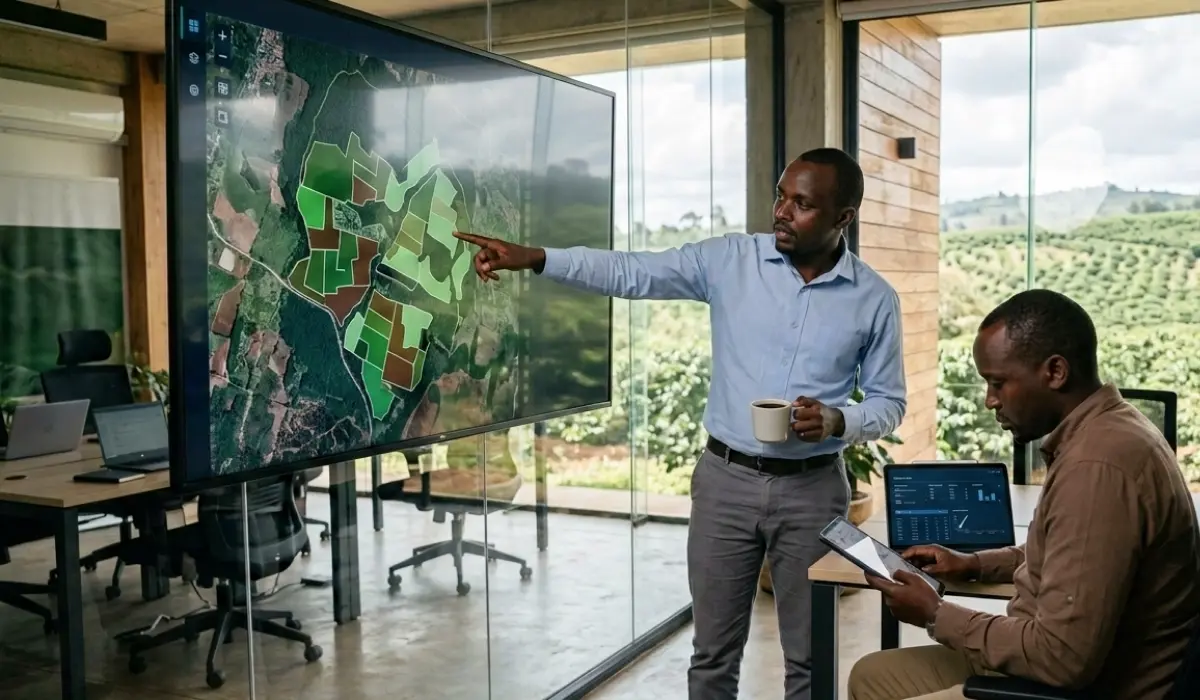
A coalition of major coffee traders and roasters has launched a satellite-based mapping initiative designed to help companies meet the requirements of the EU Deforestation Regulation (EUDR). The Coffee Canopy Partnership includes JDE Peet's, Tchibo, Louis Dreyfus Company, Neumann Kaffee Group, Touton, and Sucafina.
 Agri-tech specialists in Kenya analyzing satellite imagery of coffee plantations to ensure compliance with deforestation regulations. AI generated picture.
The partnership uses satellite imagery supplied by Airbus, processed through artificial intelligence models, to map coffee-growing areas and identify where farms overlap with forest land or zones of recent tree cover loss.
The rollout begins in East Africa, covering Ethiopia, Tanzania, Kenya, Uganda, Burundi, and Rwanda—regions that together account for a significant share of global coffee supply and depend heavily on smallholder farming.
The EUDR introduces strict traceability obligations for agricultural commodities sold in the EU. Companies must provide precise geolocation data for individual farms and verify that production has not taken place on land classified as forest after December 2020. Large operators face the earliest compliance deadlines, with smaller businesses required to follow by mid-2027.
For coffee supply chains, this creates practical challenges. Production is distributed across fragmented networks of smallholder farms, where documentation and spatial data have historically been limited.
Read more: South Korea launches alliance and exchange to grow domestic carbon credit market
A key concern driving the initiative is the inaccuracy of existing land classification data. Traditional datasets frequently fail to distinguish between natural forests and agroforestry systems, where coffee is cultivated under tree cover rather than in open fields.
JDE Peet's identified the consequences directly: ‘This could exclude millions of smallholder farmers from important markets, despite the fact that they practice sustainable farming methods, because current maps classify their shade-grown coffee or agroforestry land incorrectly as forest.’
The partnership acknowledges the sector-wide nature of the problem, noting that the initiative will tackle the ‘historical lack of precise mapping data which has often resulted in coffee farm… being misidentified as a natural forest.’
By generating higher-resolution land-use maps through AI-driven classification, the system aims to separate genuine deforestation risk from sustainable land management. The data will also support restoration planning by identifying degraded areas.
The Coffee Canopy Partnership plans to expand beyond East Africa, targeting full global coverage of coffee-growing regions by 2027, a timeline that runs closely alongside regulatory deadlines.
For companies and investors, the initiative reflects a wider shift in ESG compliance: from disclosure-based frameworks towards verified, data-backed accountability. As regulatory requirements tighten across commodity markets, technology-driven traceability tools are becoming a central part of responsible supply chain management.
Read more: Indigenous and local knowledge in carbon projects: why it defines credit quality
As deforestation regulation raises the bar on land-use data and supply chain accountability, the integrity of nature-based carbon assets is under greater scrutiny than ever. At Green Earth, we develop nature-based carbon projects built on the same principles now driving regulatory change: precise land-use oversight, rigorous third-party verification, and a deep understanding of the ecosystems we work in.
For businesses navigating tightening compliance requirements, the quality and traceability of the carbon credits they rely on matters as much as the targets they set. We combine on-the-ground ecological expertise, data intelligence, and end-to-end project oversight to engineer possibilities at scale.