
Reforestation
Carbon credits
Forest
Nature-based solutions
Local communities
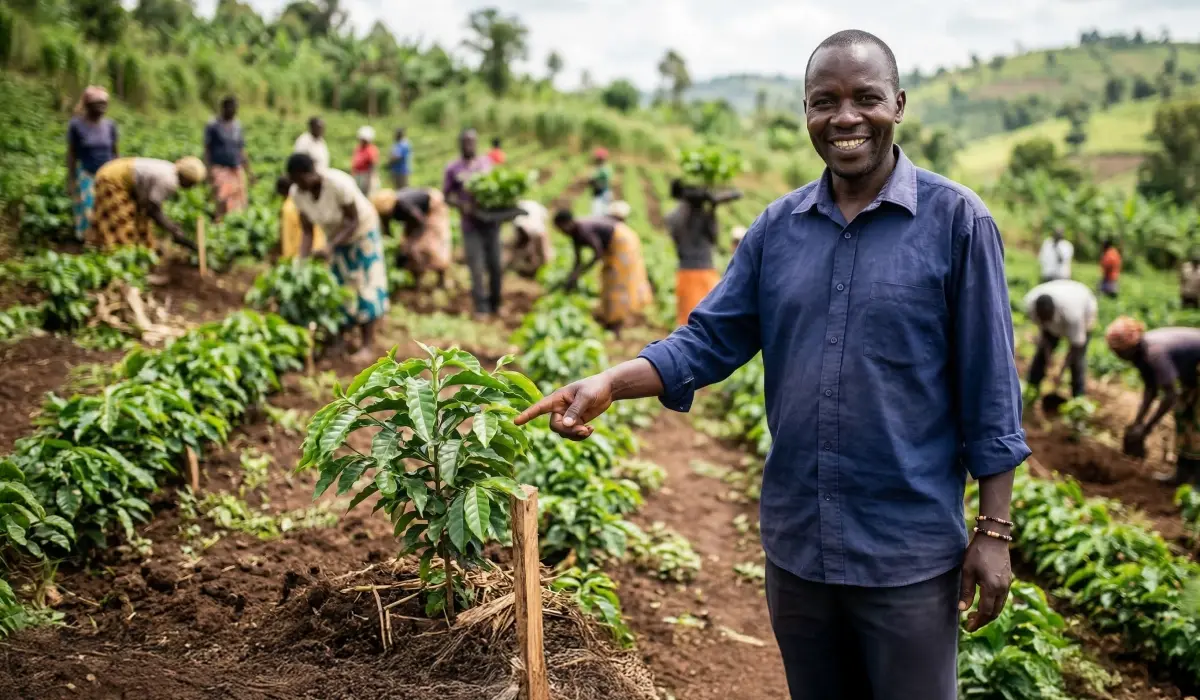
Carbon buyers are asking better questions: permanence risk, additionality, co-benefits, and third-party verification, has all become vital considerations. The due diligence applied to nature-based carbon credits has grown sharper and more rigorous over the past few years. Yet one factor consistently sits at the edges of buyer evaluation: Whether the communities living on and around the project land are genuinely embedded in its design, management, and long-term success.
This is not a peripheral concern. The role of Indigenous and local knowledge in carbon projects determines whether species are selected correctly, whether restored land stays restored, and whether the communities whose cooperation makes the project possible remain committed to it for decades. Where that knowledge is absent or ignored, projects face elevated ecological, social, and commercial risk—risk that eventually lands with the buyer.
This piece examines what the research and field evidence say about the consequences of excluding local communities from project design, how Indigenous ecological knowledge improves species selection and restoration accuracy, why community co-development is the most reliable foundation for carbon project permanence, and what all of this means for the quality and durability of the credits buyers purchase.

What happens when local knowledge is left out
The consequences of excluding Indigenous and local knowledge from carbon project design are well documented, and they are not limited to reputational damage. When projects are developed without genuine community participation, the results tend to follow a predictable pattern: wrong species planted in the wrong places, land-use pressures misread, social resistance underestimated, and eventually, project abandonment. For a buyer, that trajectory ends with credits from a project that no longer exists in its original form.
 A forest ranger inspecting the soil of a failed reforestation project, highlighting the consequences of excluding local and Indigenous knowledge from carbon project design. AI generated picture.
The scale of this problem across the verified carbon market is significant. A review of forest carbon and conservation initiatives across eight countries in the Global South found that failures to conduct robust free, prior, and informed consent (FPIC) processes were documented in seven of the eight countries studied, alongside a lack of governance transparency and limited enforcement of social safeguards. These are not outliers. They represent a systemic gap between what community engagement requires and what projects deliver.
The results of that gap can be severe. A 2025 Swedwatch investigation into carbon cookstove projects in Zimbabwe found that over 20,000 households had been enrolled in a project without FPIC, no benefit-sharing agreement, and no grievance mechanism. Community members were unaware that credits generated from their participation had been sold to corporations. The integrity of those credits, and the exposure of the buyers holding them, is a direct consequence of the absence of genuine local partnership at the design stage.
Read more: The hidden strength of nature-based credits in corporate decarbonisation strategies
This pattern is not confined to any single project type or geography. A 2022 study examining 53 utility-scale wind, solar, and geothermal energy projects that were delayed or blocked across 28 US states between 2008 and 2021 found that 49% were cancelled permanently and 34% faced significant permitting difficulties—with inadequate community engagement identified as one of the seven key sources of opposition. The lesson applies directly to nature-based carbon projects: a project that has not secured the genuine participation of the communities it depends on carries a structural vulnerability that no amount of third-party verification can fully resolve.
High-integrity carbon credits are, by definition, credits backed by projects that will endure. Endurance requires the people closest to the land to be partners in it, from the first consultation to the final monitoring report.
 A local farmer posing with cocoa fruits from her plantation, where she has a successful harvest. Bulindi Agroforestry and Chimpanzee Conservation Project, Green Earth.
Local knowledge as ecological intelligence
Restoration cannot be designed purely from the outside. Satellite data and species databases are useful tools, but they do not capture what communities living on and managing land have observed across generations: which species thrive in which soil conditions, how seasonal water patterns shift across a hillside, and where forests once stood before degradation set in. This knowledge improves restoration accuracy in ways no remote methodology can fully replicate.
The research confirms it. A Frontiers in Conservation Science review found that community-based institutions are frequently more successful than government policies in achieving restoration outcomes, and a study in Mountain Research and Development shows precisely why. In a reforestation project in central Nepal, local community members selected tree species based on their knowledge of terrain, elevation, and soil conditions. Vegetation health scores nearly doubled over four years. Species chosen by people who know the land survive. Species chosen without that knowledge frequently do not.
Read more: What business leaders need to know before buying carbon offsets
This is precisely the logic behind Green Earth's network of community-run nurseries in Kenya. Across the Mount Kenya Regenerative Agroforestry Project, we collaborate with local nurseries specifically for indigenous species sourcing—because local practitioners carry knowledge about which species establish, thrive, and persist in specific microclimates.
 Members of the local community working in the tree nursery, using their knowledge to grow indigenous species that thrive in specific microclimates. Mount Kenya Regenerative Agroforestry Project, Green Earth.
One of the clearest examples is the Chaka Gwikuria Women Group, based in Nyeri County's Kieni West sub-county. Founded in 2014 as a small community savings initiative among ten women, the group registered with the Muringato Community Forest Association by 2015 and received training in nursery management and conservation. In 2023, they became the first group in the association to sign a contract supplying seedlings to large-scale reforestation projects in the region, including to Green Earth’s projects.
Read more: Local nurseries driving our reforestation in Kenya
Today, they propagate more than half a million seedlings every year, including indigenous tree species selected for their adaptability to local conditions. Since 2023, seedling sales have generated more than $11,000 for group members, enabling land ownership, access to financial literacy programmes, and long-term economic resilience.
The ecological and the economic are inseparable here. The Chaka Gwikuria Women Group produces better seedlings because they know this land, and they continue to produce them because doing so sustains their livelihoods. Local knowledge in nature-based solutions is most effective when that knowledge is valued, compensated, and structurally embedded in the project from the outset.
Community co-development and carbon project permanence
Permanence is the most commercially significant risk a carbon credit buyer carries. It is the requirement that the carbon stored in a project is not released back. That the forest stays standing and the ecosystem continues to function decades after the credits are issued. Meeting that requirement depends on one thing above all else: whether the people living on and around the project land have a genuine stake in protecting it.
The evidence is consistent across geographies and project types. Amazonian Indigenous lands lost less than 0.3% of their forest carbon between 2003 and 2016, compared to 3.6% for areas without community stewardship. A study of 245 Indigenous territories in Brazil found that securing land rights was associated with a roughly 66% reduction in deforestation rates.
As a Frontiers in Conservation Science review puts it plainly: communities that rely on ecosystems for their livelihoods have a strong interest in restoring and maintaining them. Where that interest exists, permanence follows. Where it does not, no monitoring framework can fully compensate.
This is the principle that underpins Green Earth's approach in Kenya. The Bungoma food forest initiative places farmer livelihoods at the centre of project design—deliberately, and before the carbon phase begins. By helping farmers generate stable, diversified income from their land through agroecological methods, the project removes the economic pressure that drives land degradation and forest encroachment. Conservation is maintained through livelihoods, not enforcement.
 A drone view of well-managed land thriving with lush crops and vegetation, showing how the Bungoma food forest initiative supports farmers’ livelihoods and protects the environment.
The Mount Kenya Regenerative Agroforestry Project operates on the same foundation. This 41-year project is backed by farmer participation from the start. We work with 11,000 local farmers, providing them indigenous and fruit and nut tree seedlings together with the necessary training, support, and grievance mechanisms to plant and care for their trees and participate in the project. All tree yields belong to the farmer, offering them additional income and more stable livelihoods.
Read more: The social impact of Green Earth’s projects
Nature-based project integrity starts at design
The findings in the previous sections point to the same conclusion: local collaboration only works if it begins at the right moment. That moment is not after a project has been designed, funded, and set in motion. It is before any of those things happen.
Free, prior, and informed consent (FPIC) is the formal expression of this principle. According to a review published by CABI Digital Library, FPIC must be transparent and culturally appropriate to ensure the full and effective participation of all community members, and benefit-sharing mechanisms must be considered at the early stages of projects, not after implementation.
Read more: Beyond tonnes: How carbon credit co-benefits elevate value
The distinction matters: consultation that happens after the project design is fixed is not genuine participation. It is a notification. And projects built on notification rather than co-development carry the integrity risks as outlined earlier.
The scientific case for early integration is equally clear. A December 2024 IPBES report, prepared by more than 100 experts from 42 countries, concluded that Indigenous and local knowledge systems offer cost-effective strategies for conserving high-value areas—and identified their integration as central to achieving the 2030 global biodiversity goals.
Cost-effective is worth noting here. Genuine community co-development is not a costly addition to project design. It is an efficiency gain: Projects designed with local knowledge require less correction, face less resistance, and produce more durable outcomes.
Read more: Three steps driving Kenya's forest comeback
At Green Earth, this is how projects are structured from the outset. The expansion of the Mount Kenya Regenerative Agroforestry Project into Meru County was not a unilateral decision, it depended on communities and farmers in the region being ready and willing to participate. Monitoring survival rates and refining species selection season by season is only possible because local partners are embedded in the project from day one, not brought in once the framework is already fixed.
The Bungoma food forest initiative follows the same logic: Active community engagement and shared ownership are built into the project architecture before the carbon phase begins, because the carbon outcome depends on the community foundation beneath it.
Nature-based solutions project integrity, in the end, is inseparable from the process that produces it. Local collaboration is not a social nicety. It is a project integrity requirement.

What high-integrity carbon credits look like in practice
Research published in PNAS found that Indigenous territories in the Amazon stored more than 58% of the Amazon's carbon in 2016, while accounting for just 10% of net carbon change. Between 2001 and 2021, those same territories achieved a net removal of 340 million tonnes of CO₂ annually, roughly equivalent to the UK's total annual fossil fuel emissions. Areas outside Indigenous territories became net carbon sources over the same period. The takeaway: Community stewardship is the difference between a carbon sink and a carbon source.
Read more: Agroforestry explained: a guide to regenerative farming
For prospective buyers, the key question is: What does community co-development mean for the quality of the credits you purchase?
The answer is clear. Strong community stewardship does more than reduce permanence risk. It can determine whether a project remains a lasting carbon sink while improving livelihoods and biodiversity. Green Earth’s agroforestry projects in Kenya demonstrate this in practice.
Indigenous and local knowledge sits at the foundation of every nature-based project we develop. From the community nurseries supplying indigenous seedlings to working with local farmers to build a food forest and restore degraded land, local knowledge and collaboration shapes our species selection, secures permanence, and ensures that communities have a direct stake in project success. The result is carbon credits backed by verification and the durable ecosystems and human relationships that make carbon finance truly meaningful.
Read more: What makes Green Earth’s reforestation projects unique?
The verified carbon market is maturing. Buyers are applying more rigorous due diligence, standards bodies are raising the bar on social safeguards, and the evidence linking community co-development to project durability is now substantial. In this context, Indigenous and local knowledge in carbon projects is one of the clearest signals of credit quality: confirmed by the science, visible in permanence data, and demonstrated in the field across Green Earth's project geographies.
For buyers seeking credits that retain their value—ecologically, commercially, and reputationally—the focus must go beyond the certification standard to the real impact delivered on the ground.
 A member of the Green Earth team with local community members participating in the Bungoma Food Forest Initiative.
Credits supported by genuine community partnerships represent a fundamentally stronger asset. They carry lower permanence risk, generate meaningful co-benefits, and build lasting relationships with the land and communities involved. For organisations aiming to contribute to positive environmental impact with confidence, that distinction is essential.