
Farming
Nature market
Environmental commodities
Cocoa
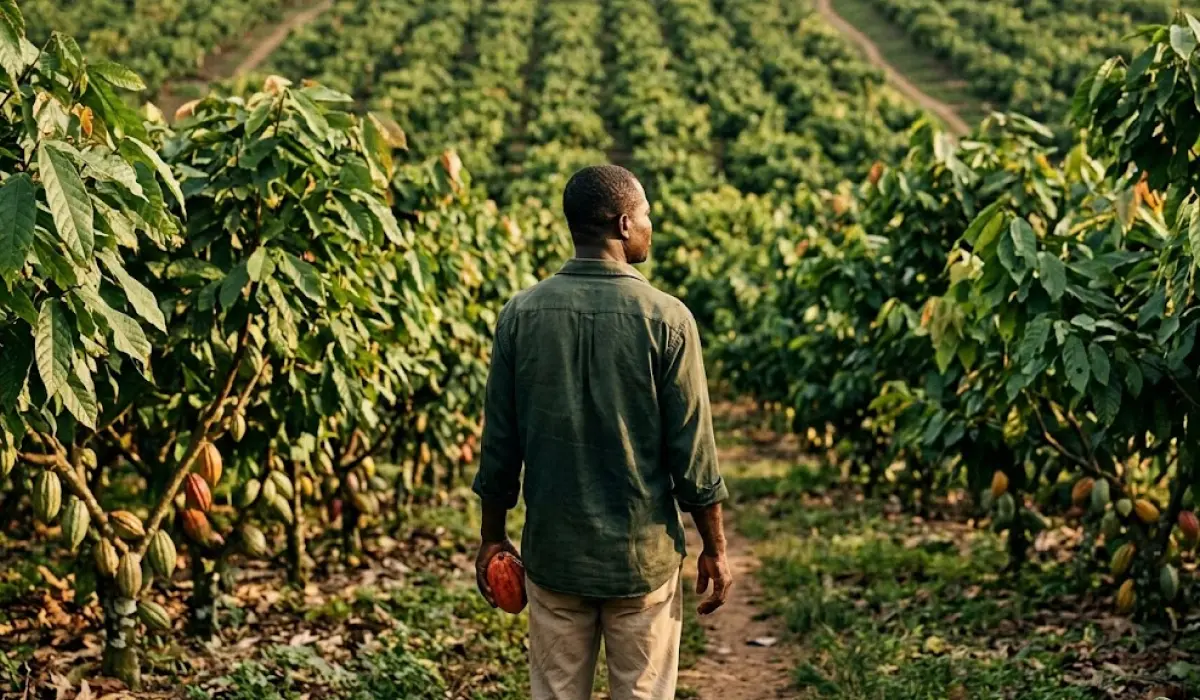
Chocolate consumption is rising. Global demand has grown by 20% in the last 5 years, and the appetite for premium chocolate has never been stronger. Yet, across West Africa, many of the farmers who grow the core ingredient are actively abandoning their crops.
This is a paradox that defies basic economic logic. How can consumer demand for chocolate be so high while the farmers producing cocoa are struggling to survive?
To understand this disconnect, we have to examine the physical reality on the ground. The market is currently celebrating a collapse in cocoa prices, treating it as the end of a speculative bubble. However, the market is misreading the cycle.
The structure of the global cocoa supply is fundamentally broken, and the farmers are paying the heaviest price.

The rollercoaster of cocoa pricing
For most of the 2010s, cocoa prices were remarkably stable. Manufacturers enjoyed a predictable market, with prices hovering reliably around $2,500 per tonne. This stability allowed the chocolate industry to thrive and expand globally.
Then, the system fractured. In 2024, a catastrophic mixture of bad weather and crop disease triggered a massive supply shock. Panic set in, and prices skyrocketed to historic highs, briefly crossing the staggering $10,000 per tonne threshold.
Today, those prices have crashed back down. Financial analysts claim the bubble has burst and normality has returned.
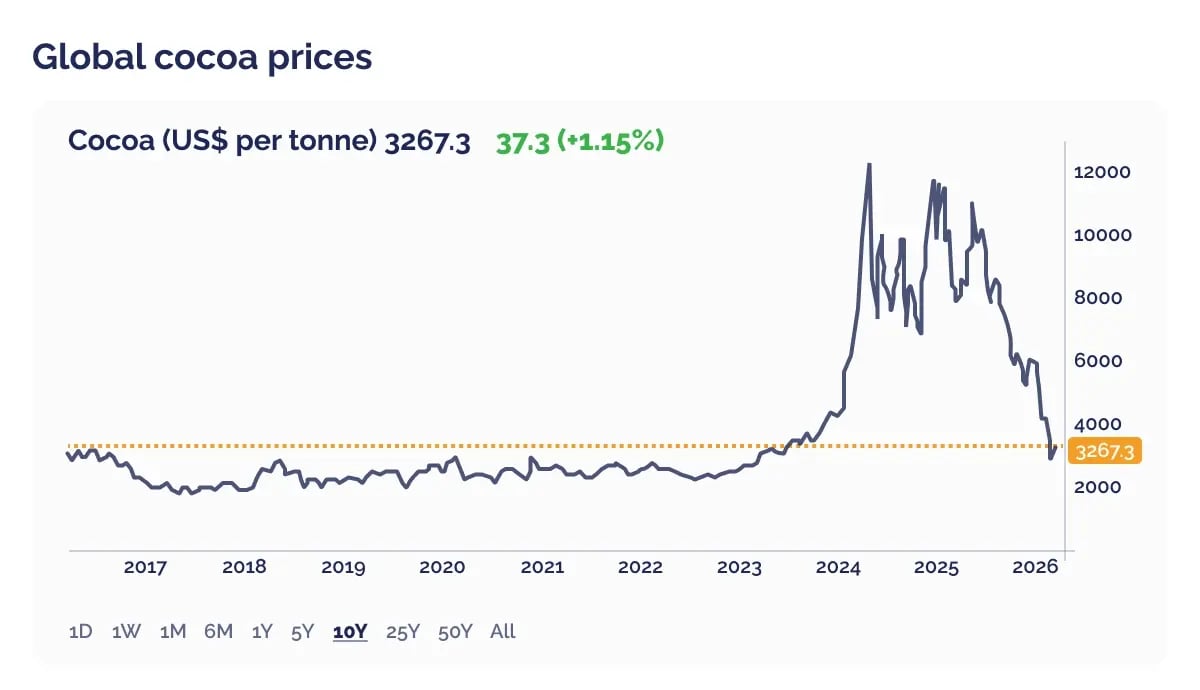 Global cocoa prices have been regular until 2024’s spike and the recent fall. Source: tradingeconomics.com
But this recent drop in price is not a sign of a healthy, recovered market. It is an illusion masking a multi-year supply constraint.
Why farmers are leaving beans to rot
West Africa produces approximately 60% to 70% of global cocoa, with the Republic of Côte d'Ivoire (Ivory Coast) and Ghana dominating the landscape. Currently, both nations are in a state of structural agricultural decline.
Read more: Why we need to restore high-priority areas like Africa
Recent reports highlight a tragic reality for West African farmers. Despite the global love for chocolate, many smallholder farmers are currently abandoning their harvests. During the massive price spike of 2024, the cost of essential agricultural inputs like fertiliser and daily labour skyrocketed alongside inflation.
Now that the global commodity price of cocoa has suddenly dropped, the maths simply no longer works for the farmer. The cost to harvest, ferment, and transport the beans is now higher than the price they will receive at the market. Selling the beans results in a financial loss, so the crops are left to rot on the trees or in the warehouses.
This creates a devastating cycle. Without a living margin, farmers cannot afford to invest in their land.
Read more: The role of local communities in preserving Ivory Coast's forests
The physical constraints of supply
When farmers cannot afford to invest in their farms, the long-term supply of cocoa degrades rapidly. We are seeing this play out in real time through several compounding factors:
-
Ghana has seen its cocoa production collapse by roughly 50% in just two seasons.
-
The devastating cocoa swollen shoot virus is spreading rapidly across plantations.
-
Millions of hectares rely on aging trees with steadily declining yields.
-
Climate volatility is creating extreme rainfall and extended droughts.
-
Millions of farmers are aging out of the sector with no younger generation willing to take on the financial risk.
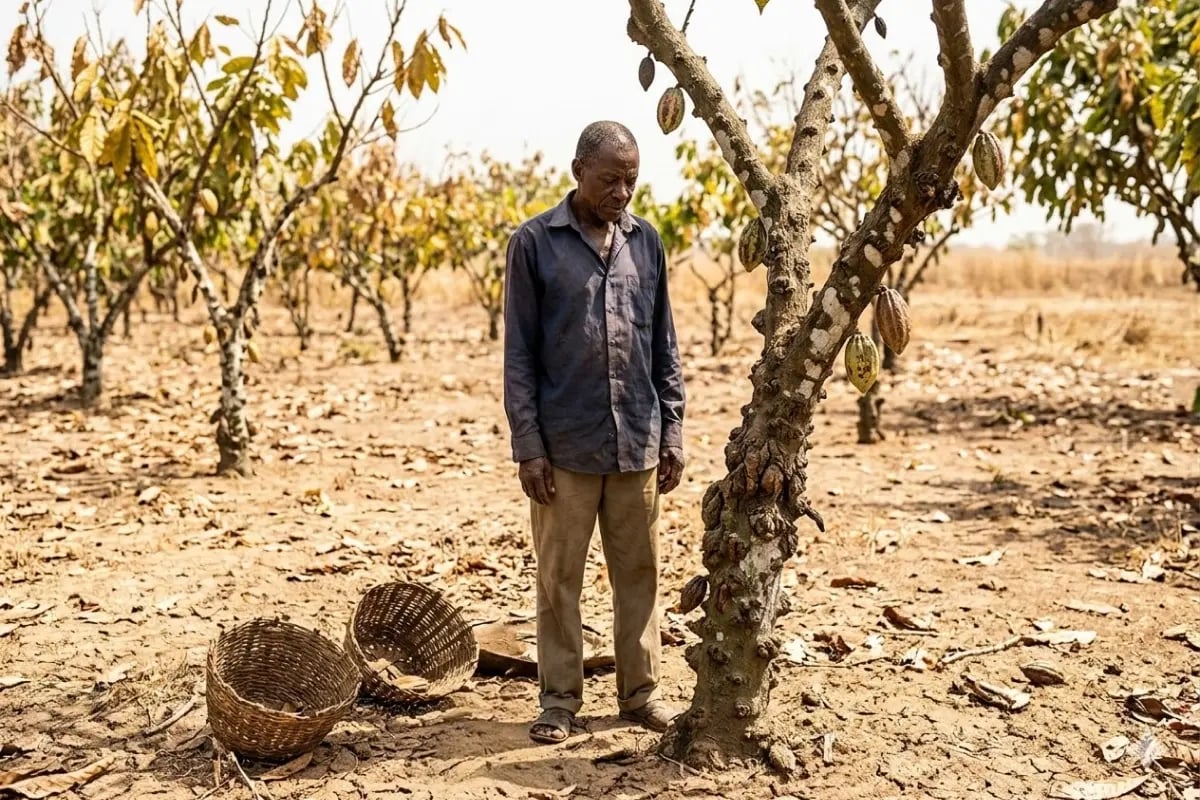 A Ghanaian farmer inspecting his degraded land on a cocoa farm. Ai generated picture.
Food commodities follow the laws of physics, not financial headlines. You cannot instantly manufacture a cocoa bean. A new cocoa tree takes three to five years to produce a viable crop. If farmers are not planting today because they cannot afford the fertiliser, there will be no cocoa tomorrow.
Read more: The deforestation in Ghana: causes and solutions
The illusion of oversupply
If supply is so tightly constrained, why did the price collapse in the first place? The answer lies in inventory timing and human behaviour.
When prices hit record highs in 2024, it forced immediate demand rationing. Large processors slowed their purchasing to manage their margins. Simultaneously, farmers who could afford to wait began hoarding their beans, hoping the record-high prices would return.
This dynamic created the temporary illusion of an oversupplied market. But it is not an oversupply. It is simply dislocated inventory occurring right in the middle of a structural deficit. The world has already run two consecutive cocoa deficits, and global stocks-to-grinding ratios are sitting near historic lows.
Read more: Planting the future: Nestlé's bold move to cut cocoa emissions
The true cost of chocolate
The current market confusion comes from pricing in short-term volatility while ignoring long-term physical scarcity. We are simply entering the phase every commodity cycle eventually reaches: the quiet period after the panic and before the next inevitable supply squeeze.
The core equation of the chocolate industry remains unsolved. No farmer margin means no investment. No investment means no future cocoa supply. Ultimately, no cocoa supply means the era of the $10 chocolate bar is rapidly approaching.
Read more: Seeds of impact: Expanding Uganda’s green horizon
Until the supply chain transforms to ensure that the farmers taking all the agricultural risk are actually paid a profitable, living wage, the structural crisis will only deepen.
The future of agricultural commodities depends on building resilience and equity back into the land. To secure sustainable supply chains and protect vulnerable farming communities, businesses must move beyond short-term market reactions and invest in long-term, transparent action.
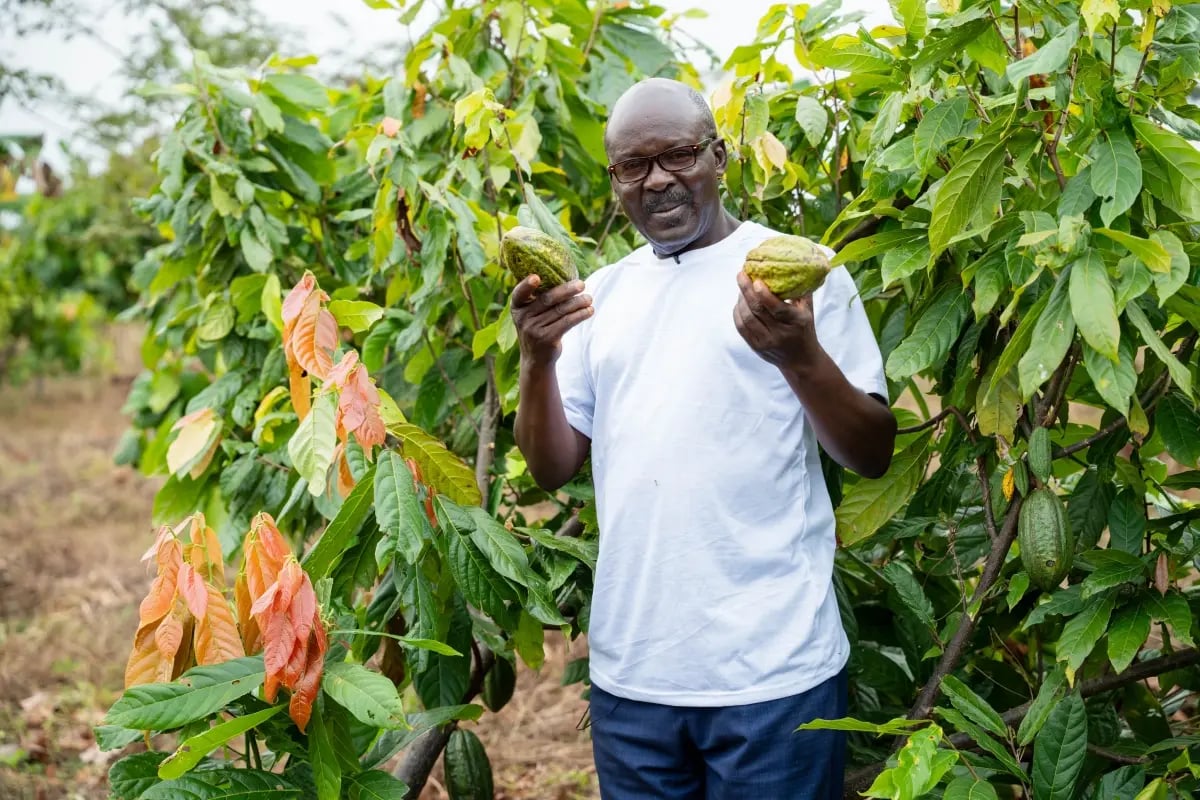 A Green Earth member inspecting healthy, mature cocoa pods on a plantation as part of Bulindi Agroforestry and Chimpanzee Conservation Project.
At Green Earth, we develop nature-based solutions at scale that support farmers and revitalise degraded land. Through sustainable agricultural methods like agroforestry, we improve soil health and bring back biodiversity, contributing to healthier crop yields. Our agroforestry and reforestation projects provide farmers with training and seedlings, from indigenous species to fruit and nut trees like cacao. Healthier land means less reliance on fertilisers and pesticides, and along with the farmers’ ownership of all crops they plant, it contributes to additional income for rural families and a more resilient local economy.
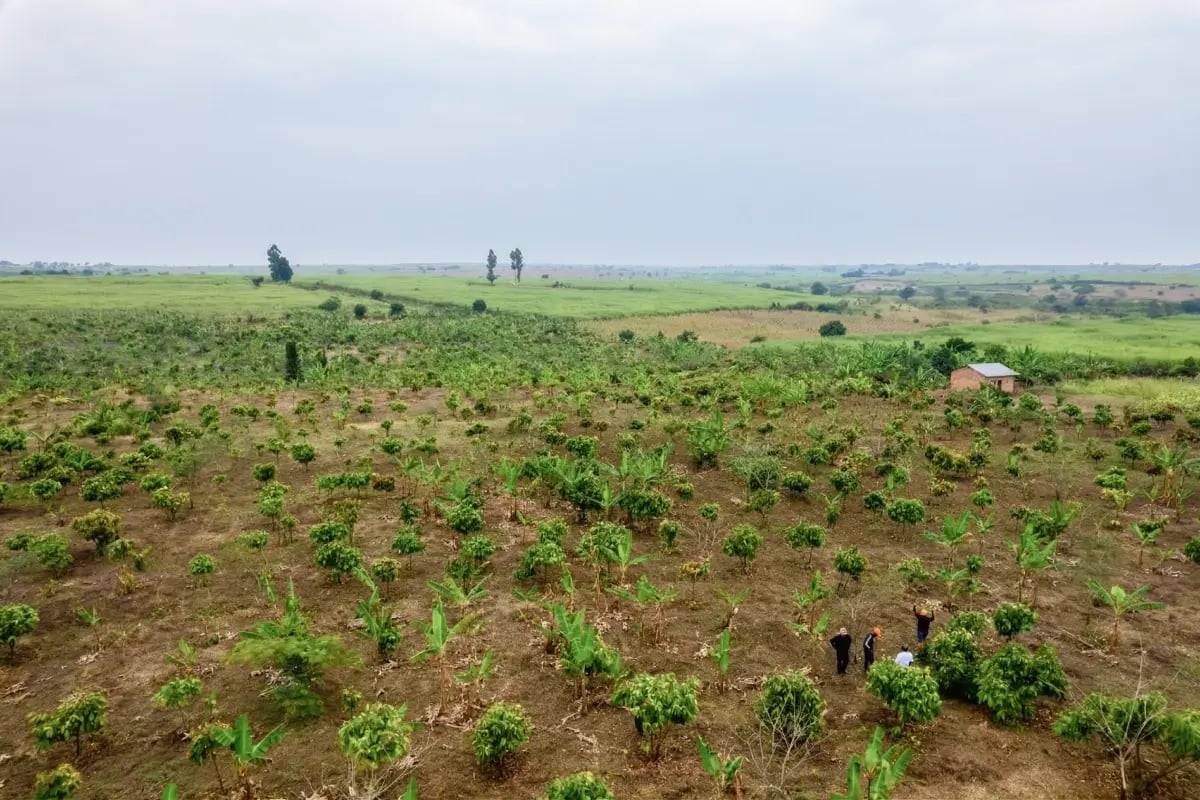 A healthy and thriving cocoa plantation in Uganda. Bulindi Agroforestry and Chimpanzee Conservation Project, Green Earth.
To discover more about our impactful projects, or to find out how to partner with Green Earth to develop a carbon project or buy verified carbon credits from our nature-based portfolio, get in touch.