
Nature conservation
Sustainability
Carbon markets
Governments
New Zealand has released a new assurance framework to support the development of verified nature and carbon markets domestically, giving buyers, landowners, and project developers greater confidence in market integrity.
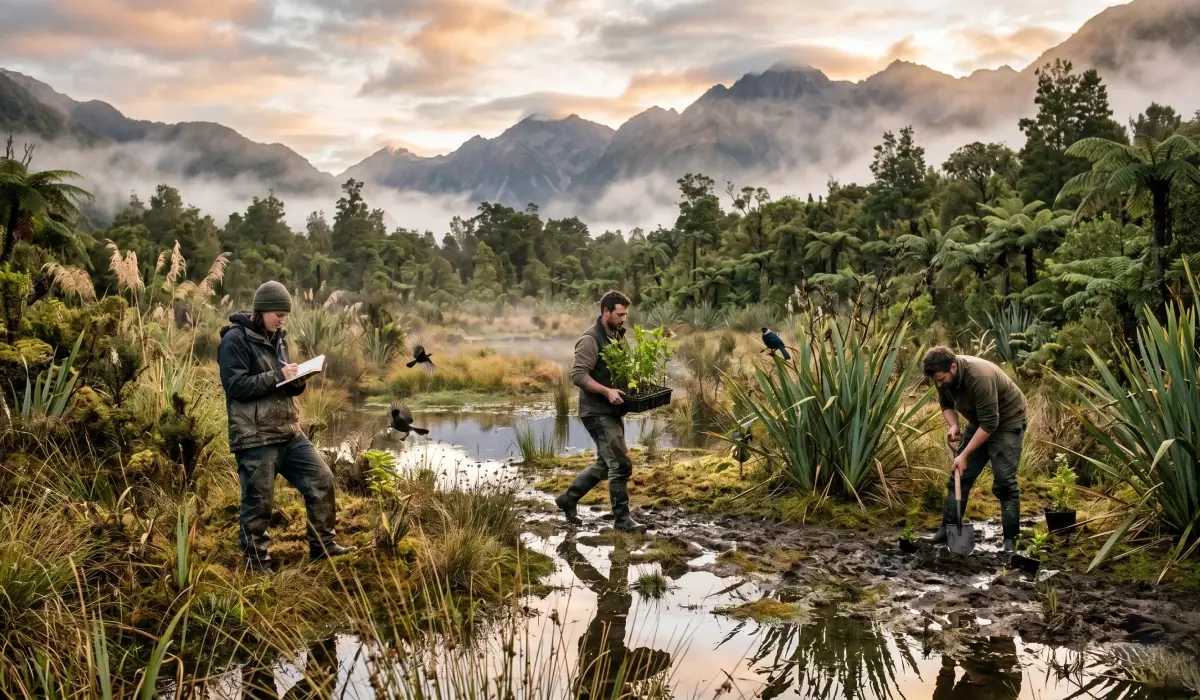
 Environmental workers restoring wetlands and planting native trees in New Zealand as part of emerging nature and carbon market projects. AI generated picture.
The framework introduces two pathways. The first recognises schemes already accredited by reputable international bodies. The second offers an opt-in endorsement pathway for domestic schemes, to be assessed against six national integrity principles.
Those principles require that projects and credits be additional, durable, real and measurable, transparent, respectful of rights, and free from double-counting.
Two international bodies have been approved with immediate effect: the Coalition to Grow Carbon Markets and the Integrity Council for the Voluntary Carbon Market (ICVCM). The domestic opt-in pathway is expected to open in the coming months.
Read more: Who’s who in the carbon market: Key institutions and frameworks and what they do
The government framed the framework as a response to a funding gap. Pressure on nature and the environment exceeds what public funding alone can address, it said, meaning New Zealand has been missing opportunities to attract private investment into local projects.
Potential areas for development named in the statement include wetland restoration, native planting, habitat protection, and carbon removal.
The framework also opens public conservation land to privately funded nature and carbon projects, provided they deliver benefits beyond what the Crown already funds. Department of Conservation concession requirements continue to apply, and projects are expected to use endorsed schemes. Applications are due to open later this year.
Importantly, endorsement under the new framework functions as a quality signal, not a Crown guarantee. Buyers retain the responsibility to carry out their own due diligence.
The framework follows ten pilot schemes conducted between June 2025 and March 2026, covering conservation and restoration projects, large landholders, and project developers. Participants included Sanctuary Mountain Maungatautari, a fenced ecosanctuary in Waikato; Pāmu, New Zealand's state-owned farming enterprise; and Trees That Count, a native reforestation non-profit.
Read more: TotalEnergies posts record Q1 carbon credit spend
Moves to strengthen market integrity are a step in the right direction for the verified carbon market globally. Green Earth supports this direction through its portfolio of verified nature-based projects across Africa and Central Asia, each independently audited and designed to deliver measurable environmental outcomes alongside lasting community benefits.