
Paris Agreement
Carbon trading
Norway
Decarbonisation
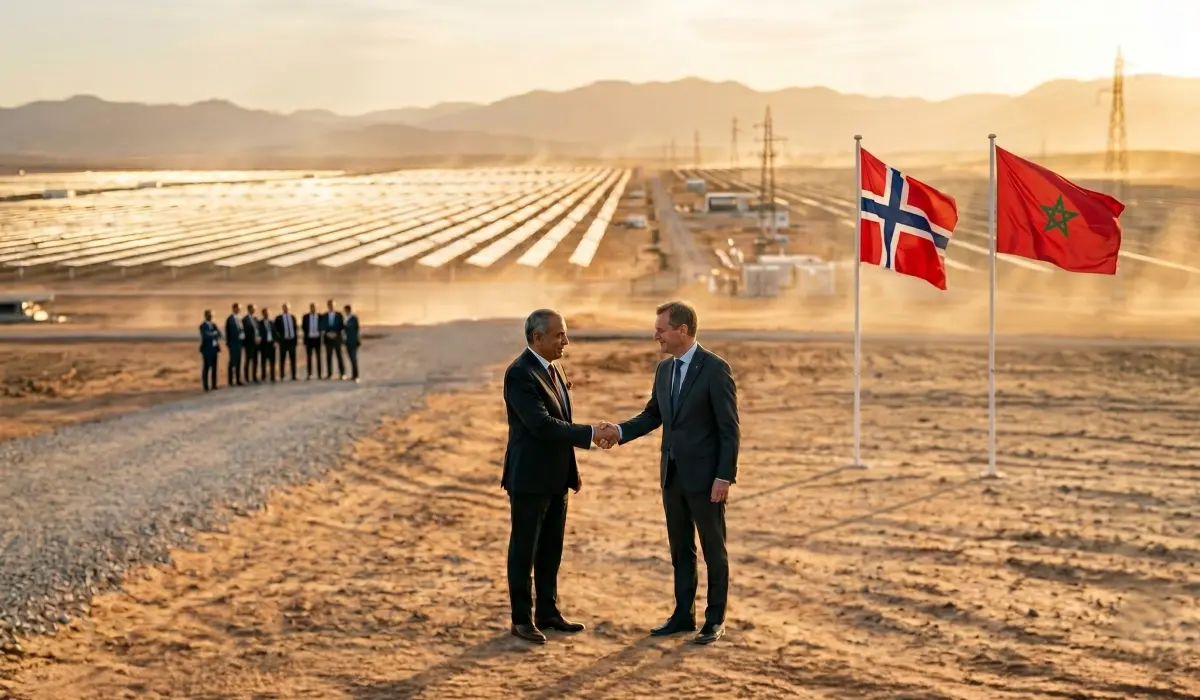
Morocco and Norway have signed a new cooperation agreement on carbon markets, setting out a framework for joint emissions-reduction projects and renewable energy investment.
 Moroccan and Norwegian officials engaging in a formal agreement, with a solar farm in Morocco’s desert landscape extending across the background, symbolizing cooperation in clean energy. AI generated picture.
The deal was signed by Morocco's Minister of Energy Transition Leila Benali and Norway's Minister of Climate and Environment Andreas Bjelland Eriksen. It positions the two countries to develop projects together and to expand the use of international carbon market mechanisms under the Paris Agreement.
The agreement focuses on projects that generate internationally transferable mitigation outcomes (ITMOs) under Article 6 of the Paris Agreement. ITMOs allow countries to cooperate on emissions reductions and count the results towards their national targets.
According to Morocco's Ministry of Energy Transition, the partnership is structured around Article 6.2, the bilateral track of the mechanism. This route lets participating countries trade mitigation outcomes directly under terms they define together, with reporting to the United Nations Framework Convention on Climate Change.
Read more: Japan and Vietnam upgrade JCM to meet Article 6 rules
The two governments plan to channel the partnership into high-impact projects and to encourage sustainable investment flows into Morocco's energy sector. A Generation-Based Incentive (GBI) programme is also on the table. The scheme is designed to reward clean energy production directly, supporting renewable capacity additions and the emissions reductions linked to them.
The cooperation is expected to strengthen the role of carbon markets in the broader decarbonisation effort within both countries' value chains and to give project developers a clearer pathway to monetise verified outcomes.
Morocco–Norway is part of a wider pattern. Governments are increasingly turning to bilateral Article 6 deals as a route to meet nationally determined contributions, with Switzerland, Singapore, Sweden, and Japan among the most active buyers of ITMOs to date. For host countries such as Morocco, these agreements can unlock financing for renewable energy and nature-based projects that might otherwise stall.
Read more: Why a forest with more species stores more carbon
As international carbon markets become more technically rigorous, the integrity of the credits used to compensate for hard-to-abate emissions within a company's value chain matters more than ever. Green Earth develops large-scale, nature-based carbon projects accredited by leading international standards, with full oversight at every stage of the project lifecycle—from design and implementation through to long-term monitoring and credit issuance. Our projects restore ecosystems, strengthen biodiversity, and improve community livelihoods, delivering verified environmental impact built to withstand the highest levels of scrutiny. For businesses operating in an increasingly regulated landscape, that integrity is what counts. Explore our verified carbon credits to find out more.