
Australia
Carbon markets
Carbon pricing
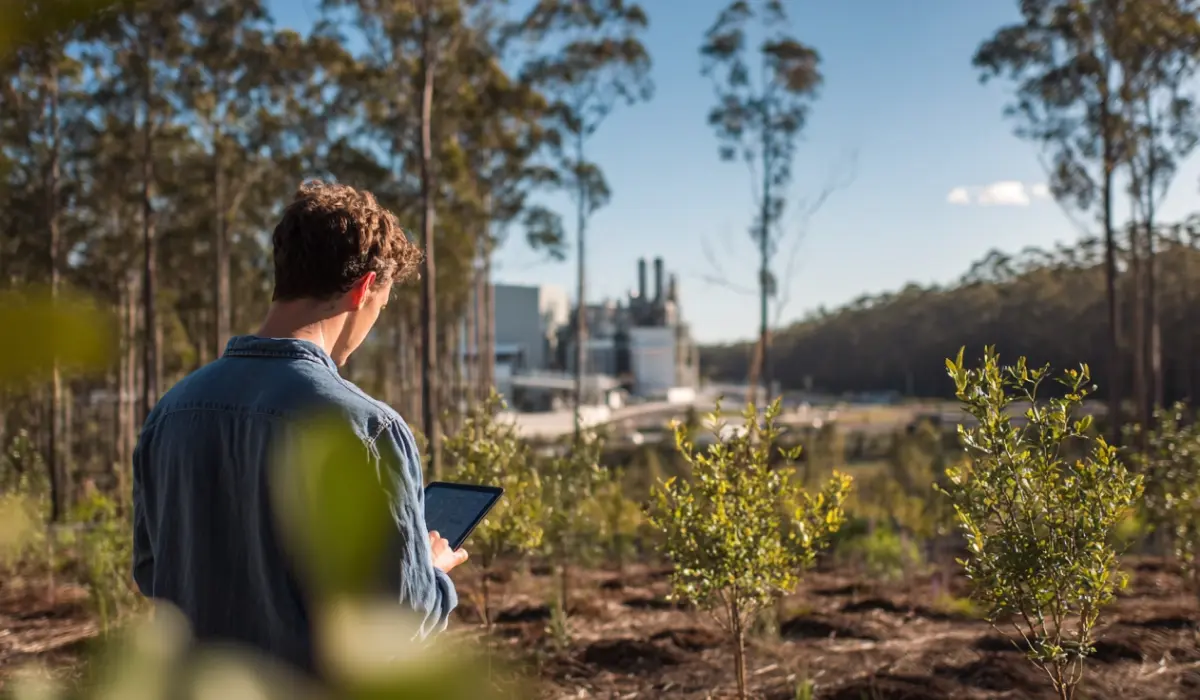
As the calendar turns to 2026, the Australasian carbon markets are entering a pivotal phase of structural adjustment. In Australia, the convergence of tightening regulatory baselines and new contractual flexibilities is creating a complex supply-demand dynamic. At the same time, New Zealand’s market remains tethered to upcoming policy signals for the 2026–2030 period.
 A man checking newly planted trees, with an Australian forest and factory in the background. AI generated picture.
Market analysts widely expect Australian Carbon Credit Units (ACCUs) to breach the $26.82 (AUD40) per tonne mark this year. The primary catalyst is the Safeguard Mechanism (SGM), which is forcing industrial facilities to secure more credits as increasingly stringent emission baselines are implemented.
Gary Wyatt, managing director at Corporate Carbon, notes that this tightening is a direct driver of value: ‘The tightening of the baselines can drive higher ACCU demand and result in price increases as facilities are required to surrender more of these units.’
The landscape may shift further as the government reviews the SGM for the 2026-2027 fiscal year. On the table is a recommendation from the Productivity Commission to lower the participation threshold from 100,000 to 25,000 tonnes of CO2e, a move that would significantly broaden the compliance buyer base.
A major variable for 2026 is the ‘permanent exit window’ for Carbon Abatement Contracts (CACs). This allows developers to pay a fee to release units from fixed-price government contracts—often locked in at under $10 (AUD15)—and sell them on the spot market for double that value.
While this could, in theory, unlock up to 63 million units by 2030, experts are divided on the immediate impact. Some fear an oversupply that could dampen prices, while others, like Ian Dobbs of Tasman Environmental Markets, suggest supply could actually tighten. He notes that the requirement to deliver 25% of the contract volume to the government to qualify for the exit could force underperforming projects to buy units from the spot market just to settle their obligations.
Read more: Green wheels: A transformative leap for plastic collection in Sri Lanka
The year 2026 also marks a turning point for transparency and project diversity:
- Concerns over greenwashing have led to exits from this voluntary scene. Dobbs warns that if the scheme is downgraded, the price premiums enjoyed by specific credit types could vanish.
- Investors are looking toward the Savanna Fire Management (SFM) and the long-awaited Integrated Farm and Land Management (IFLM) drafts. However, Wyatt remains sceptical of the latter, stating: ‘In our view, IFLM is now a dead duck and will slowly get pulled to pieces.’
Across the Tasman, the New Zealand Units (NZU) market is characterised by cautious stability. Prices are expected to remain rangebound around $26.11 (NZD45) until the government finalises unit limits and price controls for the 2026-2030 period. Nigel Brunel of Marex New Zealand emphasises that ‘any signal that restores durability, predictability, and commitment’ to the Emissions Trading Scheme will be the ultimate market mover.
Read more: CSRD for SME Suppliers: How to turn data requests into a competitive advantage
As the 2026 outlook makes clear, the era of ‘wait and see’ in the carbon markets is closing, replaced by a sophisticated environment where regulatory tightening and high-integrity demand are the new benchmarks. With ACCU prices projected to test new price thresholds and the Safeguard Mechanism expanding its reach, the distinction between generic offsets and high-value, nature-based removals has never been more critical for long-term portfolio resilience. At Green Earth, our portfolio is purpose-built for this shift; we deliver verified credits that prioritise ecosystem restoration and social co-benefits, ensuring our partners meet the rising transparency and durability standards demanded by both regulators and investors. In a market where supply is tightening and policy is maturing, aligning with proven, high-quality projects is the most effective way to turn compliance complexity into a strategic advantage—and we are ready to help you lead that transition.