
Carbon credits
Amazon
United Kingdom
Carbon trading
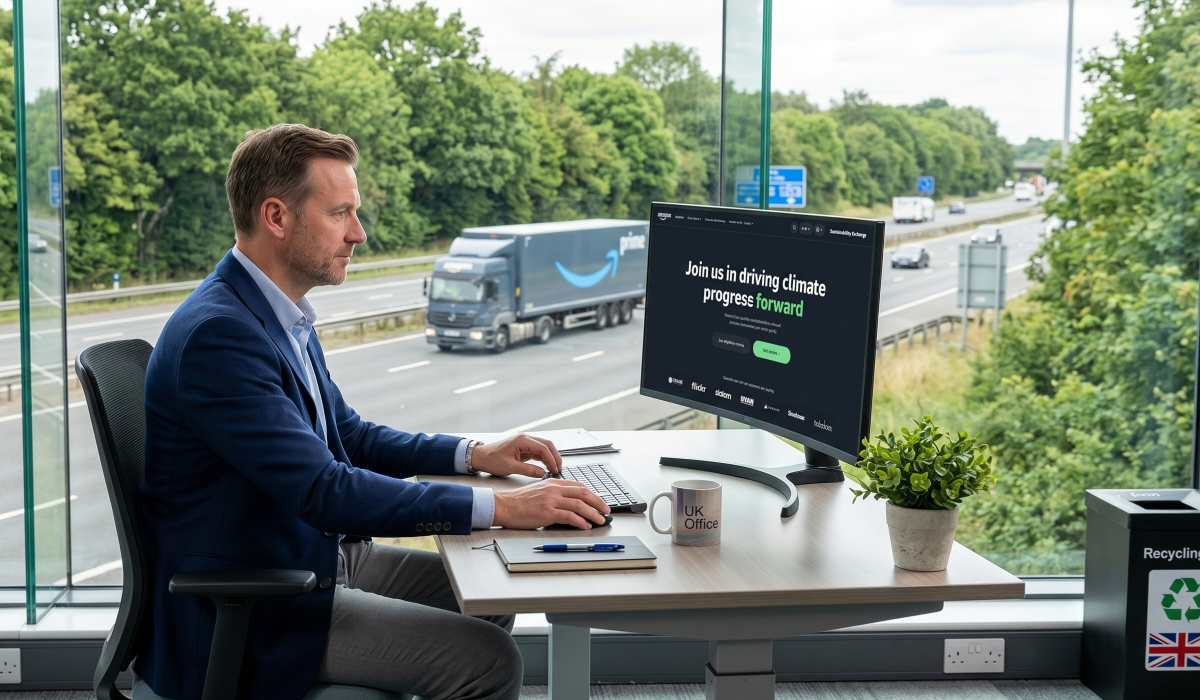
Amazon has opened its carbon credit platform to qualified businesses in the United Kingdom, marking the first international expansion of the programme since its US launch in 2025.
 A professional workspace featuring the Amazon Sustainability Exchange platform to drive climate action. AI generated image.
The company’s Sustainability Exchange now offers eligible UK companies a curated selection of vetted carbon credits. The portfolio covers forest protection and avoided deforestation, ecosystem restoration and reforestation, direct air capture (DAC) carbon removal, methane reduction, and lower-carbon fuel insets linked to supply chains.
Amazon’s chief sustainability officer, Kara Hurst, said: ‘The voluntary carbon market has struggled with transparency and quality, making it hard for companies to invest with confidence. But the science is clear: we need to protect forests, restore ecosystems, and remove carbon at scale. We’re using our size and technical expertise to make high-quality credits available to ambitious UK companies already doing the hard work of cutting their own emissions and wanting to go further.’
The service is open only to companies already working to reduce their emissions. To qualify, businesses must hold a net-zero target no later than 2050, cover Scope 1, Scope 2, and Scope 3 emissions, and publish regular carbon emissions reports. Amazon says these requirements keep carbon credits in a supplementary role—adding to a company’s reduction work, not replacing it.
Read more: UK announces 87% emissions cut target in seventh carbon budget
A notable feature of the platform is its inclusion of carbon insets alongside neutralisation credits. Traditional neutralisation credits support projects outside a company’s own operations. Insets target emissions within the value chain itself—for instance, lower-carbon fuels used in logistics or projects that reduce agricultural suppliers’ emissions.
Amazon co-founded The Climate Pledge in 2019 and committed to reaching net-zero carbon emissions by 2040, ten years ahead of the Paris Agreement timeline. More than 550 organisations have since joined the initiative. In its latest sustainability report, the company noted that its carbon intensity has fallen by more than 40% since 2019. It was the world’s largest corporate purchaser of renewable energy for the fifth consecutive year in 2024, and has deployed more than 31,000 electric delivery vans globally.
The outlook for verified carbon markets remains significant. The Taskforce on Scaling Voluntary Carbon Markets estimated the market could reach $50 billion by 2030. McKinsey & Company predicts demand for carbon credits may grow more than 15 times by 2030. Ecosystem Marketplace reported that the market generated approximately $535 million in transaction value in 2024, with activity shifting towards higher-quality projects and carbon removal solutions.
Read more: The real cost of 1 tonne of CO2: Translating carbon into hectares
As demand for trusted, high-quality carbon credits grows, the standards behind each credit matter more than ever. Green Earth develops large-scale nature-based carbon projects accredited to leading international standards, with full supply chain oversight from initial design through to long-term monitoring and credit issuance. Every project delivers verified environmental impact across ecosystems, communities, and biodiversity—built to the highest levels of regulatory scrutiny.