
Nature conservation
Carbon emissions
United Kingdom
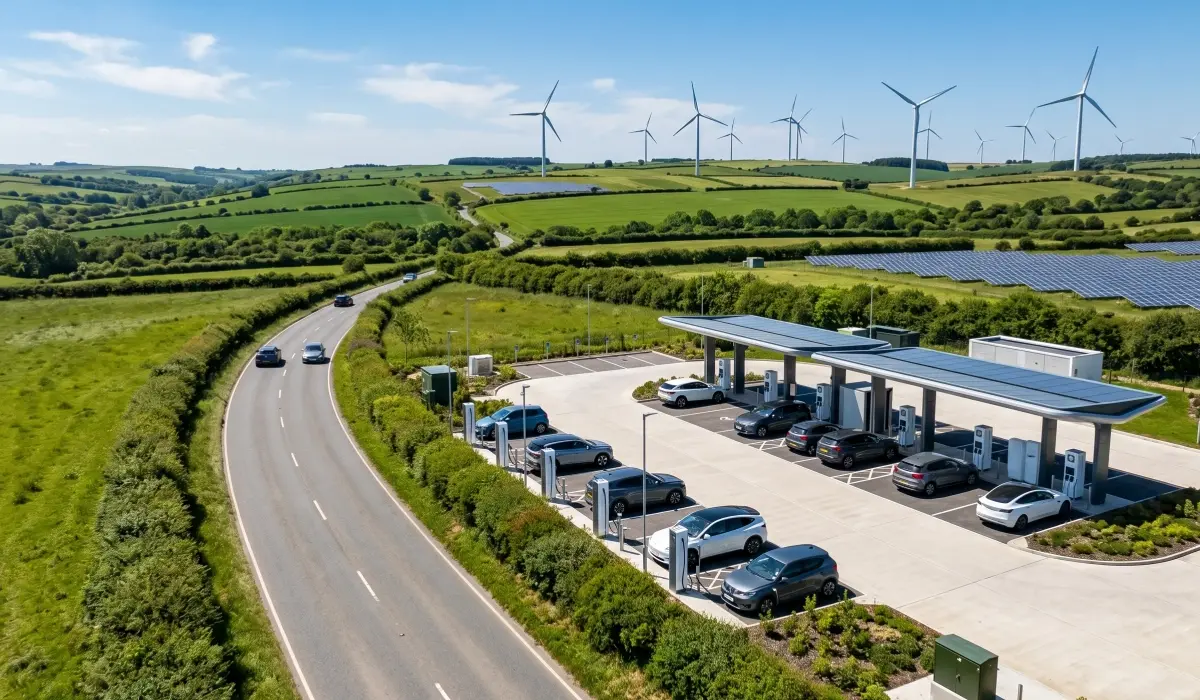
The UK government has published its proposed seventh Carbon Budget, targeting an 87% reduction in carbon emissions from 1990 levels during the 2038 to 2042 period.
 Electric vehicles charging at a modern UK station powered by nearby wind turbines and solar farms, illustrating the country’s shift to clean energy. AI generated picture.
A carbon budget is a legally binding cap on the volume of carbon emissions permitted in the UK over a five-year period. Budgets must be set at least 12 years in advance, giving policymakers, businesses, and individuals adequate time to plan and adjust.
Carbon Budget 7 (CB7), endorsed by both the Environmental Audit Committee and the Climate Change Committee (CCC), limits total emissions for the 2038–2042 period to 535 million tonnes of CO2 equivalent. The Department for Energy Security and Net Zero (DESNZ) described the proposal as grounded in ‘evidence-based assumptions about how the country will take a consumer choice-led approach to the adoption of technologies such as solar, batteries and EVs that will cut bills for families.’
DESNZ identified three drivers underpinning the target level. The transition to clean energy reduces the UK’s exposure to fossil fuel price shocks, a risk the country experienced acutely following the conflicts in Ukraine and the Middle East. The transition is also projected to generate wider benefits for the economy, public health, and nature. Additionally, CB7 is designed to be ‘consistent with the Paris Agreement aim to keep global warming to 1.5 degrees Celsius, to avoid climate disaster for future generations.’ A delivery plan will be published following parliamentary approval of the budget.
Read more: The real cost of 1 tonne of CO2: Translating carbon into hectares
The UK is currently in its fourth carbon budget period, spanning 2023 to 2027, with a target of a 77% reduction from the 1990 baseline. Performance across earlier periods has been strong: by the end of 2022, emissions had fallen by 50% from the 1990 baseline, against a target of 38%.
England’s biodiversity net gain (BNG) market adds further momentum towards the UK’s 2042 targets. Research by conservation company Nattergal indicates that the BNG system—which requires developers to deliver a minimum 10% net improvement in biodiversity on new developments—could protect more than 80,000 hectares of natural habitat by 2042, contributing to the government’s pledge to restore or create 500,000 hectares of wildlife-rich habitat by that year. The market has grown from a single 32-hectare site in February 2024 to 215 sites covering 7,410 hectares by January 2026, funded entirely by developer demand with no public subsidy. ‘Two years ago, this market did not exist,’ said Archie Struthers, chief executive of Nattergal. ‘Today, it is restoring the equivalent of the Lake District in natural habitat — without a penny of public money.’
Read more: Indonesia targets leadership in global carbon markets with new rules
As regulatory frameworks like the Carbon Budget 7 establish clearer, more demanding benchmarks for 2042 and beyond, environmental accountability becomes an increasingly pressing consideration for businesses in every sector. For companies carrying hard-to-abate emissions within their value chain, the credibility of the carbon credits they use to compensate for those emissions may becoming a defining issue.
Green Earth’s large-scale nature-based carbon projects are accredited to leading international standards, with full supply chain oversight from initial design and implementation through to long-term monitoring and credit issuance. The result is verified environmental impact across ecosystems, communities, and biodiversity—built to meet the highest levels of regulatory scrutiny.