
Tree planting
Forest
Indonesia
Carbon trading
The Indonesian Ministry of Forestry has issued Regulation No. 6/2026, a new framework designed to expand access to the country’s forestry carbon market, simplify trading procedures, and increase the supply of high-integrity carbon credits.
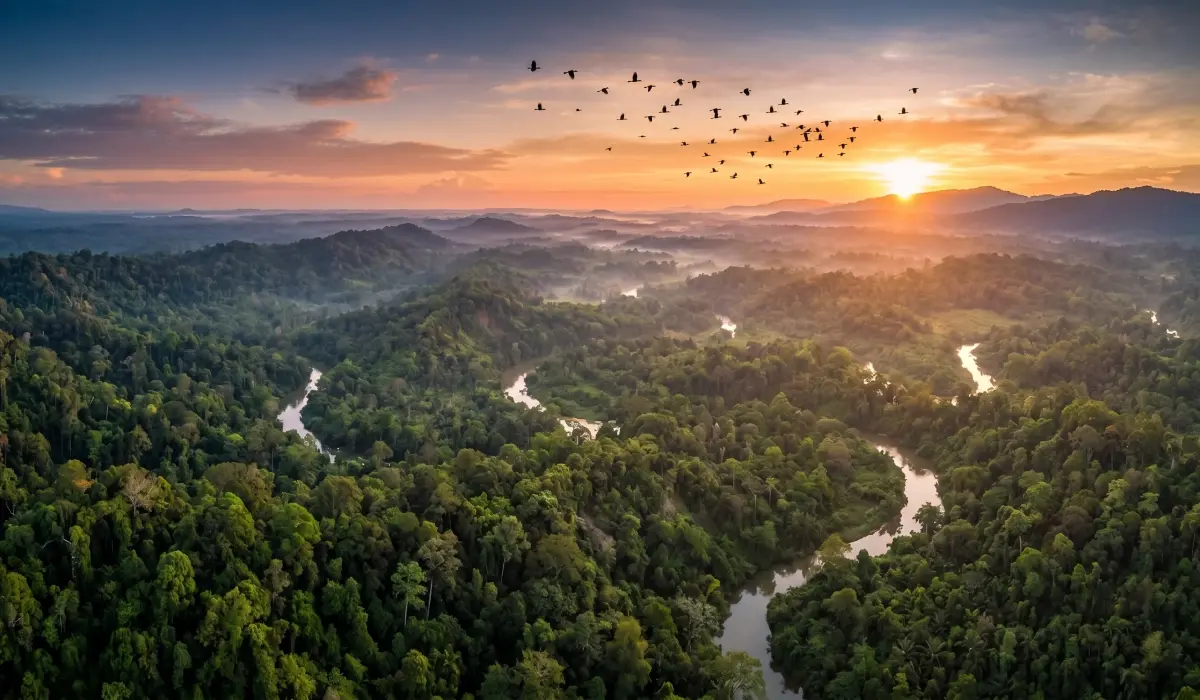
 Aerial view of Indonesia’s tropical rainforest, one of the world’s largest natural carbon sinks and a key asset in the country’s expanding carbon market. AI generated picture.
Edo Mahendra, senior adviser to Indonesia’s forestry minister, described the regulation as marking ‘a new chapter in the carbon market era’ for the country. He said the policy builds clearer and more streamlined business processes for carbon trading in the forestry sector, responding to growing global demand for higher-quality carbon credits. Preserving environmental integrity as the market expands was also identified as a key objective.
The regulation broadens access to carbon investment mechanisms and introduces a nesting approach designed to prevent double-counting of carbon credits. Nesting aims to improve coordination between individual project-level accounting and national carbon accounting frameworks, ensuring that verified emissions reductions are recorded only once. The approach is intended to strengthen confidence in the integrity of credits generated under the mechanism.
Read more: Carbon pricing revenues hit $107 billion in 2025
Mahendra said Indonesia is seeking to position itself as an active leader in international carbon markets, building on the country’s existing natural assets. The government intends to continue strengthening Indonesia’s credibility by aligning with international standards and responding to global market expectations.
Indonesia holds one of the world’s largest tropical forest areas, a significant natural asset for carbon absorption. The country has increasingly promoted forestry-based carbon trading as a route to attract investment and leverage the carbon storage potential of its forests.
Read more: Why a forest with more species stores more carbon
The new regulation arrives at a time of growing emphasis from governments and investors on transparency and environmental credibility in global carbon markets. Indonesia’s updated framework forms part of the country’s broader effort to attract carbon investment through its forestry sector.
As carbon pricing expands and regulatory scrutiny increases, the integrity of the carbon credits used to compensate for hard-to-abate emissions within a company’s value chain matters more than ever. Green Earth develops large-scale, nature-based carbon projects accredited by leading international standards, with full oversight across every stage of the project lifecycle—from design and implementation through to long-term monitoring and credit issuance. Our projects restore ecosystems, strengthen biodiversity, and improve community livelihoods, delivering verified environmental impact built to withstand the highest levels of scrutiny. For businesses operating in an increasingly regulated landscape, that integrity is what counts.