
Carbon credits
Carbon markets
Carbon compensation
The voluntary carbon market opened 2026 with a clear signal: buyers are choosing quality over quantity. New data from carbon market analytics firm Sylvera shows that credit retirements fell 8% year on year in Q1 2026, reaching 51 million from 55.3 million in the same period of 2025. Total retirement value also dipped slightly, from $309 million to $290 million. The average price per credit, however, edged upward, from $5.60 to $5.69, pointing to a market in which fewer transactions are carrying greater individual weight.
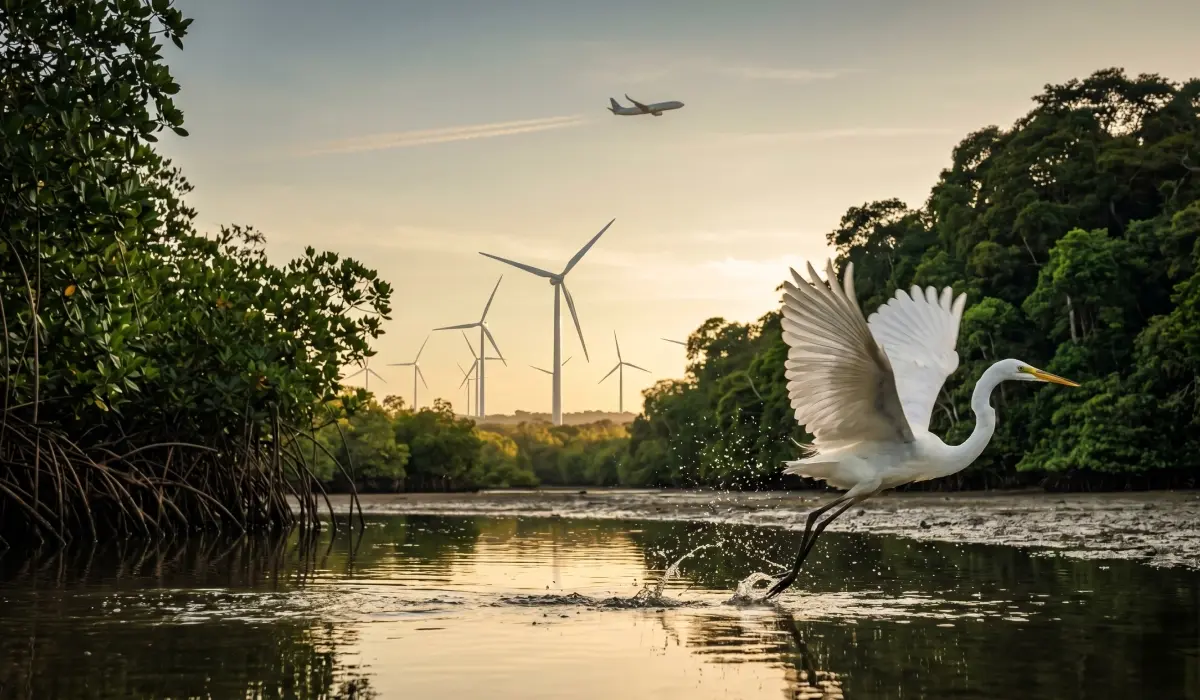
 A bird is taking flight over wetlands where mangroves, tropical forest, wind turbines, and a distant airplane are symbolizing high-quality carbon credits and a transition to a low-carbon future. AI generated picture.
One of the most significant structural shifts in Q1 was the rise of compliance-linked supply. Credits eligible under the Carbon Offsetting and Reduction Scheme for International Aviation (CORSIA), the aviation sector's compliance framework, accounted for nearly half of all new issuances for the first time. Separately, credits accredited under the Core Carbon Principles (CCP) standard reached 18% of supply, up from under 3% in 2023. The CCP price premium has more than doubled since then, reaching $3.83 per credit.
The divergence between higher- and lower-rated credits is sharpening. Investment-grade credits rated BBB+ now represent 30% of new rated issuances and 62% of total rated market value, figures that stood at 13% and 31%, respectively in 2023. Their average price reached $20.10 in Q1 2026, up from $18.10 a year earlier. B-rated credits, by contrast, averaged $7.80, down from $8.50 over the same period. Within the REDD+ (Reducing Emissions from Deforestation and forest Degradation) category, higher-rated credits have seen prices rise for three consecutive quarters, while lower-rated equivalents remain flat.
Read more: Norway and Pakistan sign their first Article 6.2 bilateral carbon market agreement
Supply is also broadening in terms of project type. Clean water initiatives generated 8.2 million credits annually by the end of 2025, 38 times their 2021 volume, making them the largest subcategory in a group of fast-growing new project types. Marine and mangrove projects reached 5.3 million credits, while nitrous oxide abatement at nitric acid plants grew 17 times since 2021 to 6.7 million credits. Regenerative agriculture went from effectively zero through 2024 to an annualised rate of more than 5 million credits in Q1 2026, the fastest rate of change of any category in the dataset.
'The first three months of the year have seen a fall in volume, but values are holding firm,' said Allister Furey, chief executive of Sylvera. He added that supply constraints could intensify, as high-quality credits become scarcer and regulatory bottlenecks limit the availability of fully compliant credits, setting the stage for tighter markets in the months ahead.
A key constraint sits at the intersection of supply and compliance. Fully authorised emissions units eligible under CORSIA now total 32.68 million, more than double the 15.84 million available in Q1 2025, yet projected Phase 1 demand stands at 181 million credits ahead of the January 2028 compliance deadline. Host country authorisation under Article 6 of the Paris Agreement remains the critical bottleneck.
Read more: Nature-based solutions vs carbon capture technology: Which is most effective?
As compliance frameworks tighten and the gap between investment-grade and lower-rated credits continues to widen, the premium on high-integrity supply is only set to grow. Green Earth develops nature-based carbon projects built to meet the standards that today's market rewards: rigorous methodology, independent verification, and full traceability from ecosystem to certificate. For businesses looking to achieve their sustainability goals with credits that hold their value and their credibility, that means measurable environmental and socio-economic outcomes backed by some of the most demanding quality benchmarks in the market.