
Carbon credits
European Union
Voluntary Carbon Market
The European Commission has adopted the first certification methodologies under the Carbon Removals and Carbon Farming (CRCF) Regulation, establishing what it describes as the world’s first voluntary standard dedicated to permanent carbon removals. The move provides long-awaited regulatory clarity for a sector seeking to scale credible, investment-ready environmental solutions.
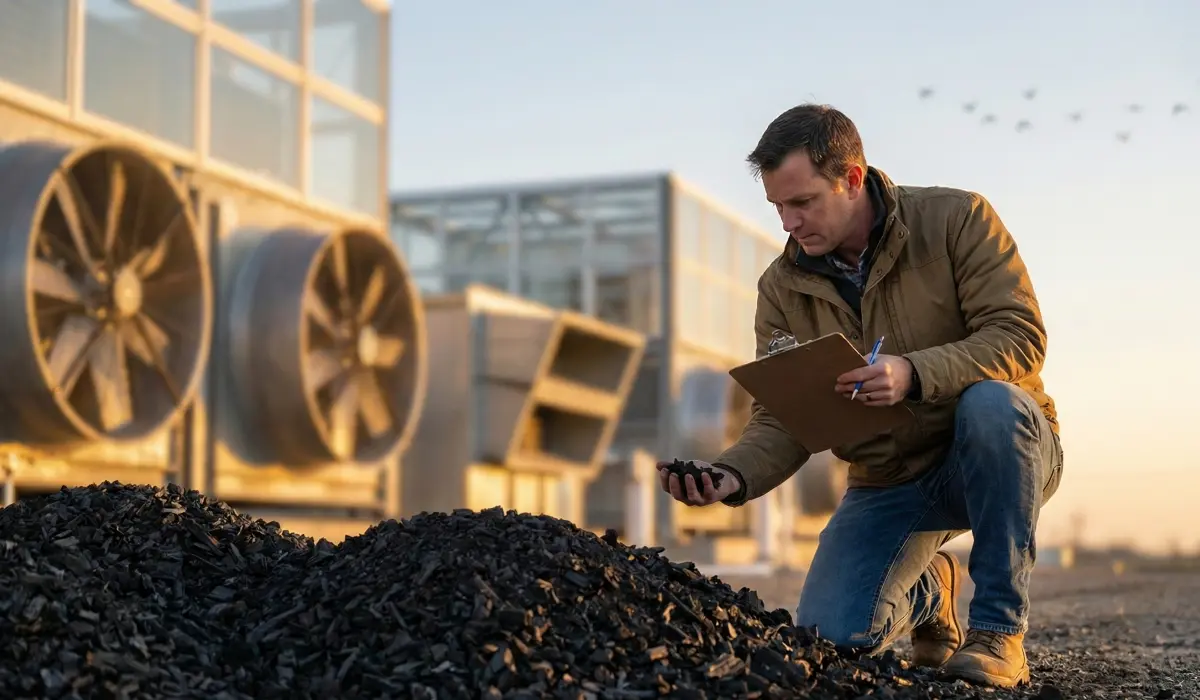
 European professional inspecting biochar pile with DACCS facility in the background. AI generated picture.
The newly adopted rules define how permanent carbon removal activities are measured, verified, and certified across the EU. They cover three categories considered technologically mature and strategically relevant for the Union’s environmental objectives: direct air capture with carbon storage (DACCS), biogenic emissions capture with carbon storage (BioCCS), and biochar carbon removal (BCR).
By formalising definitions, including what qualifies as a tonne of removed CO₂, and setting requirements around permanence, risk management, leakage prevention, and liability, the methodologies create a common European framework for assessing project integrity. The Commission states that the framework builds on existing EU green legislation, balancing environmental robustness with manageable administrative requirements.
Wopke Hoekstra, European Commissioner for Climate, Net-Zero and Clean Growth, said: ‘The European Union is taking decisive action to lead the global effort in carbon removals. By establishing clear, robust voluntary standards, we are not only fostering responsible and climate action within Europe but also setting a global benchmark for others to follow. This a vital step toward achieving our climate neutrality targets and ensuring a sustainable future.’
Read more: Koala habitat restoration credits traded at a premium
With governance structures now in place, project developers using DACCS, BioCCS, and biochar pathways can apply for EU certification. The first recognised projects are expected in the coming months, signalling a shift from regulatory design to operational implementation.
The delegated regulation will now undergo a two-month scrutiny period by the European Parliament and the Council, extendable by a further two months. If no objections are raised, publication in the Official Journal is anticipated in early April, with entry into force 20 days later.
Looking ahead, the Commission is preparing additional methodologies for carbon farming and carbon storage in bio-based construction products, with adoption targeted for 2026. An EU Buyers’ Club for permanent removals and carbon farming credits is also planned under the forthcoming EU Bioeconomy Strategy, aimed at mobilising both public and private capital.
Read more: How to choose high-quality carbon credits
As the EU formalises standards for permanent carbon removals, the market is clearly shifting towards higher integrity and greater transparency. Investors and developers now need projects that meet strict rules on measurement, permanence, and environmental credibility.
At Green Earth, we focus on building carbon solutions that align with evolving regulations while delivering measurable environmental and community benefits. Green Earth currently has high-integrity carbon credits available and invites companies and partners to connect with us to secure allocation or learn more about our projects.