
Carbon sequestration
Net zero
Sustainability strategy
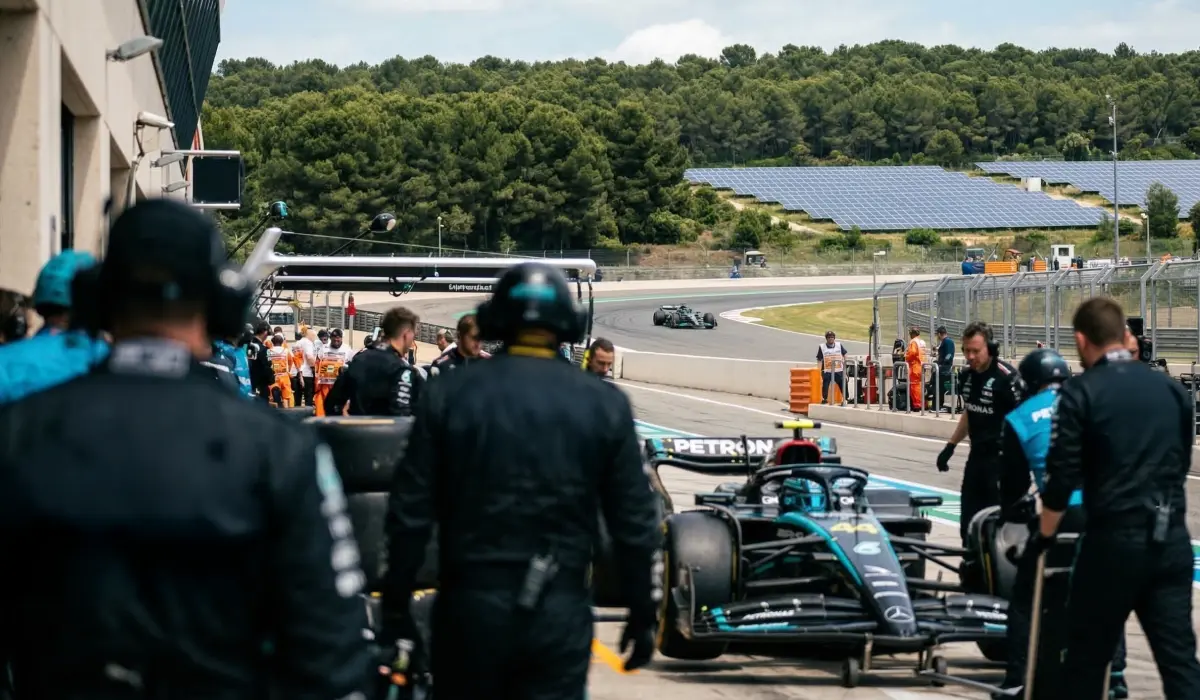
Mercedes AMG Petronas F1 Team has announced a partnership with a UK-based carbon dioxide removal (CDR) portfolio manager, to broaden its CDR activities as part of a broader net-zero strategy.
 Mercedes AMG Petronas F1 Team with their car on the track, with forest and solar panels in the background. AI generated picture.
The Formula One division of German carmaker Mercedes-Benz aims to compensate for 18,900 tonnes of CO2 equivalent (tCO2e) between 2024 and 2030. Its most recent sustainability report, published in July 2024, indicated the team had secured approximately 11,000 tCO2e at that point. The new partnership with Cur8 marks a significant step towards closing that gap.
'The expanded portfolio will be curated and delivered by Cur8, a leading carbon removal marketplace that rigorously assesses and verifies carbon removal projects to ensure project delivery,' Mercedes said.
Seven new projects will be added across six CDR technologies, including direct air capture, bioenergy with carbon capture and storage (BECCS), biochar, ocean alkalinity enhancement, and enhanced rock weathering. The portfolio spans multiple regions—Brazil, Canada, the United States, the United Kingdom, Denmark, and India—structured to align with the Formula One race calendar.
Read more: How to choose high-quality carbon credits
The team's existing CDR activities include a partnership with US forestry developer Chestnut Carbon to restore degraded land in the United States, with an expected delivery of between 1,000 and 1,500 tCO2e per year from 2027. A soil carbon project at Philipson Estates' Blaston Farm in Leicestershire, UK, is also part of the portfolio, with a three-year purchase agreement covering 2,000 tonnes against the team's footprint from 2024. Mercedes AMG Petronas is additionally linked to Frontier, a CDR buyer coalition founded in 2022 by Alphabet, Meta, Shopify, and McKinsey and Co.
These efforts support a target to cut 'Race Team Control' (RTC) emissions—which cover Scope 1 and 2 as well as selected Scope 3 value chain emissions—by 75% against 2022 levels by 2030. The remaining 25% is to be compensated with CDR credits, in line with the Oxford Offsetting Principles. In 2024, RTC emissions stood at 11,309 tCO2e, a 35% reduction from the base year. 'Our ambition is shared by our Team Partners, including Signify, UBS, and Nasdaq, who are similarly committed to advancing high-integrity climate solutions,' Mercedes said.
Read more: Net zero is driving the Formula 1 2026 regulation changes
As demand for high-integrity carbon offsetting solutions grows—demonstrated by commitments like that of Mercedes AMG Petronas F1 Team—the quality and traceability of carbon credits becomes ever more critical. Green Earth operates as an end-to-end project developer with full supply chain oversight, meaning the carbon assets we provide are directly controlled, independently verified, and designed to deliver measurable environmental restoration alongside tangible economic benefit for local communities. For organisations building or scaling a carbon compensation portfolio, that transparency is the foundation of a credible net-zero strategy.