
Governments
Blue carbon
Asia
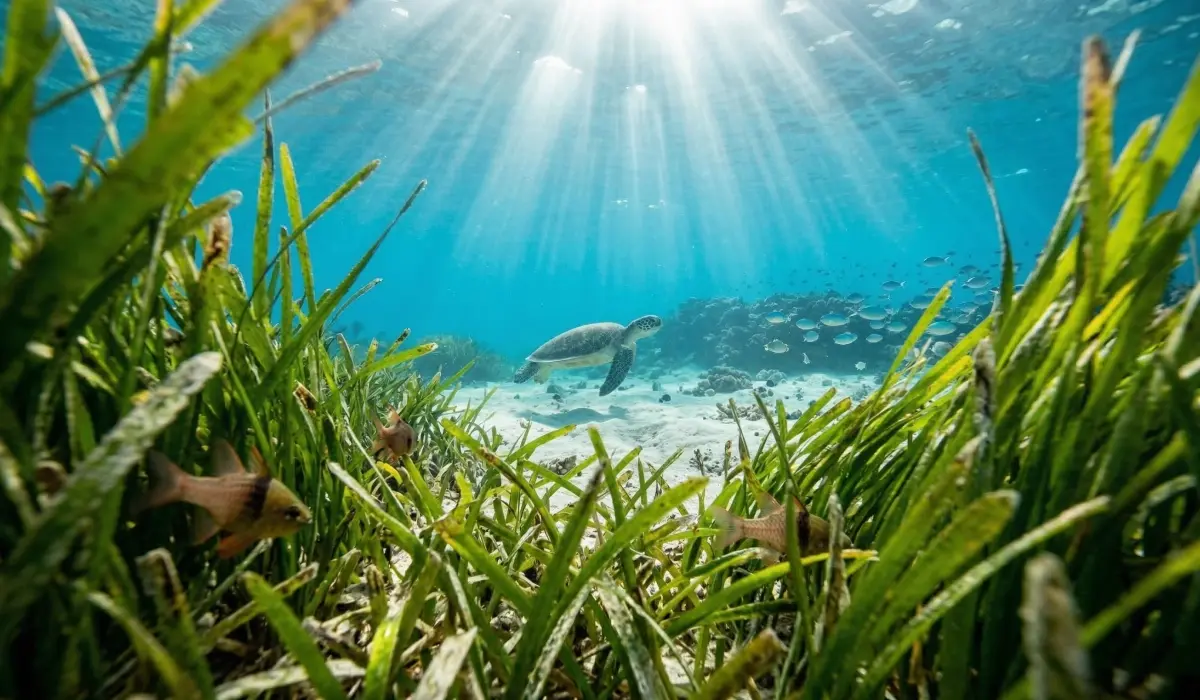
Indonesia has established a greenhouse gas emissions baseline for its seagrass ecosystems, marking a significant early step in the development of a blue carbon framework for the country's marine and fisheries sector.
 Indonesian seagrass meadows thriving under clear tropical waters, storing carbon and supporting marine life. Ai generated picture.
The baseline was developed during a technical workshop held in Jakarta, bringing together government ministries, academic institutions, and other stakeholders. Indonesia's Ministry of Maritime Affairs and Fisheries (KKP) confirmed the outcome in an official statement.
'This data will be an important foundation in formulating climate change mitigation policies in the marine and fisheries sector, while also supporting the achievement of national emission reduction targets,' said A. Koswara, director general of marine management at the KKP.
An emissions baseline establishes the initial state of carbon stocks within an ecosystem and quantifies the potential emissions that result from disturbances or changes to that ecosystem. According to KKP, this information underpins the development of emissions reduction scenarios and informs policy on sustainable coastal ecosystem management.
Read more: Agroforestry explained: a guide to regenerative farming
The announcement builds on recent action at the national level. Last month, the Indonesian government launched a national action plan to protect and restore blue carbon ecosystems across 3.45 million hectares of mangroves and 660,000 hectares of seagrass. In December, KKP published a technical manual providing standardised guidelines for measuring carbon stocks in seagrass ecosystems along the country's coastlines.
Indonesia hosts 15 of approximately 60 seagrass species found worldwide. Seagrass ecosystems are highly efficient carbon sinks, capable of storing carbon for thousands of years when habitats remain intact. KKP has noted, however, that many of Indonesia's coastal seagrass meadows are showing signs of decline, driven by coastal conversion, pollution, destructive fishing practices, and broader environmental pressures.
Read more: New carbon regulation on the horizon for Bolivia
Green Earth is an end-to-end developer of large-scale nature-based solutions, accredited by leading third-party standards. As countries like Indonesia move to establish the scientific and regulatory foundations for blue carbon markets, the pipeline of high-quality, verified projects is set to grow. Our work spans ecosystem restoration, biodiversity protection, and community development across the globe—giving businesses and governments a credible, transparent route to compensate for hard-to-abate emissions within their value chains. If Indonesia's seagrass baseline signals anything, it is that blue carbon is fast becoming a serious instrument of environmental strategy.