
Carbon markets
Governments
Latin America
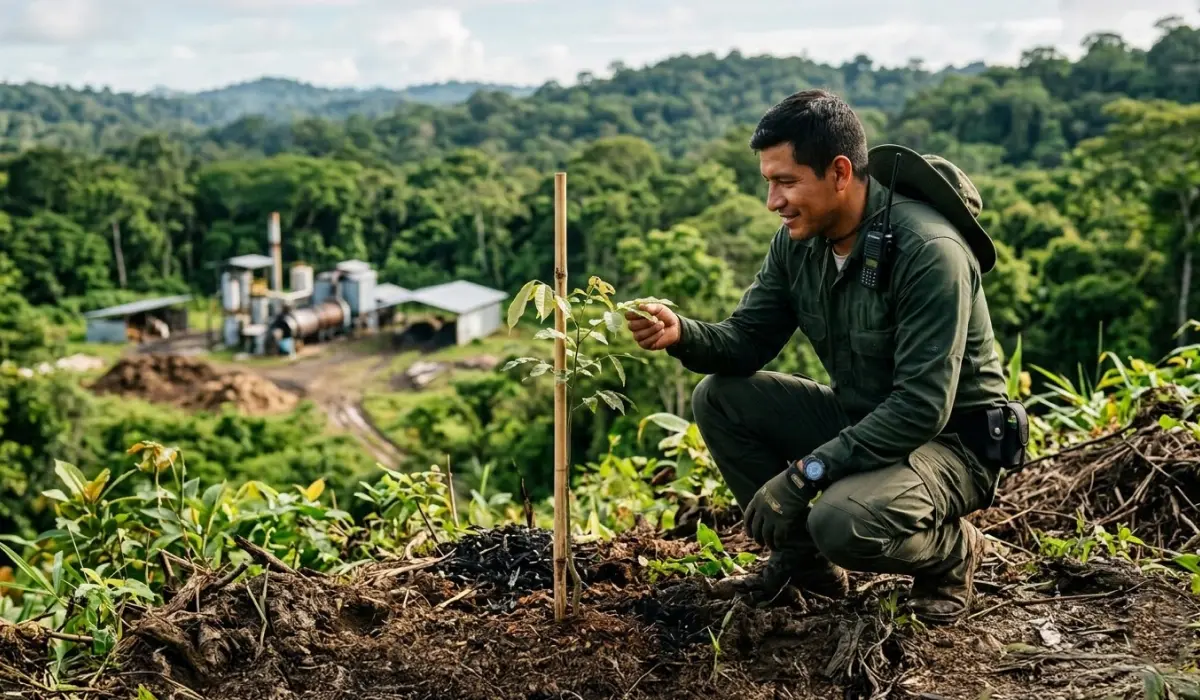
Bolivia is preparing to publish its national carbon market regulatory framework by the end of April 2026. The announcement was made by Jorge Avila, Vice Minister for Environment, at the Bolivia Carbon Forum in Santa Cruz de la Sierra.
 Bolivian forest manager inspecting a newly planted tree, with Amazon rainforest and biochar factory in the background. AI generated picture.
The framework is currently in development and has been reviewed by independent consultants funded by the European Union. Avila confirmed the government has yet to determine whether it will be introduced through Congress or via national decree.
'It's currently under construction,' said Avila. 'It's been reviewed by independent consultants paid by the European Union. We are still not sure whether it will be introduced via a bill in Congress or via a national decree... but we will likely have it by the end of April.'
The regulatory framework will replace a draft bill put forward in December, which Avila described as a unilateral initiative by a single lawmaker. The new framework carries government backing and reflects a broader shift in Bolivia's approach to carbon markets under its pro-market administration, which took office last year.
Read more: The hidden strength of nature-based credits in corporate decarbonisation strategies
Avila outlined that a key priority under the framework is building national capacity. 'Our focus is to integrate private carbon markets as part of the national climate strategy, linking economic development with environmental protection and international cooperation,' he said.
Bolivia has received support from the European Union, Germany, Sweden, and the United Kingdom in developing its carbon market infrastructure. The country has also been engaged in negotiations under Article 6 of the Paris Agreement, which governs international carbon trading between nations.
Bolivia is home to Exomad, the world's largest biochar producer. The company has signed agreements with international partners, including Microsoft, and aims to reach an annual carbon capture capacity of one million tonnes of CO2 equivalent by 2027.
Read more: Kenya moves to operationalise carbon registry
Green Earth is an end-to-end developer of large-scale nature-based solutions, accredited by leading third-party standards. As carbon markets in emerging nations move towards clearer regulatory frameworks, the opportunity to support high-quality, verified projects becomes more tangible than ever. Our work spans ecosystem restoration, biodiversity protection, and community development across the globe—giving businesses and governments a credible, transparent route to compensate for hard-to-abate emissions within their value chains. If Bolivia's evolving carbon market signals anything, it is that well-regulated, nature-based carbon credits are gaining ground as a serious instrument of environmental strategy.