
Biodiversity
Nature conservation
South Africa
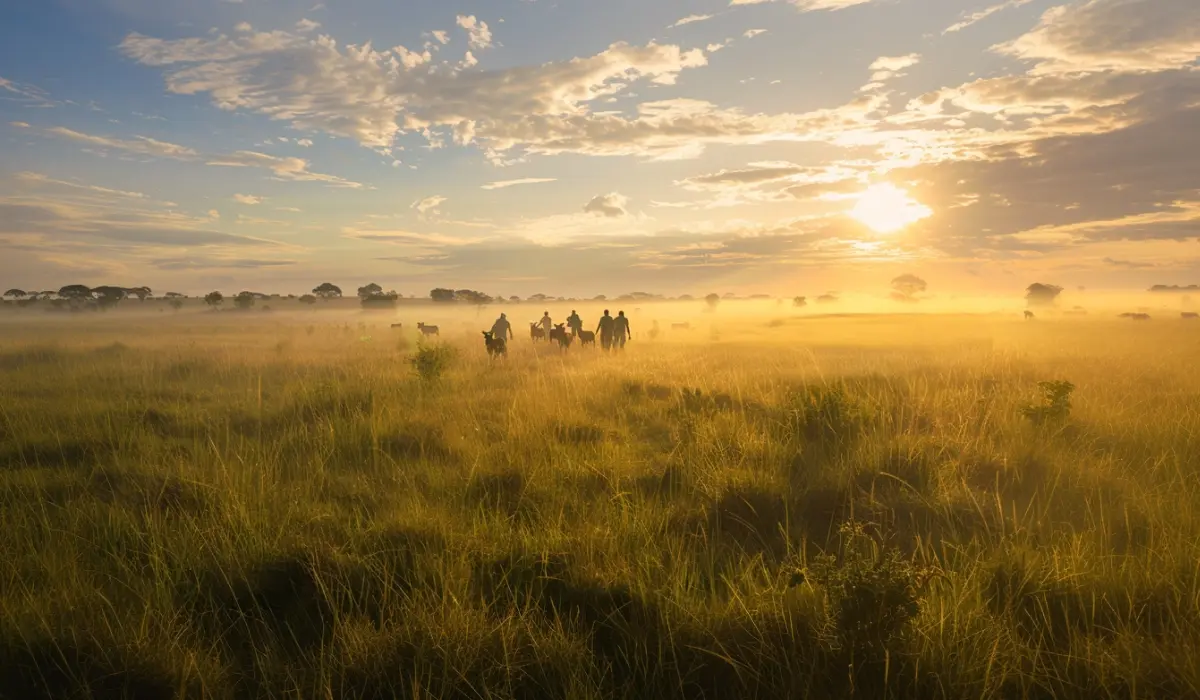
In a landmark development for nature-based finance, a South African grassland restoration initiative has successfully issued the world's first carbon credits to carry the Climate, Community and Biodiversity (CCB) label under Verra’s updated VM0042 methodology. The issuance of 266,255 Verified Carbon Units (VCUs) marks a pivotal shift towards high-integrity credits, providing a blueprint for how ecological restoration can coexist with robust social and economic development.
 Panoramic view of restored grasslands in South Africa at sunrise, with local farmers and project workers. AI generated picture.
Developed by carbon project specialist TASC, the Grassland Restoration and Stewardship in South Africa (GRASS) project targets one of the country's most pressing environmental challenges. Currently, approximately one-third of South African grasslands are severely degraded. By implementing regenerative grazing management across 235,000 acres in its initial monitoring phase, the project aims to reverse this trend by restoring soil carbon and revitalising grass cover.
What distinguishes the GRASS project is its integration of thousands of communal livestock farmers—a demographic traditionally marginalised in formal meat markets. Through a strategic partnership with the social enterprise Meat Naturally Africa, the initiative provides more than just carbon finance. Farmers receive specialised training in land stewardship and gain access to mobile auctions and abattoirs.
According to project data, these market linkages have already funnelled approximately $3.35 million (56.4 million South African rands) in additional revenue to local producers. Beyond direct income, the project has stimulated the local labour market by creating nearly 300 jobs in fire management, ecological monitoring, and grazing support.
Read more: China sets new global benchmarks with national corporate reporting standards
The voluntary carbon market has recently faced intensified scrutiny regarding the actual impact of nature-based solutions. The use of the VM0042 methodology addresses these concerns through rigorous soil carbon measurement and strict safeguards against emissions leakage. The addition of the CCB label serves as an independent verification that the project delivers tangible, measurable benefits to both local communities and regional biodiversity. ‘At a time when scrutiny of carbon markets is intensifying, GRASS demonstrates what high-integrity carbon can achieve: real emissions reductions, restored landscapes, and tangible benefits for communities that are often left behind’, stated Shelley Estcourt, CEO of TASC Africa.
The current issuance is only the beginning of a long-term, 100-year commitment. TASC plans to scale the communal portion of the project to one million hectares, with an additional one million hectares of private farmland targeted for improved management by 2027. If successful, the initiative is projected to mitigate over 14 million tonnes of CO2e within its first three decades, cementing South Africa’s position as a leader in the global transition toward sustainable, community-led land management.
Read more: Beyond tonnes: How carbon credit co-benefits elevate value
In an era where regulatory oversight is tightening and transparency is paramount, high-integrity data and verified social impact have become the true currencies of the carbon market. The success of initiatives like the GRASS project proves that carbon credits reach their full potential when they serve a dual purpose: atmospheric restoration and deep societal upliftment. At Green Earth, our projects are curated specifically to exceed these expectations, offering high-integrity removals that deliver profound co-benefits for biodiversity and local communities. By securing credits that represent both ecological durability and measurable human progress, you can turn evolving compliance requirements into a cornerstone of your long-term strategic resilience.