
Tree planting
Nature conservation
Forest
Verra
Verra has marked a significant milestone in the voluntary carbon market with the issuance of its first carbon credits labelled under the Core Carbon Principles (CCP) using the Improved Forest Management (IFM) methodology VM0045. The issuance follows approval of the methodology by the Integrity Council for the Voluntary Carbon Market (ICVCM), advancing towards greater consistency and credibility in forest carbon accounting.
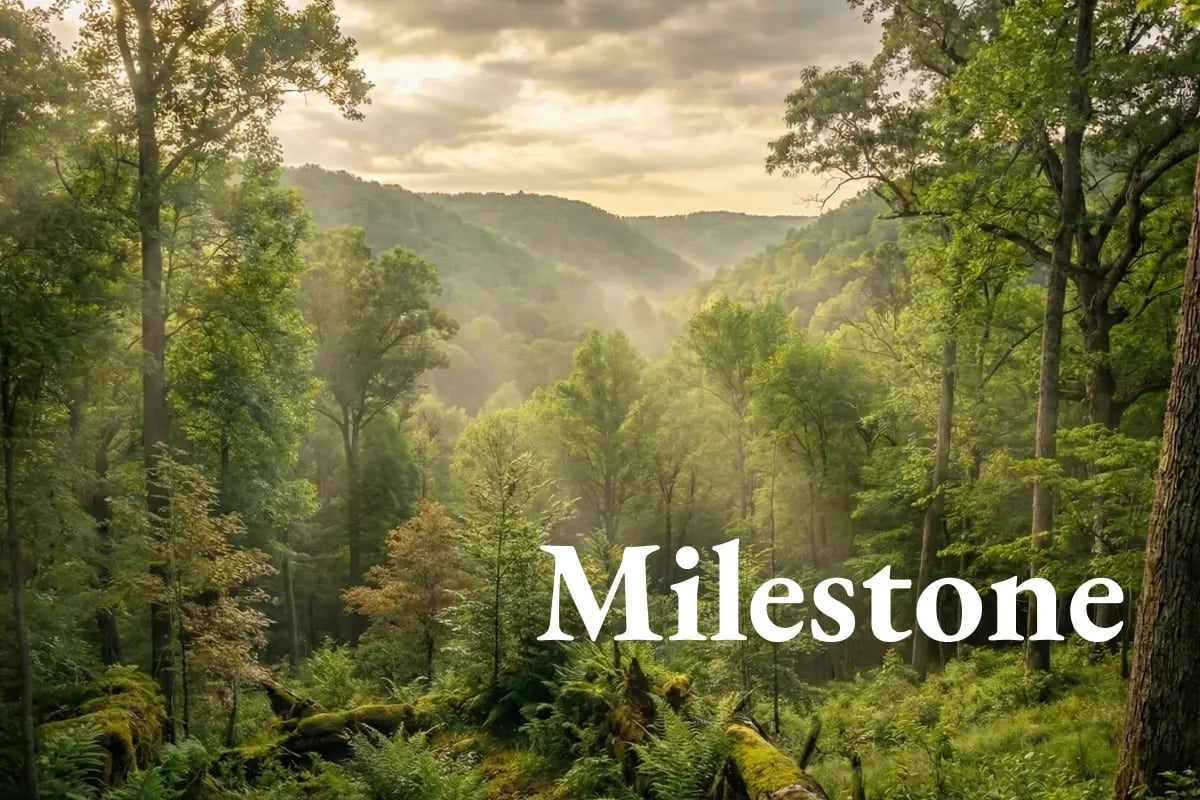 Vast forest in Central Appalachia. AI generated picture.
VM0045, formally titled Improved Forest Management Using Dynamic Matched Baselines from National Forest Inventories, introduces a departure from traditional IFM methodologies. Rather than relying on long-term growth-and-yield models or static assumptions, the methodology uses continuously updated national forest inventory data to establish dynamic baselines. This allows project performance to be assessed against real-world forest outcomes rather than projected scenarios.
Mandy Rambharos, CEO of Verra, commented: ‘This is a powerful example of how innovation and integrity can work hand-in-hand to unlock new opportunities for forest stewardship. VM0045 not only meets the highest standards of climate rigour but also empowers rural landowners to participate in climate action in innovative and impactful ways. We’re proud to see CCP-labelled credits being generated by a project that puts family forest owners at the centre of the solution.’
At the core of VM0045 is a matched-baseline approach. Project plots are compared with statistically similar baseline plots drawn from national forest inventories outside the project boundary. Because both sets of plots are monitored over time, the methodology captures the effects of real-world influences such as weather patterns, pest outbreaks, market conditions, and natural disturbances. This quasi-experimental design improves the robustness of carbon accounting and reduces opportunities for manipulation.
Read more: New registry targets emissions across UK buildings and construction supply chains
The methodology measures changes in forest carbon over time rather than estimating total carbon stocks. Permanent sample plots track increases or decreases in carbon directly, improving the precision of reported emission reductions and removals.
VM0045 supports a wide range of IFM practices, provided they are new and additional. These include enrichment planting, vegetation management to support natural regeneration, extending harvest cycles, lowering harvest intensity, establishing forest reserves, and reducing fire risk through fuel management. Unlike earlier approaches, developers are not required to run forest growth models, as accounting is based on field measurements from both project and baseline plots.
The first CCP-labelled credits under VM0045 v1.2 were issued to the Family Forest Carbon Program in Central Appalachia, developed by the American Forest Foundation with support from The Nature Conservancy. The project received 18,326 Verified Carbon Units and transitioned voluntarily from an earlier methodology version, underscoring a commitment to higher integrity standards.
Currently, VM0045 relies on data from the U.S. Forest Service’s Forest Inventory and Analysis program, but the methodology is designed for global application. As national forest inventories expand worldwide, VM0045 is positioned to support broader participation in IFM projects, including by smaller landowners who have historically faced high barriers to entry.
Read more: Beyond tonnes: How carbon credit co-benefits elevate value
As methodologies like VM0045 show, the future of carbon markets is being shaped by a clear shift toward accuracy, transparency, and verifiable real-world outcomes. Dynamic baselines, continuous monitoring, and integrity-led frameworks are raising expectations across the sector and reinforcing a simple truth: credible carbon action must be built on robust data and grounded in nature. At Green Earth, we apply these same principles by combining rigorous carbon accounting with large-scale, nature-based restoration projects that deliver high-quality carbon units rooted in ecological performance. For organisations seeking to address unavoidable emissions while supporting resilient forests and landscapes, our approach offers a dependable, forward-looking solution—inviting you to take the next step with Green Earth and explore how credible nature-based action can fit into your strategy.