
Coffee
United Nations
Vietnam
Decarbonisation
In a strategic move to align agricultural exports with global environmental standards, the Vietnamese government has unveiled a $102 million landscape restoration program. Known as the Recaf project, the initiative is a tripartite collaboration between Vietnam’s Ministry of Agriculture and Environment (MAE), the International Fund for Agricultural Development (IFAD), and the Green Climate Fund (GCF).
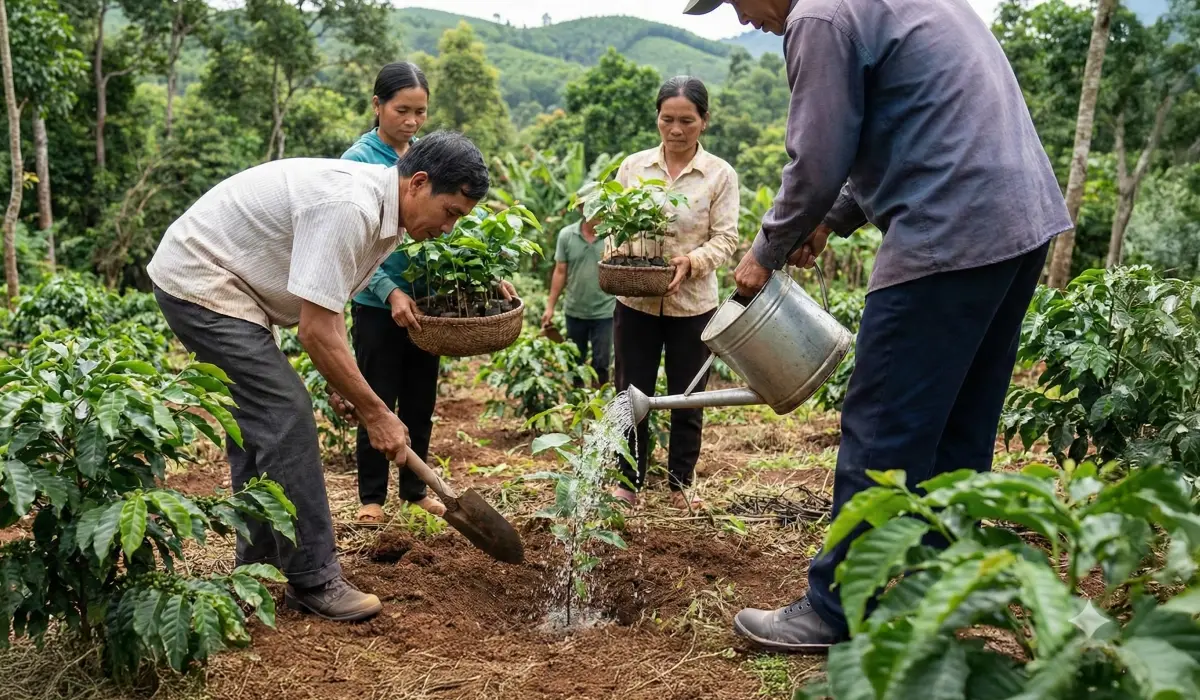
 People working in sustainable coffee farming in Vietnam’s Central Highlands with integrated forest land. AI generated picture.
The six-year program is specifically designed to address the ecological footprint of the coffee industry within the Central Highlands and South Central Coast regions. By focusing on provinces such as Dak Lak, Gia Lai, Lam Dong, and Khanh Hoa, the project seeks to bridge the gap between high-yield commodity production and rigorous forest conservation.
The project’s $102 million budget is split nearly equally between international and domestic sources. IFAD has committed a $32.4 million loan, while the GCF—the world’s largest dedicated environmental fund—will provide a $35 million grant. The remaining $35 million is sourced through domestic co-financing within Vietnam.
Read more: South Africa pioneers world-first CCB-labelled carbon credits
Recaf is projected to achieve a significant reduction in greenhouse gas emissions, with a target of 6.68 million tonnes of CO2 equivalent. The operational roadmap focuses on three primary metrics:
- Restoration: Reclaiming and improving 145,000 hectares of agroforestry land.
- Protection: Safeguarding 500,000 hectares of existing high-value natural forest.
- Value chains: Transitioning local farmers towards deforestation-free supply chains to meet evolving international regulations.
According to a statement from IFAD, the objective is to help producers ‘adopt climate-smart agroforestry practices, strengthening natural forest protection, and promoting deforestation-free value chains that contribute to sustainable economic growth.’
For local authorities, the project represents a necessary evolution of the regional economy. Nguyen Thien Van, Vice Chairman of the People's Committee of Dak Lak Province, emphasised the dual benefit for the community: ‘This project is critically important for Dak Lak and the Central Highlands. By integrating forest protection with sustainable farming, Recaf will help farmers increase their incomes while safeguarding forests for future generations.’
This initiative arrives as Vietnam ramps up its carbon-sequestration efforts. With recent approvals for carbon-credit surveys in Gia Lai and nationwide methane-reduction goals in rice farming, the Recaf project solidifies Vietnam’s position as a burgeoning hub for large-scale nature-based solutions (NbS) in Southeast Asia.
Read more: Beyond tonnes: How carbon credit co-benefits elevate value
The transition toward a sustainable future relies on more than just high-level funding; it requires the combination of ecological durability with measurable human progress. In an era where regulatory transparency is the new baseline, high-integrity data and verified social impact have emerged as the primary currencies of the carbon market. At Green Earth, our projects are meticulously curated to exceed these evolving standards, delivering high-integrity removals that offer profound co-benefits for biodiversity and local communities alike. By securing credits that represent both atmospheric restoration and societal upliftment, you can turn complex compliance requirements into a foundation for long-term strategic resilience.